
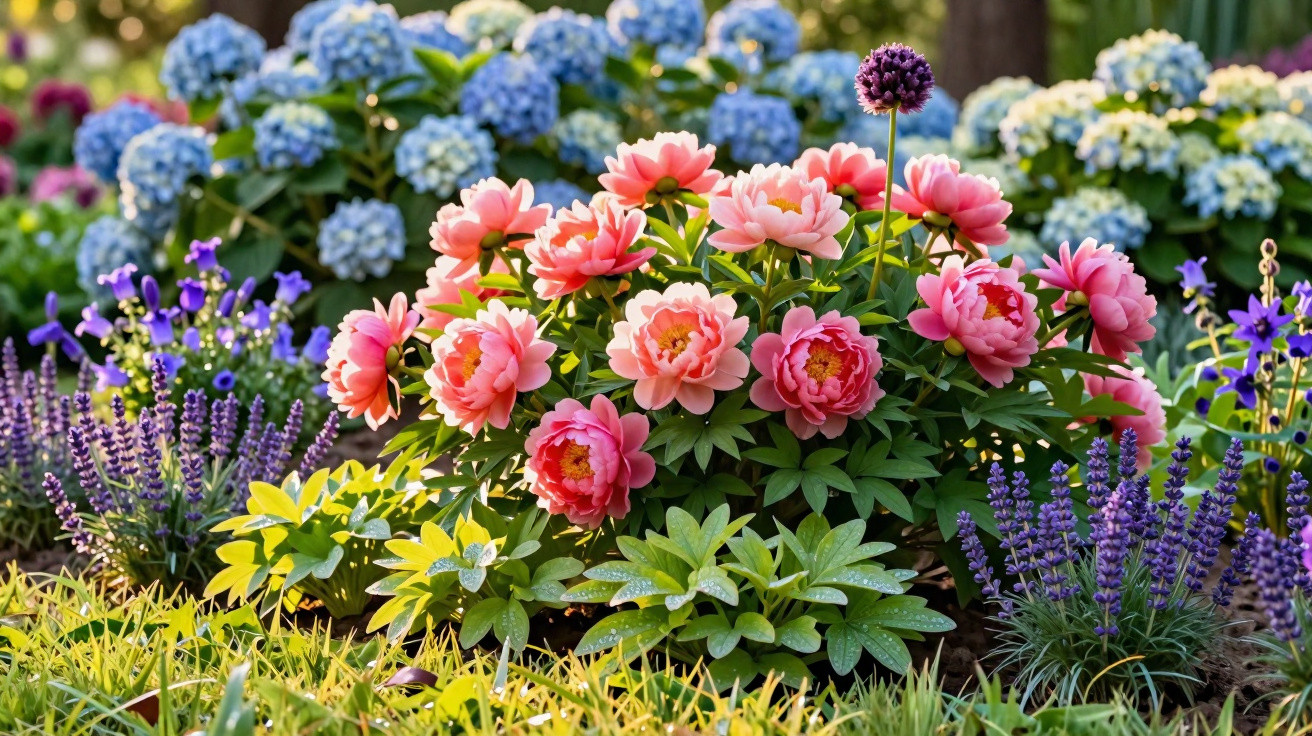
Peonies can turn any garden into a stage - as long as their neighbouring plants are chosen wisely.
With the right companions, a handful of stems becomes a true firework of flowers.
Many gardeners plant peonies as solo stars in the middle of a border and then wonder why the overall look still feels rather modest. The perennials themselves are tough, long-lived and easy to care for - but the real wow factor only appears when the planting around them is thoughtfully designed. The key is choosing companion perennials that match their needs for light, soil and space, while supporting peony blooms visually and even helping to keep the plants healthier.
What peonies need before you start planning the border
Before deciding on neighbours in a perennial border, it helps to understand the basic requirements of peonies. They thrive in full sun, but they will also cope with light partial shade. The soil should be deep, humus-rich and free-draining, with no winter waterlogging.
"Peonies mainly need three things: plenty of light, nutrient-rich, free-draining soil and air around the leaves."
Borders that are packed too tightly stay damp for longer. That creates ideal conditions for fungal problems such as grey mould, which can seriously reduce flowering. Heavy root competition from vigorous neighbours will also weaken peonies over time.
Three simple rules for good neighbouring plants
- Choose only plants with similar light and soil requirements.
- Avoid placing noticeably taller perennials directly in front of the peony.
- Leave a clearly open area around each peony clump.
If you stick to these basics, you create a border where peonies can remain in the same spot for many years - and often flower more generously as they mature.
Alchemilla, bellflowers and hydrangeas: giving the flower queen centre stage
Once the site conditions are clear, the creative question follows: which plants amplify the impact of those large flower heads without stealing the show?
Alchemilla: the perfect understated ground cover
A tried-and-tested companion for peonies is lady’s mantle (Alchemilla). This sturdy perennial forms dense cushions of soft, rounded leaves. In early summer, it carries a haze of lime-green flowers above the foliage.
"The delicate yellow-green veil of lady’s mantle makes the pastel tones of peonies glow even more intensely - in the border and in a vase."
Lady’s mantle stays comparatively low, doesn’t crowd peony roots, and continues to look good after flowering. When peony blooms droop, they can rest neatly on the leaf cushion rather than falling into wet soil.
Bellflowers and other perennials for the second row
Compact bellflower varieties fill gaps between peonies without taking away their light. Their typically blue or violet flowers create strong contrast against pink and white peony cultivars.
One point many people overlook: some bellflowers attract pests more strongly. In a perennial border that’s not a big problem if you also grow plants elsewhere that deter pests with their scent - helping the mini ecosystem stay balanced.
Hydrangeas as a calm backdrop
Hydrangeas work brilliantly as background planting. Their large flower heads echo the rounded form of peony blooms without directly competing. Planted with a little space between them, they can provide light shade in midsummer - something many peonies appreciate in hotter regions.
Hydrangeas also prefer rich soil and tolerate sun with light shading. They can be planted from autumn through to spring, making it easy to build up a border gradually.
How clever flowering sequences keep the border interesting for months
Peonies have a relatively short season: depending on the variety, from late April to early June. With well-chosen partners, you can extend the flowering interest in the border significantly.
- Iris: usually flower shortly before peonies and set the colour scene.
- Peonies: take the main role in late spring.
- Daylilies (Hemerocallis): begin as peonies fade and keep the display going into summer.
- Allium: adds architectural accents in between with perfectly round blooms.
The result is a relay effect: as peonies gradually finish, other perennials take over the focus. The border stays lively without constant replanting.
Lavender and allium: the fragrant protection team in the perennial border
Peonies are fairly robust, but there are certain visitors you’d rather keep away from the border. That’s where lavender and ornamental onions come in.
Lavender as a scented edging around peonies
Lavender enjoys the same conditions as peonies: sun and free-draining soil. Planted in a row, it forms a low edging that visually frames the bed while also confusing pests.
"Many people love the scent of lavender, but mosquitoes, flies and even deer often steer clear of beds with strongly scented varieties."
Lavender is especially effective along the border edges. It helps protect the area where peonies grow and reduces the chance of people stepping too close to delicate shoots.
Allium: ornamental onion for decoration and protection in one
With its globe-shaped flowers, ornamental onion (Allium) looks like floating balls above the planting. Many varieties bloom at the same time as peonies or shortly afterwards, adding vertical interest without casting shade.
The typical onion scent in the leaves and bulbs is far less appealing to many insects and wild animals than it is to people. Used in several groups across the border, allium creates an almost invisible protective buffer around peonies.
Plants that don’t pair well with peonies
Not every fashionable plant makes a good neighbour. Some species will make life difficult for peonies in the long run.
- Very vigorous ornamental grasses: spread into clumps and reduce air and light.
- Plants for waterlogged soils (e.g. bog perennials): keep the ground permanently damp and encourage fungal issues.
- Large, shallow-rooted perennials: compete heavily for water and nutrients.
If you still want these plants in your garden, it’s better to place them at some distance - ideally separated by paths or clear edging - so the differing site requirements don’t clash.
Practical examples: three successful border ideas with peonies
| Style | Suitable companions | Effect |
|---|---|---|
| Romantic rose border | Peonies, lady’s mantle, low bellflowers, lavender | Soft shapes, pastel colours, fragrant cushion-like look |
| Structured cottage-garden border | Peonies, allium, daylilies, iris, hydrangeas in the background | Long sequence of bloom, bold shapes, classic garden character |
| Modern perennial border | Peonies, selected grasses at a distance, white allium, sage | Clean lines, contrasts, calm colour scheme |
What to watch for with spacing and care
Peonies dislike being moved. Once planted, it pays to allow plenty of room. Leave a good half a metre between individual clumps, and more to the side of particularly vigorous partners.
For watering, it’s better to water less often but thoroughly. The soil should be able to dry out between waterings. If the ground is compacted, loosen it with a little compost and sand before the perennials go in. Use mulch only in a thin layer, otherwise moisture lingers too long around the stems.
If you include more pest-prone neighbours such as some bellflower types, it’s best to pair them deliberately with lavender or allium. This spreads pest pressure naturally, without resorting to chemical sprays.
Why the right choice of companions protects your peonies for years
Peonies build strength over several years. Poor neighbours - such as plants that keep soil permanently damp or create heavy root pressure - can silently hold back that development until flowering suddenly declines. When the surroundings suit them, however, these perennials gain momentum year after year and produce increasingly impressive blooms.
If you plan the border from the start as a small interplay of light, air, roots and fragrance, you’ll need fewer corrections later. With lady’s mantle as a ground cover, hydrangeas or iris behind, lavender and allium as a protective belt, and a handful of well-matched summer perennials, peonies stop looking like isolated flowers - and become the highlight of a carefully designed garden.


Comments
No comments yet. Be the first to comment!
Leave a Comment