
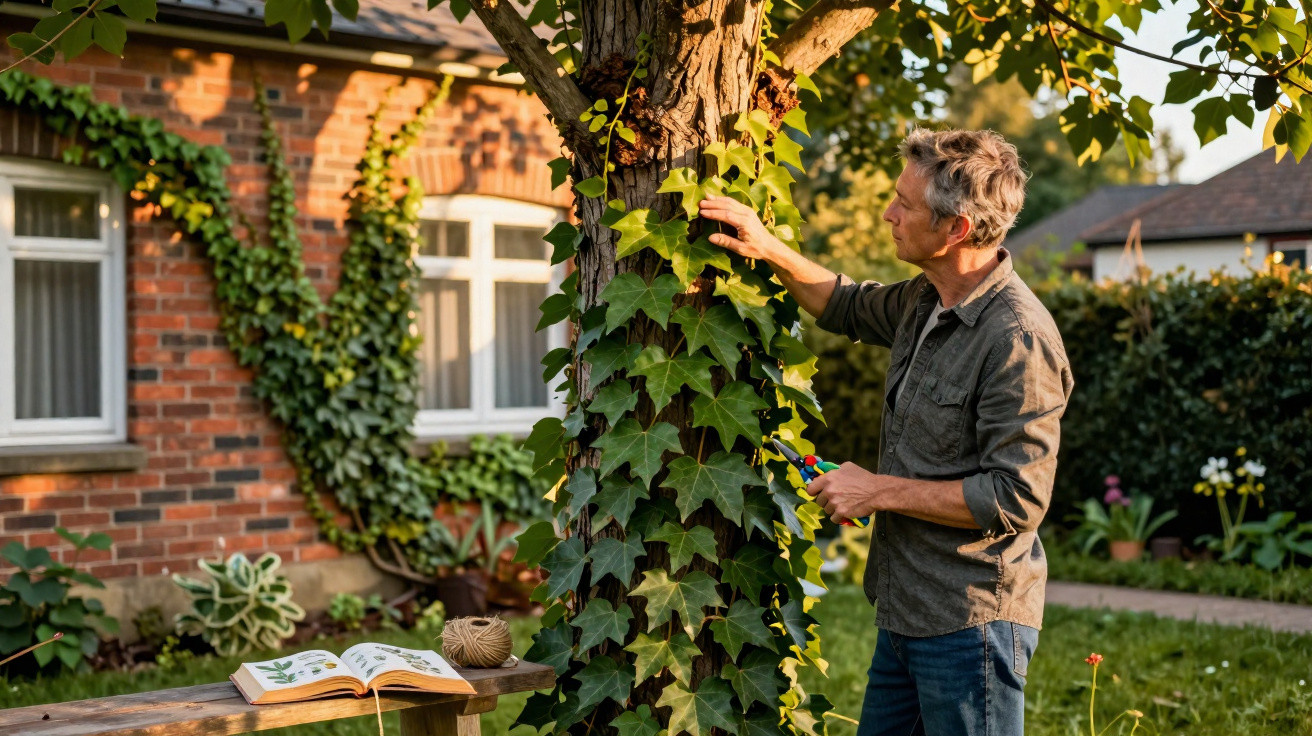
Specialists are increasingly critical of the habit.
In countless gardens, ivy clippings are routinely tossed onto the compost as if it were the obvious thing to do. The climber is often blamed for threatening trees, cracking house walls and signalling neglect. When people “tidy up”, they cut it back. The catch is that this kind of tidying frequently does more harm than good - to wildlife, to the tree, and sometimes even to the building itself.
Ivy is not a parasite - and is often an undervalued ally
A common misconception is that ivy is a parasite that steals water and nutrients from its host. That description fits mistletoe, not Hedera helix, our native climbing ivy. Its roots stay in the soil and feed only the ivy plant. The small clinging rootlets on a trunk or wall are there purely for grip.
"Ivy doesn’t ‘suck a tree dry’ - it simply uses it as a climbing frame and forms a kind of green coat."
Tree-care professionals generally find that, on a healthy, vigorous tree, this growth does not reduce vitality. In fact, the dense foliage can act like a natural protective layer: it shades the trunk from harsh sun, softens frost and hail, and helps the bark retain a slight level of moisture. In many situations, that is more benefit than risk.
How ivy protects trees - and when it becomes a problem
Look closely in a garden and you’ll see ivy doing several jobs at once. Birds tuck nests between the stems, hedgehogs and small mammals find cover, and many insects use it for food and shelter. As ground cover, ivy helps reduce erosion, keeps the soil damp for longer and can suppress some unwanted growth.
Benefits of ivy on a tree
- The leafy layer acts like a coat against heat, frost and hail
- Habitat for many insect species, spiders and small mammals
- Hiding places and nesting opportunities for birds
- Soil stays moist for longer and is less likely to be washed away
Even so, there are times when cutting back makes sense. The main risk is to wood that is already compromised: old, hollow trunks, trees with existing damage, or very young specimens such as newly planted fruit trees. In these cases, dense cover can amplify existing issues.
When it’s better to rein in ivy on the trunk
The concern is not “nutrient theft”, but competition for light, extra weight, and a larger surface area for the wind to catch.
- Old or damaged trees: Extra weight up in the crown can become an issue in high winds.
- Young trees and fruit trees: Ivy leaves can deprive thin, developing branches of essential light.
- Diseased trees: Thick ivy cover can hide fungal infection, cracks or rot, so damage goes unnoticed for too long.
- Exposed, windy locations: More leaf area means more wind load.
In these situations, tree experts tend to advise against wiping ivy out entirely. Instead, limit it strategically: it can remain lower down on the trunk, but the crown should be kept clear so light and air can move through more freely.
Ivy on a house wall: protective shield rather than a cause of damage?
Ivy also has a dubious reputation on façades. Many owners worry that the clinging roots will rip off render and pull out masonry. The reality is more nuanced: on a sound, crack-free wall, ivy usually attaches at the surface and can actually add to the wall’s protective function.
"On intact walls, ivy works like a green outer skin - less driving rain, fewer temperature extremes, less dust."
Positive effects on an intact façade
- Leaves break the force of driving rain and reduce direct wetting
- Temperature swings in the wall are less pronounced
- Indoor spaces heat up less in summer
- Some fine dust and air pollutants are trapped in the foliage
It is different where render is crumbling, mortar joints are badly washed out, or cracks are already present. In those weak points, the clinging rootlets can work their way in and, with wind movement and moisture, make the damage worse. Render can come away, joints open further, and water gets in more easily.
When ivy on masonry becomes a concern
If you own an older house that has never been refurbished, it is worth taking a closer look. Warning signs include:
- crumbly mortar joints
- flaking render, or render that sounds hollow
- damp internal walls or salt deposits (efflorescence)
- blocked gutters caused by leaves and trailing stems
The rule here is: inspect first, then decide. Professionals recommend repairing damaged areas before allowing ivy to spread widely. Where serious damage is already visible, cut the stems below the point where they branch from the base and let the plant die back gradually, rather than yanking everything off at once - that approach reduces the risk of pulling material away from the wall.
How to make the right decision in your garden
Whether on a tree or a façade, ivy itself is not automatically the problem - the issue is the condition of what it is growing on. A simple visual check usually helps you judge the situation.
Checklist: remove ivy or leave it?
| Situation | Recommendation |
|---|---|
| Strong tree, stable branches, well-rooted | Leave ivy largely in place, shorten it every few years |
| Young tree or fruit tree | Remove ivy consistently in the crown area; allow only light growth on the trunk |
| Old, previously damaged or leaning tree | Reduce ivy heavily in the upper area; if unsure, speak to a tree-care professional |
| Façade intact, no visible cracks | Allow ivy, but control growth around gutters and windows |
| Façade with cracks, crumbling joints or damp patches | Remove ivy in stages, repair damage, then reassess later |
Prune properly instead of stripping it back completely
If you want ivy under control, you don’t need to resort to a scorched-earth clear-out. Regular, moderate maintenance is far more effective. In practice, that means checking every two to three years and cutting back where needed, rather than leaving it for decades and then tearing everything off in a panic.
A typical garden approach:
- Keep stems away from the tree crown, while letting parts of the trunk remain covered
- Keep ivy away from gutters, downpipes and windows
- Thin heavily matted areas so you can assess potential damage to the wood
- Prune carefully in autumn, once the main bird nesting season has ended
If you plan to remove a lot of growth, do it in stages. That gives animals time to adjust to the loss of cover, and it also helps you monitor whether a tree suddenly becomes more wind-sensitive or whether a wall unexpectedly starts holding much more moisture.
Ivy, energy use and the urban climate
In densely built-up urban areas, green façades play an additional role. The leaves provide cooling through evaporation, and surfaces heat up less in summer. Indoors, that can help because less heat pushes aggressively through the external wall. With rising energy prices and more frequent heatwaves, this becomes increasingly relevant.
At the same time, a vegetated wall retains a little warmth and offers some shelter from wind, which can have small but measurable effects on winter heating demand. These effects do not replace insulation; they complement it - and do so with relatively little technical effort.
What amateur gardeners often get wrong
Many misunderstandings about ivy come from isolated cases that get treated as universal truths. If an old tree riddled with fungal decay falls over and its trunk was thickly covered in ivy, the climber is quickly blamed. Specialists see it differently: in those cases, ivy mainly highlights how unstable the situation already was.
The same applies to façades. If render comes away during renovation along with the plant, the underlying problem was often in the material to begin with. The growth did not create the damage, but over the years it may well have exacerbated it. With a more careful, case-by-case look, ivy can be used for what it already is in many gardens: a tough design element that provides shade, creates habitat, and tends to support trees and houses rather than destroy them - as long as you observe, check, and intervene in good time.





Comments
No comments yet. Be the first to comment!
Leave a Comment