

Many amateur gardeners will recognise the pattern: spring arrives and everything bursts into life; high summer turns patchy; autumn looks flat; winter leaves beds bare. The good news is you don’t need a huge garden - or professional-level skills - to keep colour in your borders for all twelve months. A well-matched trio of hardy ground cover plants can bridge those gaps, provided you combine and plant them correctly.
Why three specific ground cover plants keep a bed looking full all year
The principle is straightforward: three perennial, creeping plants share the calendar between them. Each one has its peak season while the others pause, die back a little, or build energy. The result is a living carpet where the plants support the overall effect rather than crowding one another out.
At the heart of the idea are three classic perennials with different flowering periods and growth habits:
- Winter flowering: winter heath (Erica carnea)
- Spring to summer: moss phlox (Phlox subulata)
- Late summer to autumn: leadwort (Ceratostigma plumbaginoides)
"What’s special is that the plants cover the bed all year round, fill bare patches, and therefore reduce the work of weeding and replanting."
Although many ground cover plants have a reputation for “taking over”, this particular trio barely steals space from each other. The key is their root behaviour and the way their flowering times dovetail.
The formula for months of flowers: 3 ground cover plants + 5 plants per square metre
Choosing the right plants matters - but so does planting density. A simple rule of thumb delivers the best results: three selected ground cover species and five young plants per square metre. That spacing shades the soil quickly, while avoiding plants being cramped from the outset.
The main players at a glance
Winter heath (Erica carnea)
Flowers in the cold season, often starting as early as January. It forms small, dense clumps packed with bell-shaped blooms in pink, white, or purple - perfect for brightening dull winter beds.Moss phlox (Phlox subulata)
A classic for rockeries and wall tops, producing true carpets of flowers from spring well into summer. Colours include white, pink, violet and blue, often with bicoloured blooms.Leadwort (Ceratostigma plumbaginoides)
A late starter with a standout finish: from late summer it carries vivid blue flowers, and in autumn the foliage shifts to glowing red through to copper tones. It covers the colour “dead zone” many beds suffer in autumn.
When you plant all three on the same area in the right numbers, you get a relay effect: as soon as winter flowering fades, spring and summer cushions take over, before autumn steps into the spotlight.
How to stop ground cover plants smothering each other
A common worry is: "If I mix ground cover, the strongest will eventually dominate." To prevent that, this approach relies on a kind of underground “tiered garden”.
Layering below ground: each plant has its own level
These three plants draw on different rooting depths and nutrient zones:
- winter heath with finer, more surface-level roots
- moss phlox forming tight mats right at the surface
- leadwort rooting a little deeper and making use of gaps
That reduces direct competition for water and nutrients. Above ground, shoots may overlap here and there, but they don’t all surge forward aggressively at the same time. When one species is resting, another naturally becomes the visual focus.
"The plants work like a layered system: flowers on top, leaves beneath, roots below - each species has its own storey."
Not a chequerboard but triangles: the planting plan
Planting in neat rows tends to create obvious gaps and harsh lines. A planting plan based on interlocking triangles looks far more natural.
Practical steps:
- Mark out the area and remove perennial weeds.
- Imagine triangles across the space, similar to a honeycomb pattern.
- Place a different species in each triangle until you reach five plants per square metre.
This mixes the three perennials from day one. Transitions look softer, and when one variety finishes flowering it’s barely noticeable because the next layer of colour is already waiting next door.
The perfect timing: when you should plant
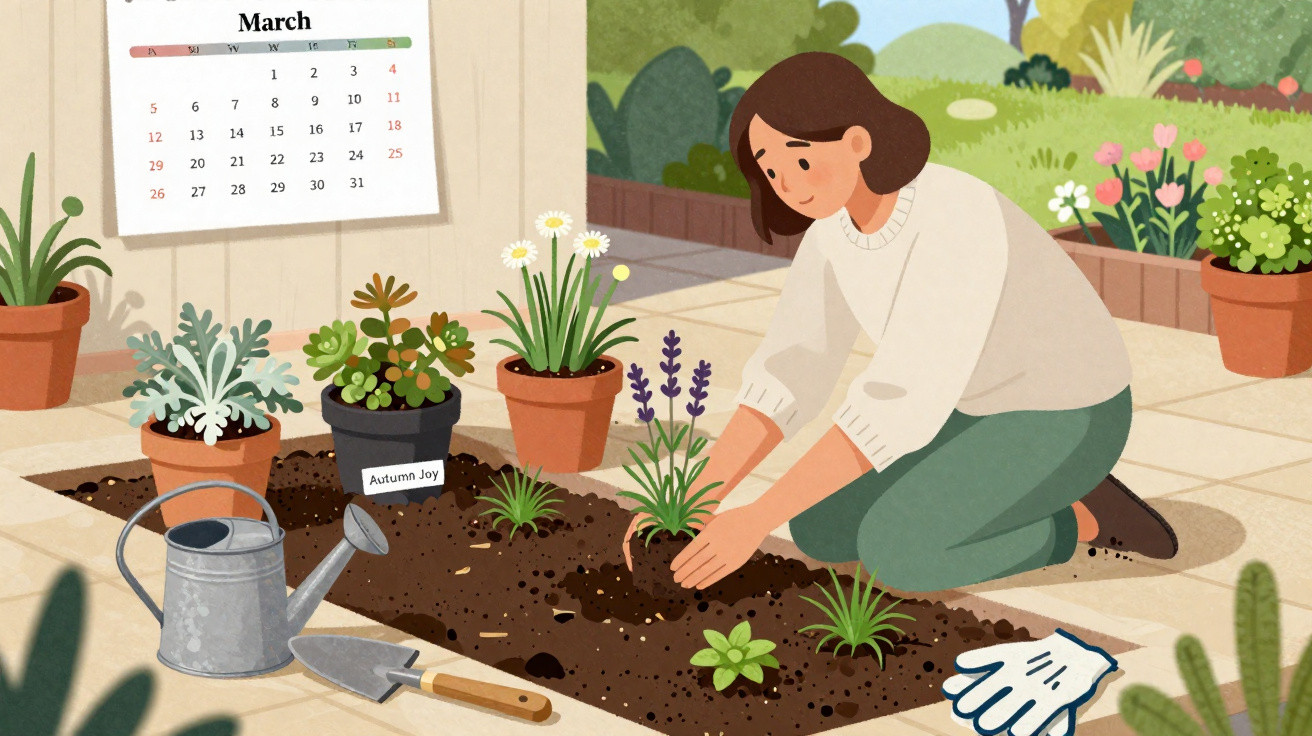
With perennial ground cover, success depends not only on what you plant, but very much on when you plant it. Two windows usually give the strongest results:
- Mid-October: the soil is still warm, so plants can root well without heat stress. They head into the next year with a head start.
- Early spring: as soon as the soil is frost-free, you can set out young plants. They then have the full growing season to establish.
If you’re starting a new area from scratch, it’s best to apply the recommended density immediately: five potted plants per square metre, spread evenly. You can always add more later, but doing so simply prolongs the period where gaps are visible.
What the bed looks like through the year: quick flowering calendar
| Month | Main plant | What you see in the bed |
|---|---|---|
| January–April | Winter heath | Pink-red or white winter flowers above evergreen foliage |
| May–August | Moss phlox | Dense carpets of bloom with very little soil showing |
| September–December | Leadwort | Blue flowers and glowing red autumn leaves |
In between, the other two remain present as a backdrop - sometimes as foliage, sometimes as green peeking through the currently flowering mats.
Low-maintenance rather than labour-intensive: what to do after planting
Once the trio is established, the workload drops noticeably. The soil is rarely left exposed, so weeds have fewer chances to take hold. Watering is mainly needed during prolonged dry spells and in the first weeks after planting.
The most important care tasks across the year
- Spring: lightly rake through winter heath to remove dead shoots, or trim back gently.
- Summer: if needed, cut moss phlox back a little after flowering to keep the cushions compact.
- Autumn: leave leadwort standing; the coloured foliage keeps the bed lively until frost arrives.
"If you stick consistently to these three species, you’ll hardly need to replant. The perennials stay in place for years and thicken up on their own."
This system works not only in traditional borders, but also on banks, along path edges, or in narrow front-garden strips. Anywhere weeding feels like a chore, a permanently closed planting carpet shows its strengths.
Who benefits most from this ground cover system
This approach particularly suits people with limited time. If you only reach the garden at weekends, you’ll appreciate areas that largely take care of themselves. The trio is especially useful for:
- working people with little spare time
- gardening beginners without lots of plant knowledge
- older gardeners who prefer less bending
- holiday or weekend gardens that aren’t checked constantly
Another advantage: staggered flowering attracts insects for many months. Bees and bumblebees find plenty of food on moss phlox in spring and summer, while winter heath can provide early pollen on mild winter days.
How to expand the concept without upsetting the balance
If you’d like more structure in the bed, you can add taller accents to the trio. The key is not to weave in additional spreading ground cover, so the balance remains intact. Good options include:
- small ornamental grasses as upright focal points
- spring bulbs such as crocuses and miniature daffodils pushing through the carpet
- occasional compact shrubs, for example lavender or small spiraeas
This creates a layered picture: the permanent flowering carpet below, with grasses and shrubs dotted above it. If you like, you can also play with colour themes - for instance mostly pink and white for a calmer look, or bold contrasts with violet and blue.
The core idea stays the same throughout: a small number of species that work well together, a clear planting density, and a thought-through plan. Done properly, even a previously plain bed becomes a stage that has something to show all year - without constantly adding new plants to the trolley at the garden centre.




Comments
No comments yet. Be the first to comment!
Leave a Comment