
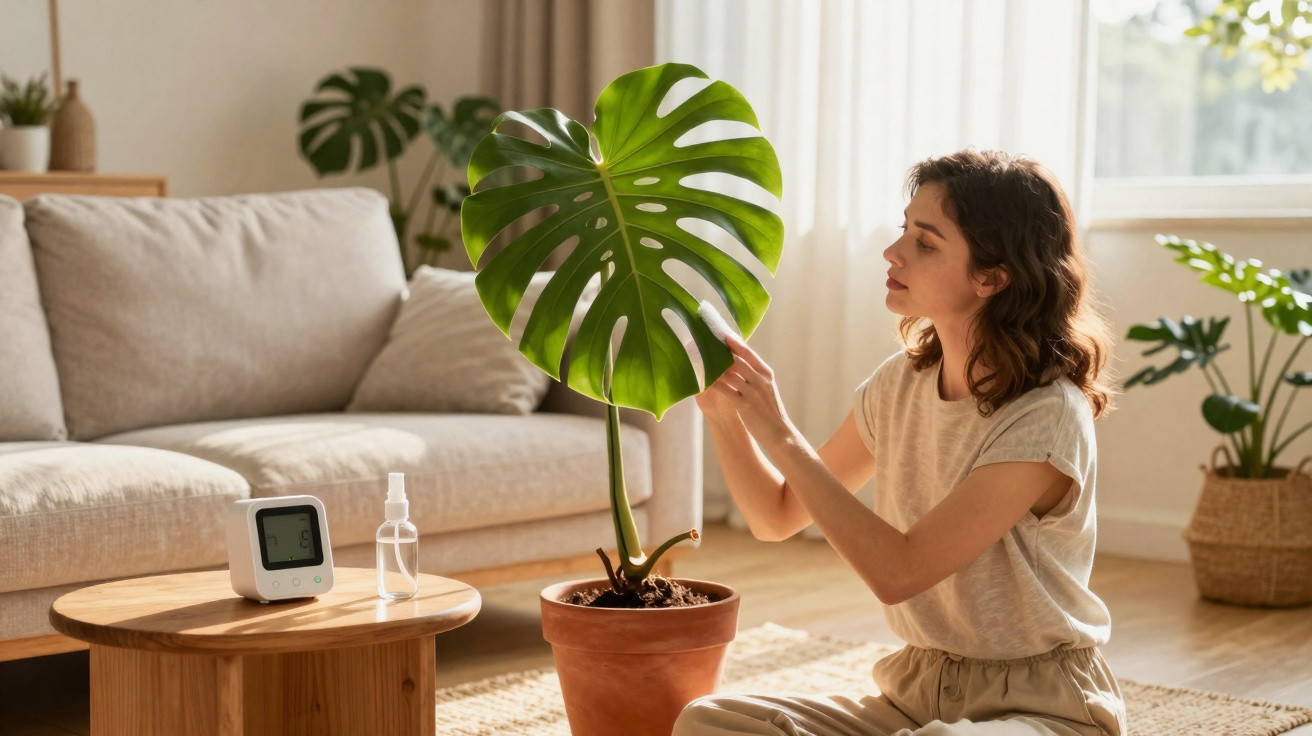
How much can this on-trend houseplant really do for your indoor air quality?
In how-to guides and social media clips, the Monstera is often praised as a natural air filter. The idea is tempting: put a large Swiss cheese plant in the corner and the room instantly becomes a mini wellness retreat. The reality is more matter-of-fact - but still genuinely interesting once you understand what the plant can do, and where the limits are.
What the Monstera actually changes in the air
Monstera deliciosa - usually called simply a Monstera or the Swiss cheese plant in English - has been one of the most popular houseplants in recent years. Its reputation as an “air purifier” largely traces back to older research on houseplants and indoor air, especially the frequently cited NASA study from the late 1980s.
In that research, scientists explored how certain green plants can take up pollutants in sealed indoor environments. Monstera itself was not on the test list, but its structure and metabolism share similarities with some of the species that were studied.
"The Monstera improves the air – but in small steps rather than on a grand scale."
Like any green plant, the Swiss cheese plant photosynthesises: it absorbs carbon dioxide and releases oxygen. Its large, broad leaves provide a substantial surface area for this gas exchange. Those same leaves also trap dust particles, which then settle on the leaf surface instead of continuing to circulate around the room.
Where it stands on pollutants
The key question is what happens with pollutants that are common in many homes: volatile organic compounds (VOCs) released from paints, varnishes, furniture or cleaning products. These include substances such as formaldehyde and benzene.
| Substance | Effect of the Monstera | Notable point |
|---|---|---|
| Carbon dioxide | moderate uptake | mainly during daylight via photosynthesis |
| Formaldehyde | only a slight reduction | noticeable effects require several large plants |
| Dust particles | good binding | large leaves act like “dust catchers” |
| Benzene | hardly any impact | significantly weaker than some specialist species |
So the plant can absorb a portion of certain substances - just not in large quantities. In real living spaces, with normal room sizes and regular ventilation, the benefit can be hard to notice if there is only a single plant sitting in the corner.
Comparison with the “air-purifier stars” among houseplants
If someone wants to reduce airborne pollutants specifically through plants, they often end up with classic choices such as snake plant, spider plant or golden pothos. In studies, these are commonly described as particularly robust “chemical processors”, breaking down certain compounds more efficiently than a Monstera.
With the Swiss cheese plant, the strengths tend to sit slightly elsewhere:
- it noticeably increases humidity through evaporation from the leaves
- it provides steady oxygen production during the day
- it has a strong visual impact, which can have a positive effect on mood and stress levels
Especially in dry homes - for example when central heating is running hard in winter - higher humidity can improve comfort and ease the airways. Anyone who often struggles with dry eyes or a scratchy throat is more likely to notice this effect than the purely “filtering” impact on pollutants.
How many plants does a room need?
As a rough guide, specialists often suggest two larger plants per ten square metres if you want plants to make a measurable difference to air quality. For a Monstera, that means multiple substantial specimens - not just one pot on the windowsill.
There is also the matter of care. A Swiss cheese plant prefers bright, indirect light, consistent moisture and occasional feeding. Plants that are neglected and struggling do very little for the air - they simply lack the energy for strong growth and an active metabolism.
How to get the most out of your Monstera
If you want to use a Monstera as one component in improving indoor air, the priority is creating stable, plant-friendly conditions. The healthier the Swiss cheese plant, the more leaf mass it builds - and the more surface area it has for gas exchange and dust capture.
Placement and everyday care
A bright spot without harsh midday sun works best, such as beside a window rather than directly in it. Turning the pot regularly helps the plant grow evenly instead of leaning towards the light.
These routines tend to work well:
- water as soon as the top two finger-widths of compost feel dry
- keep humidity at around 60 to 80 percent, for example by grouping several plants together
- during the growing season, feed about once a month with a balanced liquid fertiliser
- wipe leaves with a slightly damp cloth to remove dust so photosynthesis is not slowed
- repot every two years into a slightly larger pot with fresh compost
If you stick to these points, you can build up a genuinely dense canopy of leaves over time. That increases the plant’s contribution to indoor air - within a range that still needs to be kept realistic.
Why a plant mix often works better
Rather than relying on a single “miracle plant”, a considered mix of different houseplants is typically more effective. Each species brings different strengths, whether for pollutants, humidity or sheer resilience.
One possible combination for a typical living room:
- one large Monstera as a focal point and humidity booster
- several smaller spider plants or golden pothos for extra air-filter support
- potentially a snake plant in the bedroom, as it is considered particularly easy to look after
This creates a small “home biotope” where different plants contribute in their own ways. As a bonus, a green corner like this often feels calming - many studies suggest that simply looking at foliage reduces stress and improves concentration.
Why plants alone do not replace an air purifier
For all the affection people have for houseplants, they cannot fully replace technical filtration. Modern units with a HEPA filter pull far larger volumes of air through their systems and remove particles and pollutants more efficiently.
"Plants work well as an addition to ventilation and filtration – not as the only solution."
If you live on a busy road, cook frequently, smoke, or use many chemical products at home, you still need the basics: proper ventilation, filtration where appropriate, and cutting pollutant sources. Plants then become the finishing touch, not the main tool.
The often-overlooked psychological effect
There is another angle that matters: for wellbeing, how a room feels can matter more than what a monitor shows to the decimal point. A large, healthy Monstera can change the atmosphere immediately - making it feel more homely, softer and more natural.
Many people say they feel less stressed at their desk when there is a bit of “jungle” next to the monitor and keyboard. This can be particularly valuable for those who work from home a lot, offering a green counterpoint to screens. The measurable air improvement may be moderate, but the perceived difference can be substantial.
Risks, limits and sensible additions
One important point: Monstera is toxic to pets. If you have cats or dogs, place the plant where they cannot chew the leaves or roots. Children should also be kept from reaching it to avoid accidental bites.
It is also worth considering allergies. While the plant does trap dust, that dust accumulates on the leaves. If the leaves are rarely wiped, moving or repositioning the plant can release fine particles back into the air. Allergy sufferers should therefore be especially consistent about cleaning the foliage with a cloth.
For the most rounded improvement to indoor air, a combination approach works best:
- regular burst ventilation, especially after cooking and before going to bed
- avoiding unnecessary fragrance sprays, solvent-based paints and cheap furniture that off-gasses strongly
- if needed, an air purifier with a HEPA filter in heavily affected rooms
- several healthy houseplants, including one or two large Monsteras
Within this overall package, the Monstera plays an attractive part: it brings a touch of tropical character to the living room, quietly supports oxygen and humidity, and contributes a modest amount of filtering. If you treat it not as a cure-all but as a stylish building block within a sensible air strategy, you will be close to what current research suggests about what this trendy plant can actually do.


Comments
No comments yet. Be the first to comment!
Leave a Comment