
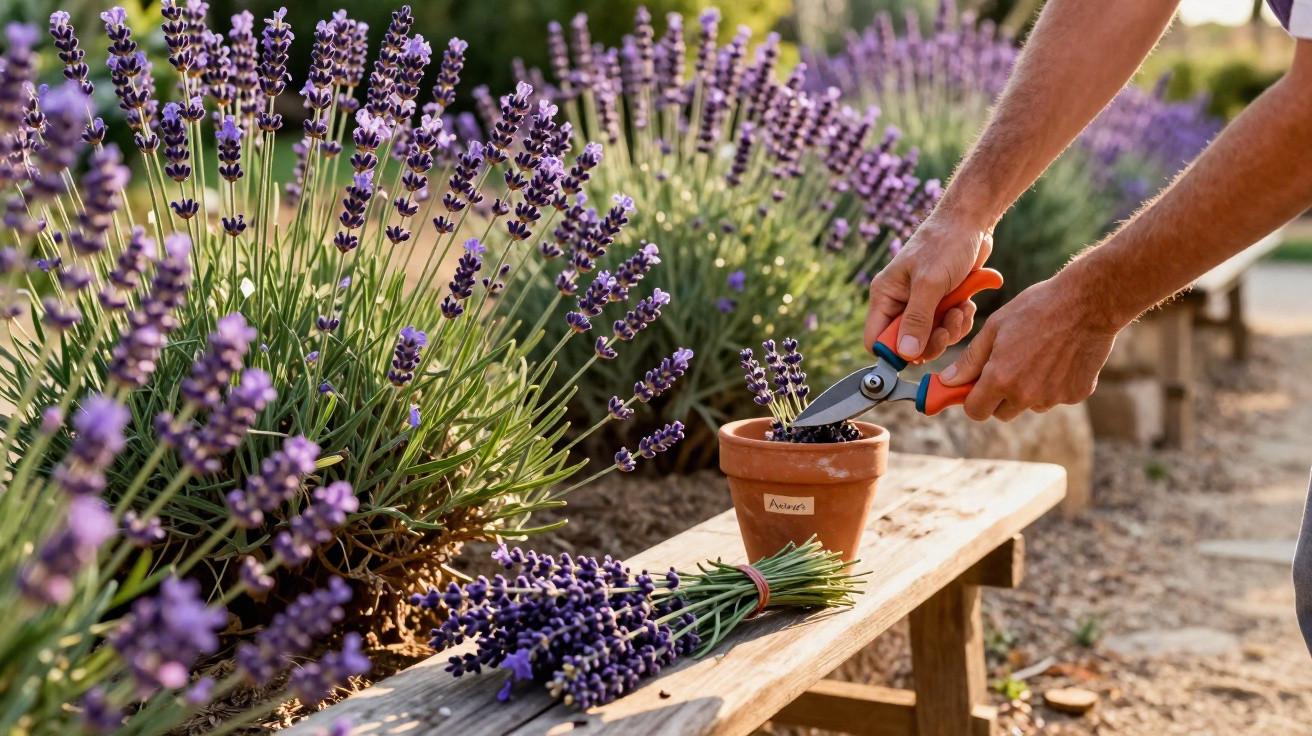
The good news is that the problem is usually not ‘poor soil’ or the weather, but one often-overlooked pruning technique. Applied correctly once or twice a year, it can almost double the lifespan of lavender plants and keep them healthy for decades.
Why lavender becomes woody so quickly without pruning
Lavender is not a conventional herbaceous border plant but a subshrub. This means that its base becomes woody comparatively quickly. This so-called old wood turns brown and hard, and produces very few new shoots.
If lavender is simply left to grow, the following happens: it starts producing growth only at the outer tips, the centre becomes bare and its overall shape splays apart. After only a few years, what was once a fragrant cushion in the border becomes a clump of dry, woody stems.
“Those who never prune lavender, or prune it incorrectly, often unknowingly halve its lifespan in the garden.”
By contrast, well-maintained lavender bushes that are cut regularly remain in the border for considerably longer. Gardeners report that, with consistent care, plants can reach up to 20 years of age while staying compact and floriferous.
The best time to prune: reach for the shears twice a year
Timing determines whether pruning strengthens or weakens the plant. A simple routine has proved effective: carry out the main cut after flowering, followed by a shaping or corrective cut towards the end of winter.
Main pruning after flowering
Depending on the region, lavender flowers from June to August. As soon as the flower heads turn brown and no longer give off their scent, do not wait too long:
- Period: roughly late August to late September
- Aim: rejuvenate the plant, remove spent flowers and retain its shape
- Important: cut only within the green growth; never cut deeply into old wood
This cut removes the exhausted flowers as well as some of the fresh shoot growth. It encourages new side branches and stops the plant from falling open.
Shaping cut in late winter
The second pruning window comes at the end of winter, before lavender properly starts growing:
- Period: usually February to March
- Aim: refine the shape, remove frost damage and keep the plant compact
- Condition: choose a dry, frost-free day – wet or frozen plants are put under unnecessary stress
In mild areas, this pruning can be done quite early. In harsher locations, it is better to wait until the severest frosts have passed.
How pruning differs between mild and harsh regions
The calendar alone is not enough, as climate change is shifting many stages of the gardening year. This broad rule of thumb provides useful guidance:
| Region | Autumn / after flowering | Late winter / spring |
|---|---|---|
| Mild locations (wine-growing areas, western regions, urban gardens) | More substantial maintenance cut in late summer | A light shaping cut is possible from late February if buds are still held tightly closed |
| Cool locations (north, east, higher ground) | Tidy only lightly and remove flower heads | Main pruning in March during frost-free weather |
If in doubt, look directly at the plant: when the buds are already noticeably swollen and sap pressure is clearly present, prune more moderately.
The golden rule for pruning lavender: cut only in the green growth
The key factor in a long lavender life is not timing, but pruning depth. Lavender rarely forgives mistakes when cuts are made into old wood.
“The safe line is always just above the last green leaves. Below that is the danger zone.”
For a cautious approach, remember these three steps:
- Remove flower stems: cut faded spikes just above the first leaves.
- Shorten the green growth: trim the entire cushion-shaped plant by around one third.
- Create a rounded form: lightly reshape the sides so that the result is an even cushion.
Young plants can also cope with a slightly harder cut – up to half of the green growth – provided enough leaves are always left behind. Mature specimens of true lavender, lavandin or Spanish lavender should be treated more gently: 3 to 5 centimetres of leafy stems must remain.
Pruning mistakes that make lavender age prematurely
Many issues in a lavender border can be traced back to the same pruning errors. Once you know them, they are easy to avoid:
- Cutting too deeply into woody growth: shoots rarely regrow from brown, bare wood, and whole branches may die.
- Hard pruning when sap pressure is high: cutting too late in spring can cause branches to dry out because the plant seals its wounds poorly.
- Not pruning at all for months: the shrub ‘moves’ outwards, leaving a hole in the middle that is virtually impossible to close again.
- Blunt tools: crushed stems provide ideal entry points for fungi and rot.
The best protection is a sharp, clean pair of secateurs, a dry day and a brief inspection of the plant before making the first cut.
How lavender stays young for up to twenty years
Those who care for lavender consistently can enjoy the same plant for many years. The underlying principle is simple: remove a little each year so that as much young, vigorous wood as possible develops.
With older plants, gardeners often use a ‘partial retirement’ approach: instead of cutting everything back hard at once, they remove only some of the oldest woody shoots each year. This allows the shrub to rejuvenate gradually without collapsing completely.
There is another useful way to secure your stock over the long term: in late summer, take cuttings around 8–10 centimetres long from the most attractive, healthy shoots, remove the lower leaves and place them in seed compost. With a little luck, a new generation of lavender plants will develop within a few months, perfectly suited to the existing border.
What terms such as ‘old wood’ and ‘subshrub’ mean
Many amateur gardeners come across specialist terms used as a matter of course in gardening guides. A brief explanation removes the uncertainty:
- Old wood: the fully woody, brown part of the plant, usually at its base. It contains very few dormant buds, so new shoots are uncommon.
- Subshrub: a plant form between a perennial and a shrub. Its base becomes woody, while the younger parts remain soft and herbaceous. Lavender belongs to this category.
- Branching: this refers to the formation of branches. Every cut within green growth encourages the plant to produce several side shoots.
Once this basic principle is understood, pruning becomes automatically safer: make active use of green growth, avoid old wood and keep the plant compact.
Practical examples for different lavender types
Not every lavender responds in exactly the same way. Three common garden types differ slightly in practice:
- True lavender (Lavandula angustifolia): relatively hardy and able to tolerate consistent, though not drastic, pruning within the green growth. Ideal for hedges and border edging.
- Lavandin: grows more vigorously and forms large bushes. Clear shaping is worthwhile to prevent plants from splaying apart.
- Spanish lavender: slightly more frost-sensitive and better kept in a container in many areas. Prune it carefully and moderately.
The same principle broadly applies to containers: remove faded flower spikes promptly, shorten green shoots and leave old woody parts in place. With very old container-grown plants, it may make sense to ‘rejuvenate’ part of the plant from cuttings and replant the pot.
Anyone who follows these basic rules will soon discover that lavender is not a diva of a plant. With a clear pruning plan and an attentive eye, this seemingly delicate subshrub becomes a long-lived, low-maintenance source of fragrance that defines borders, paths and terraces for years.
Comments
No comments yet. Be the first to comment!
Leave a Comment