
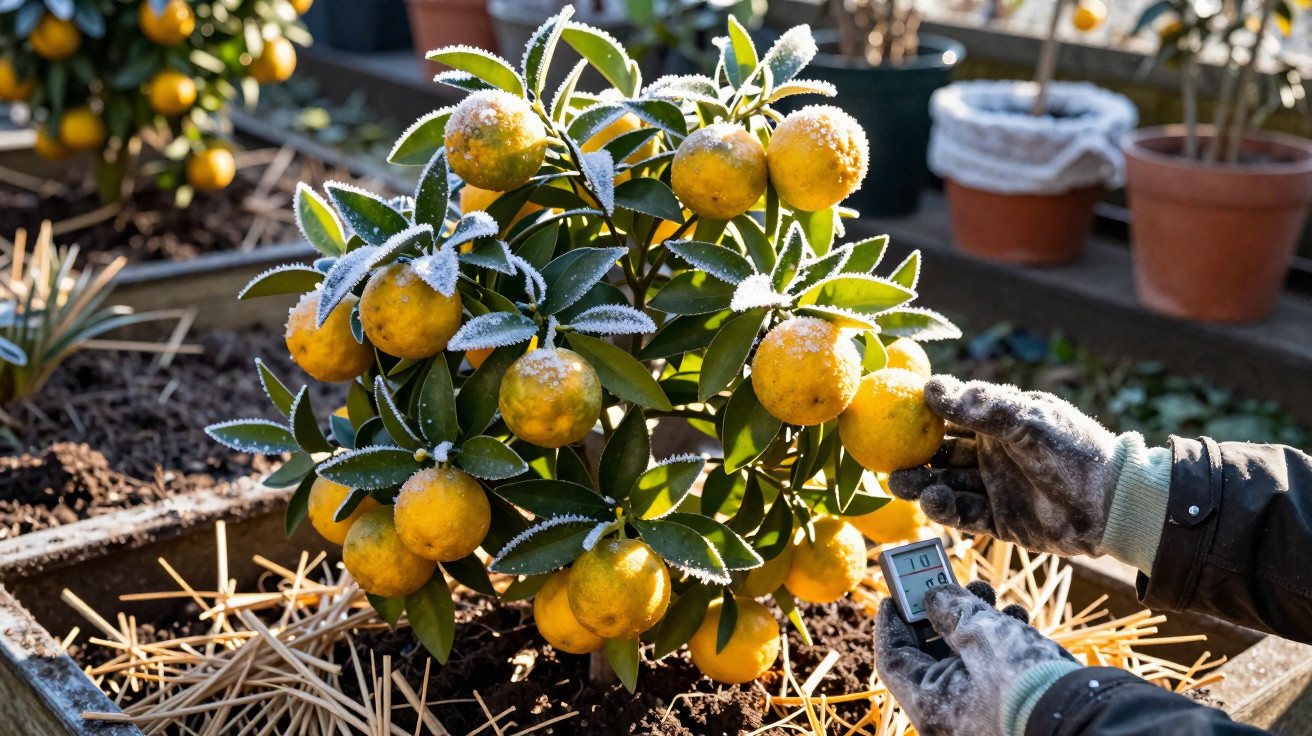
Some tough citrus relatives can take frosts that would finish off a classic lemon tree.
Plenty of gardeners picture bright yellow fruit just outside the patio doors, even while the air outside turns to tiny clouds with every breath. Then the first proper frost arrives, and the carefully tended lemon tree becomes a blackened skeleton. It doesn’t have to be that way: there are citrus cousins that cope remarkably well with Central European winters - as long as you choose suitable varieties and meet their basic requirements.
Frost and citrus: what the stated minus temperatures really mean
If you read plant labels, you’ll quickly see claims such as “hardy to –12 °C”. It sounds reassuring, but it often sets people up for disappointment. In practice, those figures almost always assume:
- a mature plant that has been established in the ground for years,
- free-draining soil with no waterlogging,
- short cold snaps rather than days of continuous hard frost.
Wood, foliage and fruit don’t react to cold in the same way. A yuzu shrub may survive very low temperatures while its fruit has long since turned to mush. With the popular kumquat, the fruit can be ruined from around –5 °C even though the plant itself still pulls through.
"If you only go by the frost number on the label, you’ll often get a nasty surprise - site, soil and the plant’s age matter just as much."
Broadly speaking, citrus plants can be grouped into three categories:
- very robust species that tolerate down to around –15 °C, and in extreme cases down to –20 °C,
- moderate frost tolerance in the region of about –10 to –12 °C,
- sensitive classics such as lemon and orange trees, which can suffer badly from as little as –3 to –5 °C.
The quiet number one: the three-leaved bitter orange relative
The toughest contender is a citrus relative known botanically as Poncirus trifoliata. In English it’s commonly called the trifoliate orange; some nurseries simply market it as an “extra-hardy citrus shrub”.
| Botanical name | Poncirus trifoliata |
|---|---|
| Habit | 3–5 m tall, 2–4 m wide |
| Position | Sun, sheltered spot, well-drained soil |
| Frost tolerance | up to around –20 °C in free-draining soil |
| Leaves | deciduous, very thorny |
Its fruit is small, hard and intensely bitter - more suitable for marmalade experiments or decoration than fresh eating. Where it really shines is as a hardy rootstock for grafting and as an indicator plant: if this survivor freezes through, no other citrus grown in the ground in the same bed is likely to stand a chance.
"Poncirus trifoliata is considered a litmus test in frost-prone areas: if it doesn’t make it through winter, you’re better off growing other citrus in pots."
Edible options: citrus species that cope with cold surprisingly well
If you want more than leaves and thorns - and would like to harvest fragrant fruit - there are now several interesting choices on the market. They’re widely regarded as far more cold-tolerant than the classic lemon tree, and they’ve already proved themselves in sheltered sites in Western Europe.
Yuzu: a trend fruit with a surprising frost advantage
Yuzu (Citrus junos) is a staple in Asian cooking and is now turning up in bars and restaurants across Central Europe. In the garden, it offers:
- frost tolerance down to about –12 °C in a favourable spot,
- a bushy, thorny growth habit,
- strongly scented blossoms,
- small, highly aromatic fruit in winter.
The zest brings powerful fragrance to desserts, sauces and drinks, while the juice is sharp yet complex. In colder areas, it pays to plant it by a warm house wall, ideally out of the wind.
Ichang lemon: substantial fruit, hardy genetics
The Ichang lemon comes from a cross involving Poncirus and inherits some of its toughness. It:
- withstands winters with clearly double-digit sub-zero temperatures,
- produces large, lemon-like fruit with plenty of juice,
- forms a vigorous shrub or a small tree.
For self-sufficiency gardens in wine-growing climates or mild river valleys, it can be an appealing alternative to the usual lemon, which quickly reaches its limits outdoors.
Satsuma mandarin: seedless fruit, a tougher tree
The Satsuma mandarin tree (Citrus unshiu) has a strong track record in Japan and is considered one of the most frost-tolerant mandarin types. Typical characteristics include:
- coping with readings around –11 °C when the site is right,
- ripening as early as autumn, before the harshest frosts arrive,
- producing mostly seedless fruit with a delicate flavour.
If you have children in the garden, the easy-to-peel fruit is a real bonus. In exposed locations it still needs winter protection, but it remains noticeably sturdier than the standard mandarins sold in many garden centres.
Kumquat and finger lime: small fruit, a decent frost buffer
Kumquat - especially the ‘Meiwa’ cultivar - is tougher than many people expect. Once well established, it can tolerate about –8 to –9 °C. The small fruit can be eaten skin and all, making it a fun, unusual snack.
Some selections of so-called finger lime (citrus caviar) manage frost levels around –10 °C. Here it’s worth reading the variety notes carefully, because performance varies widely. Not every type is suitable for an in-ground trial.
Mandarins, clementines, lemons: where outdoor growing hits its limits
That tempting garden-centre impulse buy often ends in midwinter disappointment: a small mandarin or clementine tree looks wonderfully Mediterranean in summer, then by January it resembles dry, dead twigs.
A few rough guidelines for the more sensitive types:
- many classic mandarin varieties tolerate down to about –8 °C,
- clementines are usually closer to around –7 °C,
- standard lemon and orange trees as well as grapefruits can show severe damage from about –5 °C.
In mild coastal spots with a long growing season, these types can survive in the ground if they’re sheltered from wind and not sitting in a frost pocket. Across much of inland areas, though, they’re better treated as large-container plants that move to a cold greenhouse, a bright garage or a conservatory for winter.
How to protect sensitive citrus trees in winter
If you still want to try a classic lemon tree in the ground, you’ll need to look after it diligently. Key points include:
- Choosing the site: a heat-reflecting house wall, not deep shade, and never waterlogged ground.
- Soil: a coarse, free-draining base; in heavy soils, work in plenty of sand and grit.
- Winter protection: a thick mulch of leaves, bark chunks or straw over the root area; during cold spells, cover crown and trunk with horticultural fleece or purpose-made winter fleece.
- Watering: keep it on the dry side in winter and avoid waterlogging; only water sparingly on frost-free days.
- Feeding: stop nitrogen from late summer onwards so new growth hardens off and doesn’t enter winter soft.
"Many citrus trees don’t die from frost alone - they rot in cold, wet soil. Good drainage protects more than any fleece cover."
Why free-draining soil is so crucial for citrus plants
Citrus relatives originate from regions with comparatively dry, often stony soils. Wet feet in winter push their roots to the edge. On heavy clay, a raised bed or a mound bed is often worthwhile. A layer of coarse gravel or expanded clay in the planting hole improves run-off, but it doesn’t replace the need for an overall free-draining soil structure.
If you’re not sure, try a simple check: after a thorough watering, the water should drain away completely within one to two hours. If it takes longer, loosen the area properly and incorporate sand or grit before planting - otherwise every winter becomes a gamble.
Plan B: a smart mix of border and container
For many gardens, the most realistic strategy is a combination approach: hardy types such as yuzu or Poncirus in the ground, while lemons, oranges and grapefruits stay in pots. That way you get the Mediterranean feel without risking total losses year after year.
A large pot on wheels makes it easy to switch between a summer spot outdoors and sheltered winter quarters. If you don’t have a conservatory, a bright stairwell, a frost-free shed with a window, or even an unheated spare room can work. In winter, temperatures can sit anywhere between 2 and 10 degrees - the main thing is that the rootball doesn’t freeze solid and the air doesn’t become bone-dry.
Many hobby gardeners begin with a tougher choice like yuzu, build up experience, and then move on to more sensitive citrus in containers. This way, a Mediterranean corner in the garden develops step by step - and stays green and productive even after harsh winters.
Comments
No comments yet. Be the first to comment!
Leave a Comment