
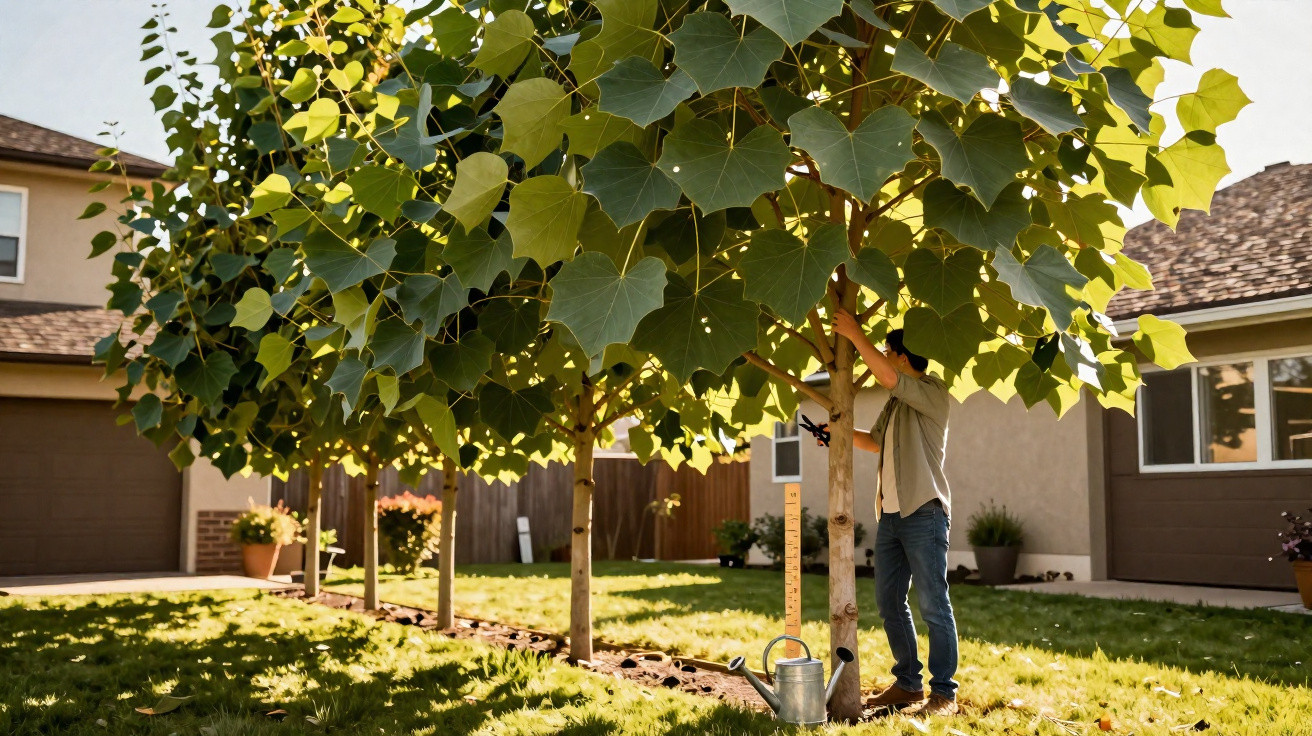
Many people reach for ready‑made privacy screens made from timber, plastic or reed fencing. They can look tidy at first, but they weather quickly, turn grey and often block daylight. A different approach uses living greenery: a tree that grows at record speed, forms a dense canopy within a few years and simply makes prying eyes disappear.
Why a fast‑growing tree is often better than any privacy fence
When a new house goes up next door, or a balcony suddenly overlooks your patio, most people want an instant fix. DIY‑store screening panels, trellises and tall fences can be tempting, but they come with familiar downsides:
- They deteriorate and often need replacing after a few years.
- They can feel harsh and make the garden seem “boxed in”.
- They reduce light and can make small gardens look even tighter.
- They rarely solve the issue when neighbours are sitting noticeably higher up.
A tall, quick‑growing tree works differently. It places the screening where the sightlines actually come from: up above. And it creates a living roof rather than a rigid wall. In tightly built‑up areas, that can completely change how a garden feels.
"A turbo tree can create privacy screening of more than 5 metres within three years - without a concrete wall."
Well‑known quick starters: useful, but with side effects
There are plenty of fast‑growing hedging plants. Two long‑standing favourites are:
- Leyland cypress: grows by around 0.9 to 1.5 metres per year and can reach up to 18 metres.
- Thuja ‘Green Giant’: forms a substantial evergreen wall of roughly 15 metres if planted with about 1.5 metres between plants.
Both can deliver a closed, dense hedge within a few years and reliably block views. The trade‑off is frequent, time‑consuming trimming and a garden atmosphere that can feel gloomy. Tall conifers cast heavy shade, visually dominate the space and can resemble a fortress wall.
That is why many gardeners want something else: privacy quickly, yes - but with an airy crown, dramatic foliage and more of a park‑like feel than a barricade. This is exactly where a deciduous tree comes in - one that for years was considered an insider tip.
Paulownia tomentosa: the Empress tree in overtaking mode
Paulownia tomentosa - commonly known as the Empress tree - is now widely seen as a front‑runner when the goal is a broad, fast‑forming leaf canopy. In the right conditions it can add up to 2 metres in height per year, which is close to record pace for a deciduous tree.
Its secret is its enormous leaves. They can grow to as much as 60 centimetres across and act like giant solar panels: the more light they capture, the more energy the tree has available for growth. The result is a thick, tall “umbrella” of green.
"With its XXL leaves, the Empress tree builds natural privacy screening in just a few seasons, hanging like a green curtain in front of the neighbour’s house."
A real‑world example shows what is possible
In a typical suburban garden, three Paulownias were planted in a row, each 4 metres apart, directly opposite a two‑storey home with balconies. After three years, a living screen more than 5 metres tall stood in front of the façade.
From May to November - precisely when life shifts outdoors - the balconies were fully hidden from view. Only in winter, when the tree is bare, do sightlines open up again. That means privacy during the warm months without darkening the garden all year round.
How to plant a dense “green curtain” in three years
For the Empress tree to reach top speed, it needs the right start. The best planting window is autumn or very early spring. The soil should be deep, well‑draining, and the position should be sunny to partly shaded.
The key trick: hard pruning for more density
One crucial step creates the compact, opaque result: hard coppicing. At the end of the first winter, once the young tree has established, cut the trunk back drastically to about 10 centimetres above ground level. It sounds extreme, but the effect is straightforward: the tree resprouts with several strong shoots.
Keep only three to four of the strongest shoots and remove the rest. This produces a multi‑stem structure with plenty of side branches and therefore much denser foliage. This one‑off intervention determines whether you end up with a light, open tree or a substantial “green curtain” in front of the house.
Water, spacing and patience: the growth schedule
During the first two summers, the Empress tree needs regular watering. About 20 litres per week per tree is a good guideline; in very hot weather, a little more is fine. A thick mulch layer of bark chips or grass clippings helps stop the soil drying out and supports rapid growth.
For planting, a distance of at least 2 metres from the property boundary is recommended. Between trees, 3 to 4 metres is ideal so the crowns can later meet and merge into one continuous canopy.
A typical progression looks like this:
- Year 1: the tree reaches 1 to 2 metres; the crown still looks quite open.
- Year 2: 3 to 4 metres tall; the screening already works fairly well.
- Year 3: more than 5 metres; privacy in front of a two‑storey house is fully established.
Laws, roots, neighbours: what must be sorted before planting
If you plan to place a fast‑growing tree close to the boundary, it is wise to check neighbour‑law rules in advance. Under German law - broadly guided by the German Civil Code and the neighbour‑law regulations of each federal state - the general principle is: trees that will grow taller than 2 metres typically require a minimum distance of 2 metres from the property boundary.
Plant too close and you risk a dispute. Neighbours may demand pruning or even removal. For screening at balcony level, that would be disastrous. Building in the correct distances from the start prevents costly corrections and unnecessary conflict.
There is another practical point: the Empress tree develops vigorous roots. They seek moisture and, over time, can lift patio slabs or lighter foundations. A root barrier installed to around 1 metre deep can slow growth towards the house or terrace and steer roots into a safer zone.
How the Empress tree fits into a year‑round privacy plan
The Empress tree is deciduous. From late spring through to autumn it provides maximum screening; in winter, only the branches remain and the garden feels more open. Anyone wanting privacy all year long can pair it with lower evergreen elements.
Possible combinations include:
- A narrow, low‑maintained conifer hedge at the lower level.
- A light pergola over the patio to break sightlines during the leafless season.
- Climbers such as evergreen ivy or tough climbing shrubs trained on individual posts.
This keeps the dramatic impact of the huge Paulownia leaves, while still providing a basic level of screening when the crown is bare.
Opportunities, risks and who this turbo tree suits
Anyone with a small urban garden can benefit in particular from this vertical solution. Instead of walling off the boundary with a 2‑metre barrier, the screening grows upwards. The lower part of the garden stays bright and usable, and borders and lawn still get enough light.
At the same time, the Empress tree brings a strong design statement. Its huge leaves create an almost exotic feel, and its outline is striking. It works well with modern homes and clean lines, but can also make an older garden feel more dynamic.
Not every site is suitable. In very windy positions the oversized leaves can suffer, and extremely dry sandy soils slow growth noticeably. If you are not willing to water or to carry out the drastic cutback in the first winter, it is better to choose tougher, lower‑maintenance species - even if they grow more slowly.
The Empress tree is especially appealing to anyone who wants to protect their plot without tall walls or heavy hedges and is willing to invest a little planning and care. In new‑build neighbourhoods with tight spacing, it can be the missing piece that turns an exposed plot into a genuinely sheltered retreat.
If insect friendliness matters too, the Empress tree has another advantage: older specimens produce showy, bell‑shaped flowers in spring that attract bees. Combined with perennials and flowering shrubs, it becomes not just a privacy solution, but a lively, ecologically valuable garden space.




Comments
No comments yet. Be the first to comment!
Leave a Comment