
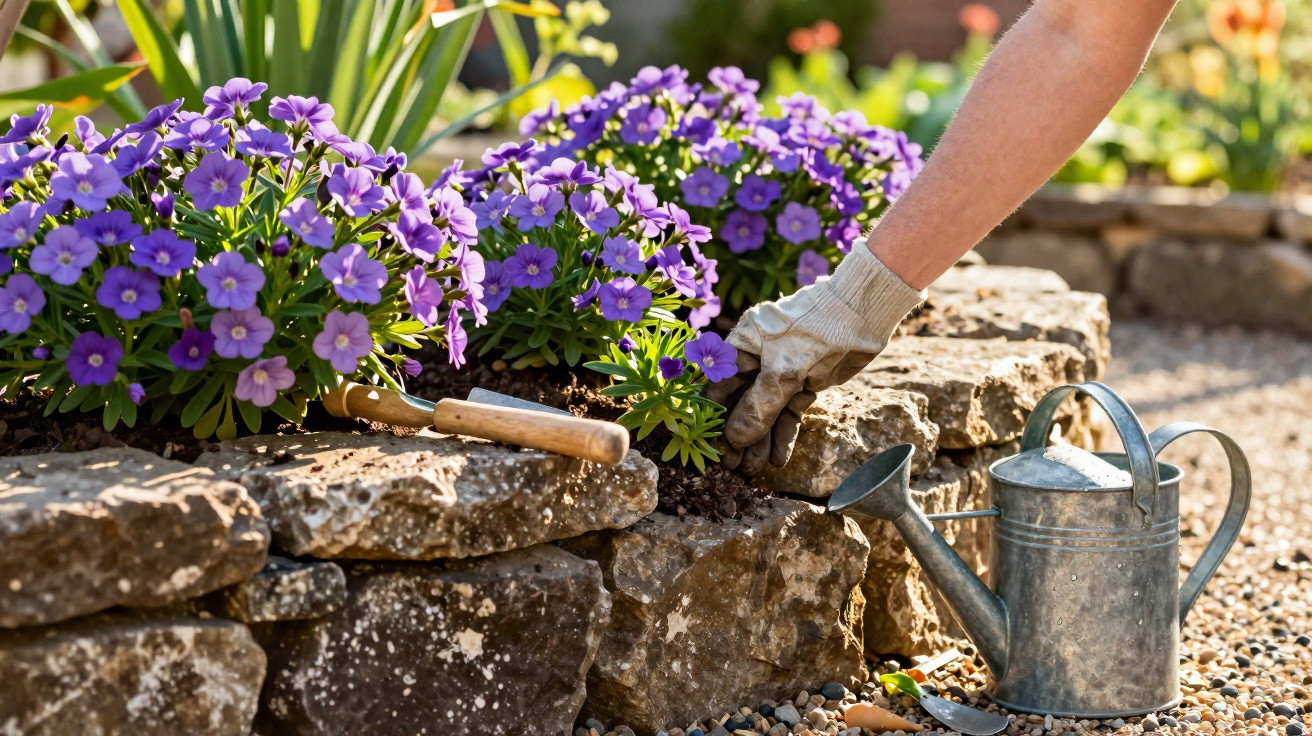
Many homeowners run into the same eyesore: a retaining wall on a slope that sits in the garden like a flat grey lump. There’s hardly any soil, the sun beats down relentlessly, and rainwater runs off in seconds-so ordinary border perennials tend to fail fast. One small, tough cushion perennial, however, actually thrives on these extremes and can cloak stonework in a violet sea of flowers in surprisingly little time.
Why these walls are so difficult to plant up
In garden design, retaining walls are classic problem areas. Built from concrete or natural stone, they soak up heat and usually offer only narrow joints with very little growing medium. Water drains away quickly and nutrients leach out.
As a result, many plants either dry out completely or suffer winter damage, because their roots aren’t sufficiently insulated and protected.
Yet these harsh conditions are remarkably close to the natural habitat of alpine rock plants. In scree, among stones, and in cracks and crevices live specialists that actively prefer drought, intense sun and poor soils. One of those specialists is the star when it comes to greening up retaining walls.
The violet lead: Aubrieta, the “rock cress”
Gardeners know it as aubrieta (Aubrieta deltoidea), usually sold as a cushion perennial. It forms low, evergreen mounds around 10 to 15 centimetres tall, while spreading sideways in every direction. Over time, this creates a dense, continuous mat.
From mid-April into early summer, that mat turns into what looks like a single flower cushion: countless tiny, four-petalled blooms in violet, purple or soft pinkish tones almost completely hide the foliage. Depending on the variety, the effect is either a uniform violet sheet or a subtly mixed display of different shades.
“The clever bit: the flexible shoots drape over the wall edge and lie across the stones-so the hard, stark feel of the wall disappears beneath a soft, flowering cascade.”
Aubrieta comes from rocky ground and scree slopes. That’s exactly the kind of environment you get along the top of a retaining wall: dry, sharply drained, full sun, and very little humus. Once established, this cushion perennial takes summer heat and frost in its stride.
The ideal position on a retaining wall
For the strongest flowering display, plant along the top edge of the wall. From there, the plant can spill forward and gradually cover the stonework. A south- or west-facing aspect is best, so the spot gets several hours of direct sun each day.
- Position: top of the wall or a wide joint within the masonry
- Aspect: south- or west-facing, with plenty of sun
- Soil: very free-draining, fairly lean, gritty
- Water: short dry spells are fine; avoid waterlogging
In shade or consistently damp areas, growth stays thin, flowering weakens and the cushions age more quickly. Very rich, heavy garden soil doesn’t suit this rock-dweller either-it may produce more bulk, but it also makes the plant more vulnerable.
Planting successfully, step by step
1. Choose the right planting time
Planting is simplest in spring, once hard frosts are no longer likely. A mild autumn also works, giving the perennials time to root before winter. Sowing seed directly is rarely worth it-small pot-grown plants are far more reliable.
2. Prepare the planting pockets
At the top of the wall or between two stones, create a small “pocket” for planting. Fill it with a loose mix, for example:
- 1 part ordinary garden soil
- 1 part well-rotted compost
- 2 parts grit or coarse gravel
The high proportion of stone ensures water drains away rapidly. If the material is compacted, loosen it first with a hand fork so the fine roots can work in easily later.
3. Plant correctly and water in
Ease the young plant out of its pot. If the root ball is tightly packed, gently tease the bottom with your fingers. Set the plant into the prepared mix, angled slightly towards the wall edge so the shoots naturally grow forwards.
Water thoroughly after planting to settle the soil and remove air pockets. After that, allow the surface to dry again. For the first few weeks, only water when it has been dry for an extended period and temperatures are high.
Care: minimal effort, maximum impact
Once it has rooted in, this cushion perennial needs very little attention. It prefers drier conditions to frequent watering. Feeding should be light-such as a thin layer of compost in spring. Strong synthetic fertilisers encourage soft growth that’s more prone to problems.
The key maintenance task comes straight after the main flowering period in May or June: use shears to cut the cushions back by roughly half. It may feel severe, but it prompts fresh new shoots and keeps the plant compact.
“A quick trim after flowering keeps the cushions dense, rejuvenates the plant and noticeably boosts flowering the following spring.”
Cut out any bare or brown patches completely. Open areas can be filled later with new young plants. On very old walls, it’s normal for certain sections to lose vigour a little after several years.
Turning the wall into a living micro-habitat
That violet wall of flowers isn’t just attractive-it’s useful, too. The many open blooms draw in bees, solitary bees and butterflies. Small insects also find shelter in the joints and beneath the cushions.
Another advantage: larger grazing animals such as deer tend not to find the plant particularly appetising, which can be helpful in rural locations.
To increase the wildlife and design value further, combine the flowering mat along the top edge with other drought-tolerant species:
- houseleeks (Sempervivum) for bold rosettes
- stonecrops and other Sedum species for a long-lasting green carpet
- thyme varieties for fragrance and extra flowers
This way, the wall stays appealing all year: the violet cushion perennial takes centre stage in spring, while sedum, thyme and houseleeks add structure through summer and winter.
Risks, common mistakes and how to avoid them
The most frequent issues are too much water and too little sun. Planting into heavy, wet soil-or placing plants below a downpipe that drips constantly-invites root rot. Equally unhelpful are extreme doses of fertiliser, which lead to lush, sappy growth and potential frost damage.
Another point is competition from vigorous weeds. While the plants are establishing, it pays to check regularly. Pull out grasses and deep-rooted wild plants early, before they become embedded in the cushions.
Practical ideas for garden design
This cushion plant doesn’t only disguise retaining walls. It also works well on banks, between natural-stone steps, or along the top of a gabion wall. In rock gardens, it creates bright bands of colour beside paths and edging.
If your driveway runs alongside a slope, you can plant a continuous strip of this perennial between paving and wall. Visually, it softens the hardness of sealed surfaces and makes the area feel more welcoming.
One more bonus: it tolerates moderate foot scuffs at the edge. Snapped shoots usually grow back as long as the rooted cushions remain intact. Even so, it’s best treated as an edging plant rather than something to plant in the centre of a heavily used path.
Why it’s worth using on a retaining wall
With just a few well-placed cushions, a dull block of concrete or natural stone becomes a lively garden feature. The cost of a handful of young plants is manageable, and upkeep is low. In return, you get a vivid focal point that draws attention every spring.
If you’ve been stuck with bare, unattractive retaining walls, this violet-flowering cushion perennial offers a refreshingly simple fix. With a bit of preparation, a quick post-flowering trim and restrained watering, the wall can be made to almost visually disappear-becoming part of the garden design rather than an unwanted intruder.
Comments
No comments yet. Be the first to comment!
Leave a Comment