
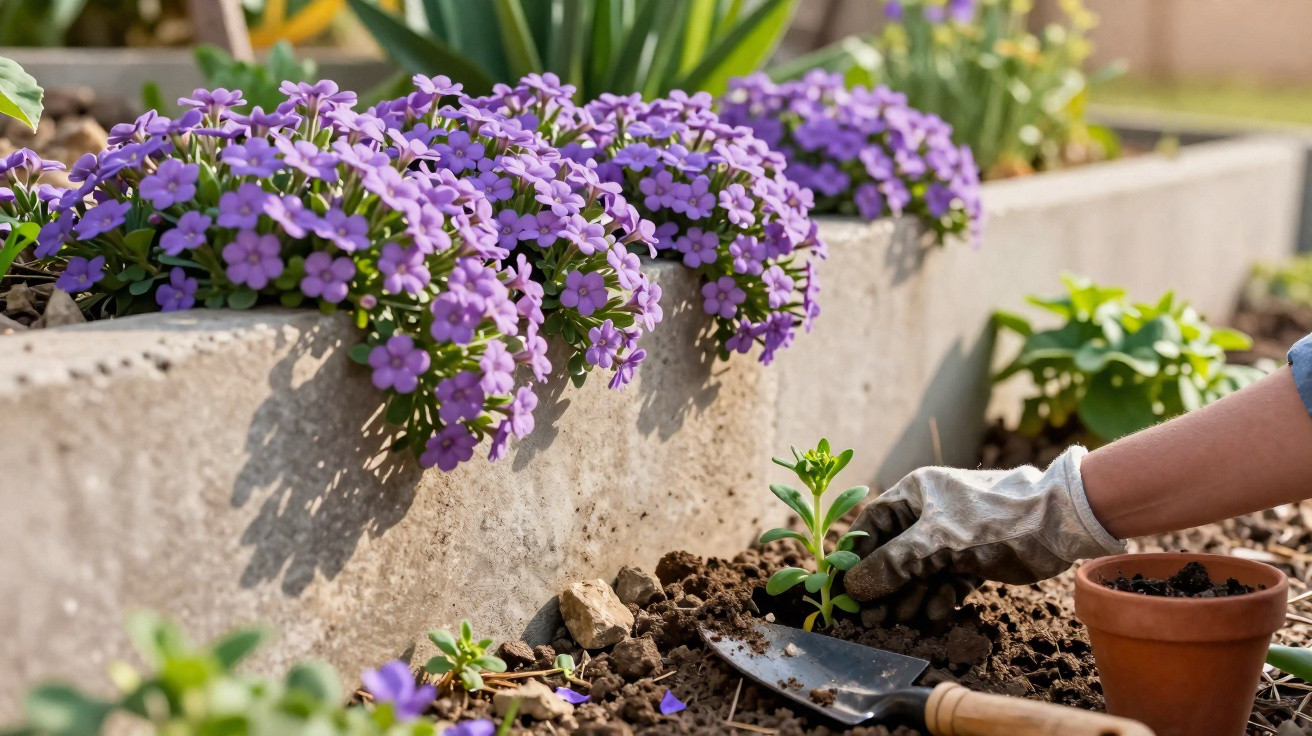
In many gardens, retaining walls feel like a necessary evil: visually harsh, baking hot in summer, and in spring they can look completely out of place against fresh green growth. With the right plant, though, that awkward strip can become the most striking feature in the whole garden - with surprisingly little effort.
From concrete block to a curtain of flowers
Retaining walls are often seen as a tricky spot to plant up. There’s usually very little soil, water drains away almost instantly, and the sun can beat down on the stones for hours at a time. Plenty of garden plants struggle and quickly give up in these conditions. A small number, however, actually thrive there - and only really get going when things are extreme.
That’s exactly where a low-growing, violet-flowering cushion perennial comes into its own: it creeps over edges, fills cracks, drapes gently downwards and turns a hard wall face into a soft, living veil of flowers and foliage.
"The right cushion perennial can turn a bare retaining wall into a living garden picture glowing violet."
The secret star plant: why rock cress species love walls
The perennial in question originally comes from sparse, rocky landscapes. In its natural habitat it makes do with very little soil, plenty of loose stone, and big swings in temperature. That background is precisely what makes it so well suited to garden retaining walls.
Its growth habit is distinctive: it forms dense, cushion-like mats around 10 to 15 centimetres high, spreading out across the surface. The shoots hang loosely over the top of walling and settle around uneven stones without damaging them.
From roughly mid-April through to early summer, countless small flowers cover the entire cushion. Depending on the variety, the colour reads as violet, lilac, or shifts slightly towards purple. At peak bloom the foliage is almost hidden by the mass of flowers - the wall looks as if it has been drenched in colour.
- Height: approx. 10–15 cm
- Spread: per plant up to 40–50 cm over the years
- Flowering period: roughly April to early June
- Flower colour: mainly violet shades, sometimes pink through to purple
- Position: full sun, dry, free-draining
The perfect position on the wall
The best place is along the top edge of the retaining wall. From there, the plant can trail forward over the face while its roots grow back into the soil behind. A south- or west-facing aspect provides plenty of sun and, as a result, noticeably more abundant flowering.
Soil needs to be loose and gritty. The plant does not cope well with waterlogging, and it also dislikes heavy, wet garden soil. A lean mix with a high proportion of sand or grit is ideal. That keeps the growth short and compact rather than soft and stretched.
"The sunnier the spot and the more free-draining the soil, the denser and more intensely coloured the violet carpet of flowers will be."
Step by step: how to plant the violet cushion star
1. Choose the right planting time
Planting is easiest in spring, once there’s no longer any risk of night frosts. A mild autumn also works well, as the perennial can still establish strong roots before winter.
2. Prepare the planting pocket
Between two stones, or just behind the top course of the wall, dig out a small pocket. Fill it with a mix of:
- one part loose garden soil,
- one part well-rotted compost,
- at least one part coarse gravel or grit.
The mix should crumble easily and not feel claggy. The heavier the original soil, the more mineral material should go into the blend.
3. Set the plant in place
Rather than sowing seed, young pot-grown plants are the better option. They cover the area faster and establish more reliably. Lightly tease the root ball, then place it into the prepared pocket so the shoots point slightly over the wall edge.
Finish with a thorough initial watering. The aim is to settle the substrate and remove air pockets so the roots make good contact with the soil. After that, it’s fine for the surface to dry out again - regular watering isn’t necessary.
Low maintenance, but not entirely hands-off
Once established, this plant manages with very little attention. A dry, sunny summer is far less of an issue for it than for many border perennials. Short dry spells are handled without trouble.
Heavy feeding is unnecessary - and can even be a disadvantage. Over-rich conditions lead to soft, unstable growth and fewer flowers. A small amount of compost every few years is entirely sufficient.
Pruning for compact growth
After the main flush of flowers in May or June, a confident trim is worthwhile. Cut the cushions back by about half. The plant then grows away strongly, produces fresh young shoots and stays neat and tight.
If the foliage looks tired or slightly brown after a harsh winter, a lighter tidy-up with shears helps too. Removing dried sections encourages new growth from the base.
What else this violet cushion plant can do
The flowers are a popular stop for wild bees and various butterfly species. Anyone aiming for a wildlife-friendly garden scores highly with a flowering carpet on a wall. At the same time, the plant is generally considered unappealing to deer and other grazers, which can be a real advantage in rural areas.
Visually, the retaining wall looks even better if you pair the violet perennial with other drought-tolerant plants. Good companions include:
- houseleeks tucked into upper wall joints,
- Sedum species with foliage in different colours,
- low-growing thyme varieties for scent and bee forage,
- small ornamental grasses for extra texture.
Practical tips for quick results
For a faster, more continuous cover, plant several specimens about 25 to 30 centimetres apart. Over time the cushions merge and drape over the wall edge like a broad ribbon. In the first few months, keep a close eye out: remove weeds early so they don’t crowd the young plants.
Watering is also about getting the balance right. While the plants are establishing, the soil shouldn’t be allowed to become dust-dry; later on, occasional drought does no harm. Persistent wetness - especially in cracks with no drainage - can quickly lead to root rot.
Risks, limits and sensible alternatives
This approach isn’t trouble-free everywhere. In shaded situations, such as north-facing retaining walls, flowering is noticeably weaker and the cushion loosens. In those spots, shade-tolerant choices such as ivy or certain fern varieties are more suitable.
Very exposed locations can also cause problems: icy winter winds dry plants out severely. In that case, a light cover of fir branches during the coldest period helps until the planting is robust enough.
If you want the wall to stay varied over the long term, mix different cushion plants with staggered flowering times. That keeps the area appealing for longer, and the violet spring display from the plant described here can be followed by other colours later in the season.
The effect is especially strong when the wall isn’t treated as a standalone feature but is tied into a wider design: a natural-stone staircase, a narrow gravel path at the base, or a herb bed directly above the wall all echo the dry conditions and create a smooth transition. That way, a purely functional retaining structure becomes - step by step - a lively garden element with genuine eye-catching potential.

Comments
No comments yet. Be the first to comment!
Leave a Comment