
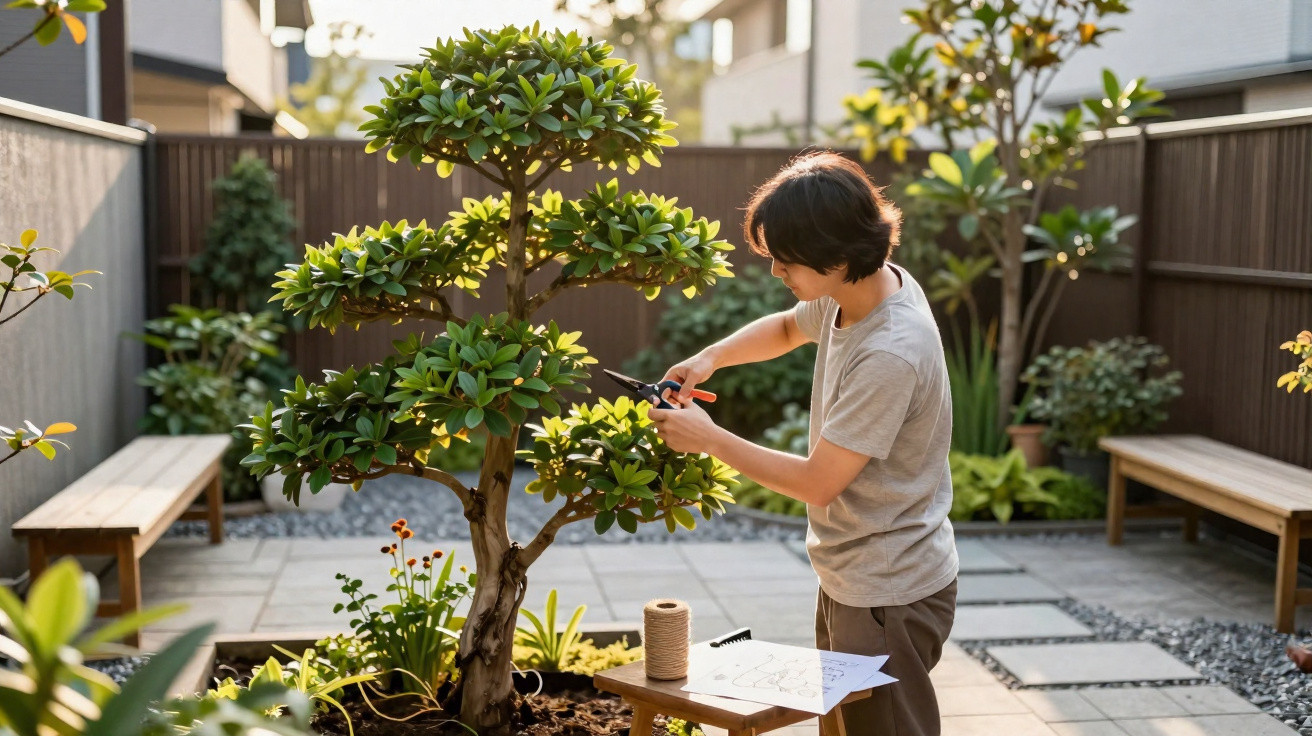
Many urban gardens and terraced-house plots start to feel overgrown after a few years. Shrubs turn into green walls, daylight gets shut out, and every square metre seems smaller than it looked on paper. Rather than hacking everything back or spending a fortune on new planting, there’s a more elegant option: a Japanese pruning method that reshapes what you already have, improves airflow - and makes the garden feel larger.
Why many small gardens eventually “close in”
When you live close to neighbours, it’s common to plant fast-growing shrubs: cherry laurel, privet, yew, box, and sometimes pines or holly. The aim is straightforward - privacy, quiet, a sense of shelter. Over time, though, that planting often becomes a solid green barrier that:
- casts heavy shade,
- leaves lawns and borders damp and mossy,
- blocks the view and makes the space feel tighter.
What began as a cosy retreat can end up like a narrow green corridor. At that point, many people reach for an electric hedge trimmer and shear everything into hard-edged blocks or balls. The result looks mechanical, strips the planting of character, and only partly solves the “cramped” feeling. This is exactly where Japanese garden craft offers a different approach.
What the Japanese Niwaki technique is all about
In Japanese gardens, trees and shrubs have been shaped with intention for centuries. The technique is called Niwaki - loosely translated as a “garden tree”. Unlike bonsai, which is grown in a pot and heavily miniaturised, a Niwaki grows in the ground and remains a full-sized tree or shrub.
"The aim of Niwaki isn’t a miniature tree, but a characterful, airy tree that opens up space, light and sightlines."
Pruning creates a clear, almost sculptural framework: the trunk and main branches are visible, while foliage sits in tiers or “clouds”. Between those layers are open areas where light and your gaze can pass through. The garden feels broader, calmer, and at the same time more visually interesting.
Before you prune, you need to look
With Niwaki, observation comes first - scissors second. You start by reading the shrub’s natural shape. Late winter or very early spring is ideal: deciduous plants are still bare, so their structure is easy to see. With evergreens such as yew, holly or pine, you’ll need a bit more imagination because the framework is partly hidden.
Finding the structural lines
When working in the Niwaki style, the first job is to identify:
- the main trunk,
- a handful of strong primary branches that define the overall form,
- attractive bends, twists or distinctive branching points.
Anything that disrupts these lines is removed. A typical first pass looks like this:
- remove dead wood and damaged branches,
- cut out branches that cross, rub or compete with each other,
- take out shoots growing inwards that darken the centre.
Even this “tidying up” can make a plant look transformed: suddenly you can see a pleasing, lightly twisted trunk with a few bold branches. That visible framework is what you build the final shape around.
The classic “cloud form” - how to create it
Next, the old thicket becomes a living structure with a deliberate silhouette. Many Japanese gardens use what’s often called cloud pruning: flattened pads of foliage that sit on a branch like small clouds.
A few principles help it work:
- Fewer, well-positioned tiers look better than lots of tiny “puffs”.
- Odd numbers tend to feel more natural - for example three or five tiers rather than four.
- Each foliage pad needs breathing space above, below and to the sides.
Branches chosen to carry the “clouds” are shortened with sharp, clean secateurs. The underside of each cloud is trimmed crisp and almost level, while the top can be softly domed. This produces a quiet, ordered look that’s clearly different from the old clipped sphere.
"The space under and between the branches isn’t empty - it works like an invisible design element and makes the garden feel bigger."
How the technique makes a garden look larger
The strongest change often appears once the lower parts of the trunk are revealed and light can filter between the tiers. Instead of your eye hitting a dense wall, the view now “moves” through the shrub and on into the back of the garden.
That shift affects several things at once:
- Previously gloomy corners become brighter and dry out faster.
- Beneath thinned shrubs, you can plant ground cover, spring bulbs or ferns.
- The boundary feels further away because it’s no longer read as one solid block.
In narrow terraced-house gardens, the plot frequently feels noticeably deeper afterwards. Being able to see between trunks - catching a glimpse of sky or another bed beyond - leads the brain to interpret the space as larger.
The right timing and year-round care
Late winter is the best moment for the main shaping prune. The plant is close to breaking into growth, pruning cuts close quickly, and the new growth is directed into the buds you’ve left behind. A strong structural prune every few years is usually enough to establish and hold the basic form.
Maintenance in small steps
Through the rest of the year, it’s more about refinement. Two to three times annually, depending on vigour, you can lightly shorten soft new shoots or pinch them out with your fingers. This keeps the cloud pads compact without letting the plant balloon out of shape.
Many garden owners say this maintenance stage can be genuinely relaxing. You work attentively but without rushing, taking it branch by branch. In a busy routine, a quiet afternoon of careful pruning can feel almost meditative.
Which plants are suitable for Niwaki
Not every species responds equally well, but many common garden shrubs cooperate just fine. The best candidates are woody plants with good branching and high tolerance of pruning.
| Suitable species | Notes |
|---|---|
| Yew | Very tolerant of pruning; an excellent choice for clean, defined forms. |
| Pine | A classic Niwaki tree; suits the cloud form particularly well. |
| Holly | Evergreen; provides a strong contrast against lighter surfaces. |
| Box | Works for smaller figures; be mindful of box tree moth. |
| Privet / cherry laurel | Also shapeable with patience; needs regular pruning. |
If you’re unsure, begin with a shrub where any mistake won’t be obvious - for example a yew towards the back of the garden. As your confidence grows, you can move on to more prominent specimens.
Mistakes, risks and how to avoid them
The most common worry is: "I’ll cut too much and ruin it." In reality, most amateurs tend to do the opposite - they leave too much foliage behind. The plant then stays bulky, and the spacious Niwaki effect only half appears.
A few practical pointers:
- Don’t remove more than a third of the overall crown in one go.
- Make cuts on a slant just above an outward-facing bud.
- It’s often better to remove a strong branch cleanly than to shorten it halfway.
- After pruning, keep an eye on watering - especially in the first summer.
If you misjudge something, you can usually correct it the following winter. Most woody plants respond well, produce new shoots, and those shoots can be trained into fresh cloud pads.
How Niwaki works alongside other garden ideas
The airy structure of Japanese-inspired trees pairs well with modern, clean-lined gardens - and also with more naturalistic planting. Under lifted, thinned canopies you create excellent spots for:
- bulbs such as crocuses, daffodils or tulips,
- shade-tolerant perennials such as hostas or barrenwort,
- pale gravel areas that reflect light and emphasise the cloud shapes.
In very small gardens, a combination often works best: one or two boldly shaped feature shrubs, plus deliberately calm open areas - a simple strip of lawn, a timber deck or a gravel zone. The contrast between crisp form and open space strengthens the feeling of width.
Once you’ve seen how much room can be “revealed” through precise pruning alone, you often start to view your planting differently. The thought "There’s no space left" becomes "There’s still a lot of potential here." And quite often, one shrub shaped with a bit of courage is enough to visually open up the entire garden.




Comments
No comments yet. Be the first to comment!
Leave a Comment