
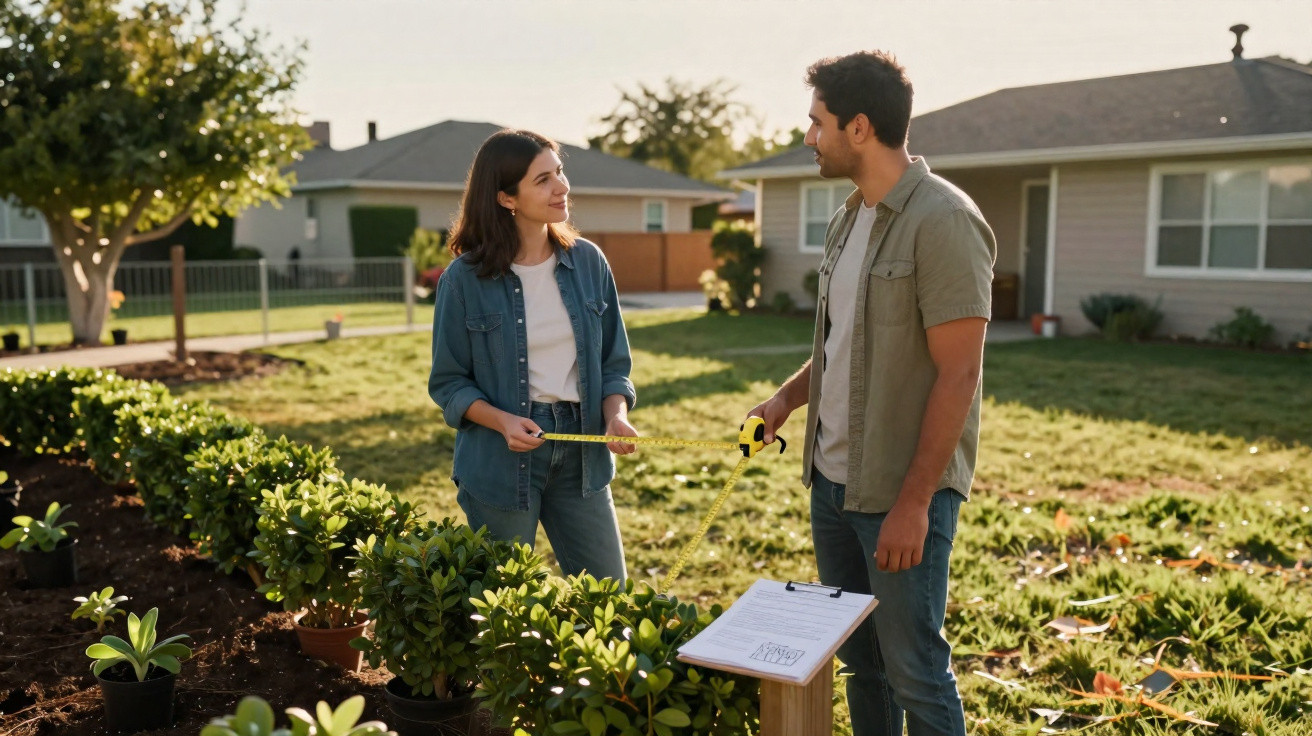
Planting right up against the boundary can quickly ignite a neighbourly row.
Plenty of homeowners start digging with the best intentions, not realising that a few centimetres can shape their relationship with the people next door for years. For hedges along a property boundary, there are clear expectations on distance, height and upkeep. Ignore them and you may end up in arguments, paying for costly reductions, or even facing legal proceedings.
Why boundary hedges so often lead to disputes
Hedges and trees on the boundary can look like a harmless bit of greenery, but they touch several sensitive issues at once: privacy, daylight, safety and money. A tree that turns a patio gloomy, or roots pushing their way beneath a fence, can trigger resentment very quickly.
Common flashpoints include:
- Ongoing shade across a terrace, balcony or living room
- Roots that damage paving, fences or underground services
- Branches that extend over the line or could fall into the neighbouring garden
- Leaves, blossom or fruit regularly ending up on the neighbour’s side
- Noise nuisance from birds or from leaf blowers because frequent trimming is needed
“Anyone who plants directly on the boundary interferes with how the neighbouring plot can be used – and that takes you into a legally sensitive area.”
The basic rule: distance and height go hand in hand
At heart, neighbour law follows a straightforward idea: the taller the plant, the further it should be from the boundary. Many sets of rules-whether in the German Civil Code (Bürgerliches Gesetzbuch) or in the state neighbour-law statutes (Landesnachbarrechtsgesetze)-use a similar stepped approach.
Typical distance rules for hedges and trees
In many regions of Germany, the rough logic tends to look like this (the exact figures can vary by federal state):
- Up to around 2 metres in height: very small distances to the boundary are often allowed, commonly about 50 centimetres
- Above 2 metres: a much larger setback is required, often around 2 metres or more
What matters is not how tall the plant is on the day you put it in, but how tall it is expected to become. If you set a small tree that stands 1.50 metres now but reaches 6 metres after a few years, you cannot rely on the original size.
“What counts is the eventual height – not the cute starter size in the planting container.”
How do you measure correctly?
To prevent arguments about measurements becoming the next argument, the rules generally stick to clear reference points:
- Height: measured from the natural ground level to the top of the plant
- Distance: measured from the centre of the trunk or the centre line of the hedge row to the property boundary
If a plant is set further back than the minimum required distance from the boundary, the ultimate height is often largely unrestricted-meaning there is usually no fixed maximum height, provided it does not create an exceptional nuisance.
Shared hedge, shared responsibility
A special case is a hedge planted directly on the boundary line. Legally, this is often treated as a so-called shared hedge, belonging to both neighbours, along with the associated obligations.
In practical terms, that means:
- Both neighbours are responsible for maintenance and trimming.
- Costs for care and pruning can usually be split.
- Major changes-such as removing it entirely-should be agreed jointly.
Trees trained as espalier against a shared wall also crop up regularly as a cause of friction. They are usually permitted on the wall itself, so long as they do not significantly overtop the wall coping or damage the structure.
Before you plant: confirm the boundary and check the rules
If you want to avoid hassle, establish the facts first-then reach for the spade and the shears, not the other way around.
1. Establish the property boundary beyond doubt
Boundary stones are often overgrown or missing altogether. If you are not certain, you should:
- check older building or surveying documents
- if in doubt, instruct a surveyor to re-mark the boundary
- never base permanent planting on a “best guess” boundary line
2. Check local regulations
Alongside the German Civil Code, municipal rules and state-level provisions can be relevant. Depending on where you live, these may include:
- local development plans and municipal by-laws
- rules for new-build areas or housing estates
- the neighbour-law statute for your federal state
Some municipalities, for example, set minimum distances from public footways or ban tall screening hedges on street corners for road safety reasons.
3. Speak to your neighbour-before the first spadeful
A quick chat often prevents years of bad feeling. Bringing your neighbour in early can help you, for instance, to:
- agree a shared hedge
- record written consent for specific planting distances
- broadly agree target heights and trimming intervals
“A half-hour chat at the garden fence often prevents a legal dispute that drags on for years.”
Which plants suit planting near the boundary-and which do not
Even perfect knowledge of the rules is of limited use if the plant choice is impractical. Some species stay manageable; others spread aggressively above or below ground.
Easy-to-manage species
- Cherry laurel, privet, hornbeam: form dense growth, take well to trimming, and suit low to medium hedges.
- Field maple, hawthorn: remain relatively compact and work as small trees or looser hedging.
With regular pruning, these can often be kept near the boundary and below the critical 2-metre threshold.
Problem plants at the boundary
- Poplars, willows: extremely vigorous root systems that can threaten foundations, services and fences.
- Giant conifers such as some thuja varieties: shoot up quickly, block daylight and cast heavy shade.
- Bamboo without a rhizome barrier: spreads underground and can suddenly appear in the neighbour’s garden.
These species should clearly be planted well away from the boundary or require special containment measures.
Who has to prune-and what can the neighbour do?
As a general rule, responsibility sits with the owner of the hedge or tree. They must maintain their plants so that they do not unreasonably interfere with the neighbouring plot.
Overhanging branches
If branches extend over the boundary, the affected neighbour can in many cases demand that they are cut back. In most situations, they are not allowed to do the cutting themselves; instead, they must ask the owner to prune. If the owner fails to act for a prolonged period, a claim for removal can arise, which can ultimately be enforced through the courts.
Roots, runners and shoots
Roots, climbing growth and underground runners that spread into the next garden are treated differently. Many rules allow the neighbour to cut these back at the boundary if they cause nuisance or damage.
“Branches belong to the tree’s owner, but troublesome roots and runners can often be cut back by the neighbour directly at the boundary.”
What to do if a hedge or tree causes a dispute
Even with care, conflict is still possible. Following a sensible sequence helps stop matters spiralling.
- Open a conversation: stay factual and name the specific issue (shade, mess, danger).
- Set a deadline: ask politely in writing for pruning or adjustment.
- Send a formal letter: if nothing happens, write by recorded delivery and refer to the applicable rules.
- Use mediation/conciliation: in many federal states, an attempt at conciliation is required before you can sue.
- Court as a last resort: only when all other steps fail does the matter end up before the local or regional court.
If things become serious, photos, survey results, letters and quotations for pruning work can serve as evidence that you tried to resolve the problem fairly.
Historic rights, established planting and special cases
Not every long-standing hedge automatically has to be moved back. Many legal systems recognise exceptions, for example where:
- the planting existed before the plot was subdivided
- the hedge or tree has stood for decades without objection
- neighbours have accepted different distances in writing or through clearly provable oral agreement
Situations like these can mean boundary distances are no longer enforceable. If you take over a property with existing planting, it is worth finding out early how long it has been there and whether any earlier agreements were made.
Practical tips for a peaceful garden at the boundary
Finally, a few hands-on pointers from everyday practice:
- Plan lower where possible: a 1.80-metre hedge usually gives plenty of privacy and avoids many conflicts from the outset.
- Consider width as well: it is not only height that matters, but how wide the hedge becomes and whether it still stays within your own land.
- Agree trimming dates if your neighbour is sensitive to noise.
- When planting a hedge together, draw up a written note with your neighbour if there is any doubt.
If you understand the legal requirements, choose plants deliberately and keep a good line of communication with next door, you gain twice over: an attractive green boundary to your plot-and a calmer day-to-day life alongside it.



Comments
No comments yet. Be the first to comment!
Leave a Comment