
The answer is below ↓
Specifically in France
- In France, householders’ green waste is classed as household waste, and disposing of it by burning it in the open air is generally prohibited, including in rural areas.
- Local rules may strengthen or clarify this framework: check with the prefecture and the town hall, particularly during droughts or periods of wildfire risk.
- Legal options normally include the recycling centre, collections organised by the municipality or intermunicipal authority, and shredding the material for mulch.
- Beyond the fine, a fire that spreads or disturbs neighbours can lead to far more serious civil or criminal consequences.
Key points
- Burning green waste at the bottom of your garden remains banned in most circumstances, even in the open countryside, with a fine of up to 750 euros.
- Green waste is treated as household waste; disposing of it through open-air burning is prohibited because it causes pollution and creates fire risks.
- Alternatives are available: recycling centres, seasonal collections, shredding sites, shredder hire, or turning it into mulch.
- The ban is governed by departmental health regulations and local rules issued by the prefect or mayor, rather than simply by the distance from homes.
Timeline
- 2024: Several departments affected by early drought tightened restrictions on fires, with more visible checks during high-risk periods.
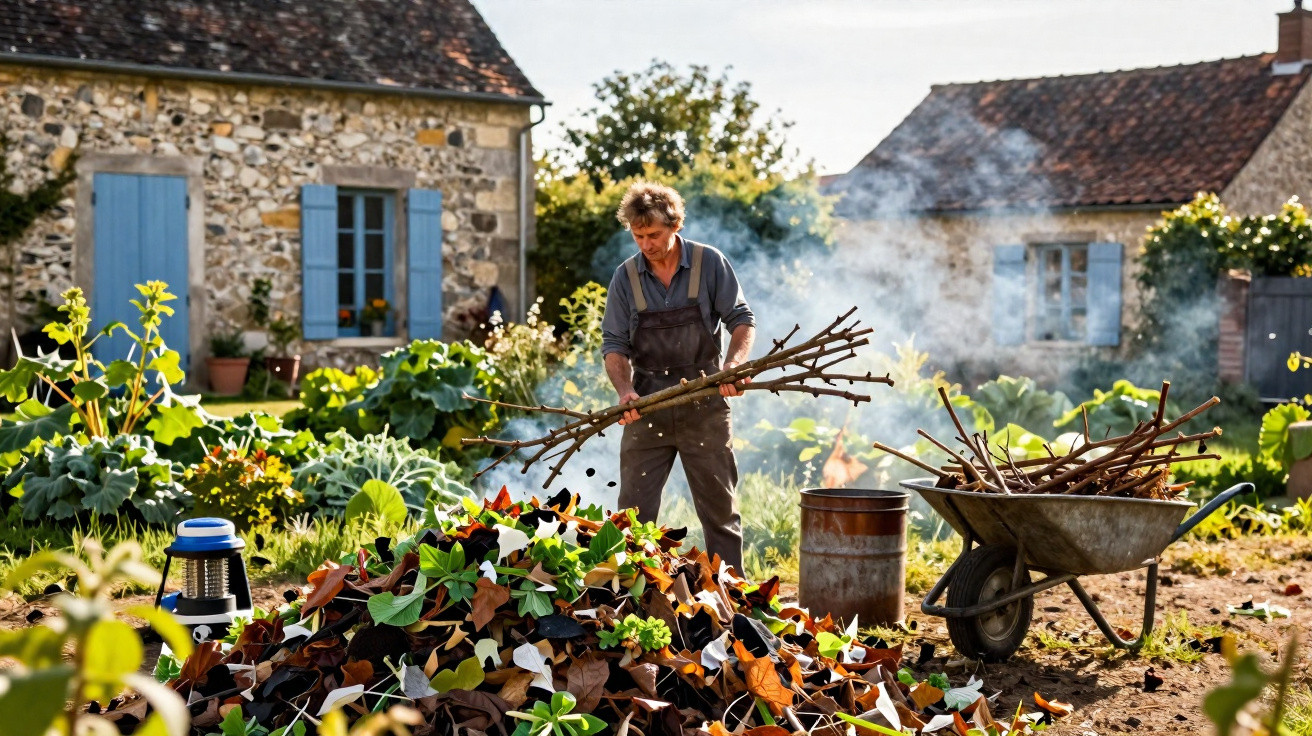
On a Saturday morning, once the hedges have been cut back, the pile of branches can soon become daunting. At the end of the garden, well away from the neighbours, some people may think that a small fire would solve the problem within an hour, accompanied by the almost familiar country smell of wood and damp leaves. Yet this seemingly ordinary act can be costly: burning green waste is prohibited in the vast majority of cases, even among open fields. The fine can reach 750 euros, and the risk extends well beyond your wallet. Toxic smoke, a fire breaking out, a dispute with neighbours… a quiet weekend bonfire can quickly turn into a very bad idea. The countryside is not outside the law. It is a rule that many people discover rather late.
Garden fires: a habit that persists in villages
We all know the moment when bags of grass cuttings pile up by the gate and cut brambles seem to return faster than they can be removed. In many villages, lighting a garden fire remains an old custom, passed on without harmful intent: people used to burn prunings from fruit trees, fallen leaves and dry grass, often at the end of winter. The issue is that the rules have changed, while practices have sometimes lagged behind. Green waste is now regarded as household waste. As a result, disposing of it by open-air burning is, in principle, prohibited.
The frequently mentioned figure is no myth: anyone who burns garden vegetation may face a fixed-penalty fine of up to 750 euros. Living in a rural municipality does not remove that rule. In 2024, orders in several departments affected by early drought even tightened restrictions on fires, with more noticeable inspections during periods of risk. A pile of branches that looks modest can create a very thick cloud of smoke, especially when the vegetation is wet. And once a neighbour calls the town hall or the fire brigade, the matter quickly stops being private.
The reasoning is straightforward: open-air burning does not dispose of vegetation cleanly; it turns part of the problem into pollution. Smoke contains fine particles and various irritating compounds, particularly when the pile includes soil, wet plants, cardboard or forgotten pieces of plastic. People with asthma, children and elderly neighbours are more vulnerable to it. There is also a fire hazard, even after recent rain. An ember can remain alive beneath a mound of ash and flare up again with a gust of wind. Let us be honest: nobody really does this every day, but a single lapse is enough.
What the rules say, and exceptions not to assume
Before lighting anything, the safest first step is to look at the options available locally. Recycling centres generally accept green waste, sometimes without any particular limit for householders, while many intermunicipal authorities arrange seasonal collections or provide shredding sites. A planned trip with a neighbour can sometimes avoid several journeys. Some rural municipalities also offer shredder hire or loans. Branches can then be turned into mulch, useful around hedges, rose bushes or on paths. It is less dramatic than a fire, but far more practical in the long run.
A common mistake is to believe that a fire is permitted as long as nobody is nearby, the weather is cold or the vegetation came from the garden. The reasoning is understandable: plots are large, habits are longstanding and smoke seems to disperse into the landscape. However, the prohibition is not based solely on the distance from houses. It is governed in particular by departmental health regulations and local rules introduced by the prefect or mayor. Exemptions may exist in tightly controlled circumstances, for example where no collection solution is available or where certain health obligations apply. They cannot be guessed at: they must be confirmed with the town hall.
A call to the municipal reception desk, or a visit to the prefecture’s website, can prevent a great deal of trouble. Officials often put it very plainly:
“If you are unsure, assume burning is prohibited until a local authorisation has been confirmed.”
The easiest options are often close at hand:
- take grass cuttings and branches to the recycling centre;
- shred prunings to make mulch;
- compost leaves, faded flowers and small cuttings;
- ask which collection days are scheduled in your municipality.
Composting requires a little patience, but it gives the soil back what the garden has provided.
Turning green waste into a resource rather than smoke
The real change often happens in an unobtrusive corner of the garden, behind a shed or near the vegetable plot. Fallen leaves become excellent compost material, small twigs can be used as ground cover, and grass cuttings can be dried before being spread in a thin layer. This is not a technique reserved for expert gardeners. With a few regular habits, the amount of waste that needs to be taken away falls sharply. Hedges also benefit from being cut outside nesting periods, allowing the work to be spread out rather than creating a mountain of vegetation in a single day. The garden breathes more easily, and so does its owner.
| Key point | Detail | Benefit for the reader |
|---|---|---|
| Burning prohibited | Green waste from a garden is treated as household waste. Burning it in the open air is prohibited in most situations, even on an isolated plot or in the open countryside. | Avoid a fine of up to 750 euros, as well as a fire brigade call-out or a lasting dispute with neighbours. |
| Local exemptions | Very limited exceptions may be set out in prefectural or municipal orders, depending on available collection facilities and the health or agricultural context. | A simple enquiry with the town hall reveals the applicable rule without relying on village rumours. |
| Useful solutions | Shredding, mulching, composting, taking waste to a recycling centre and organised collections provide practical alternatives for leaves, grass cuttings and hedge prunings. | Cut down on journeys, nourish the soil and keep the garden tidy without smoke, lingering odours or the risk of a fire spreading. |



Comments
No comments yet. Be the first to comment!
Leave a Comment