
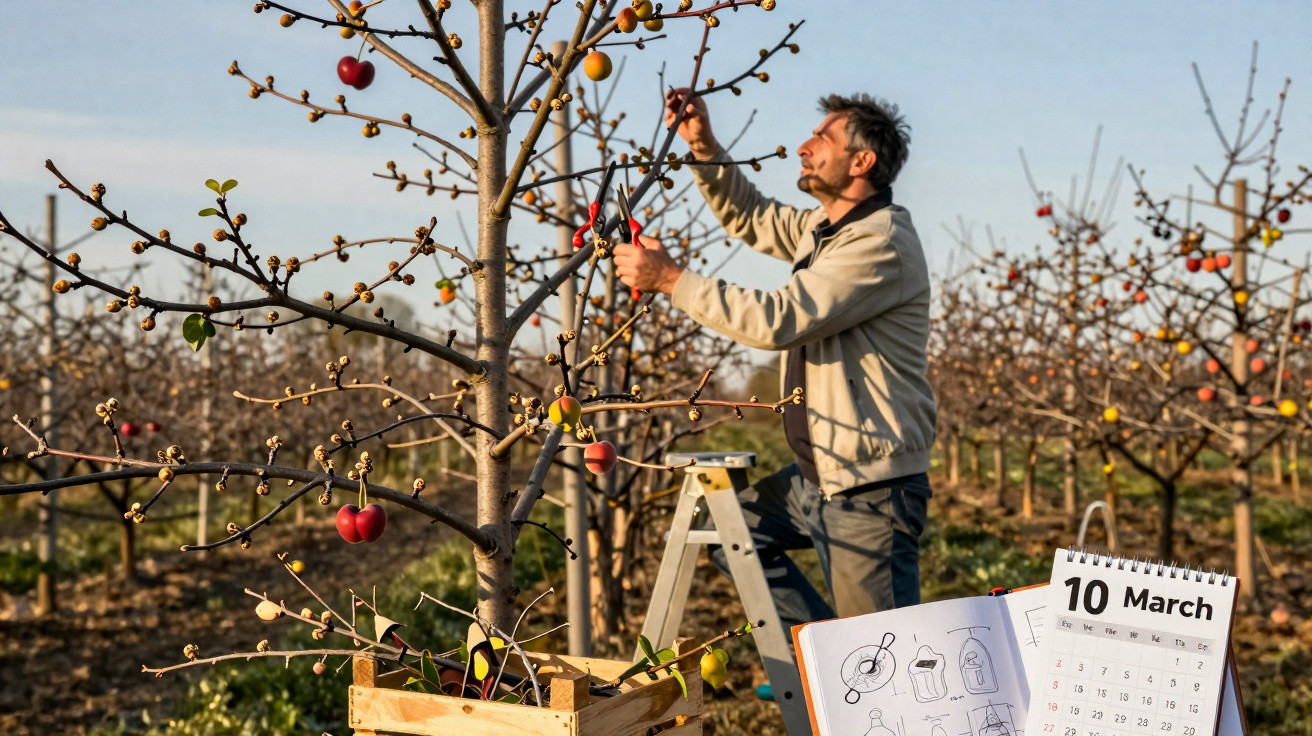
If you spend March simply longing for the first blossoms, you often miss the crucial moment in the orchard. Right now, in the final weeks of winter, apple, pear, peach and cherry trees set themselves up for a strong, healthy crop. One single slip can mean your baskets are far emptier in summer than they need to be.
Why the period up to 10 March matters so much
March acts as a hinge between winter dormancy and active growth. In many areas, sap flow begins to rise noticeably during this time. If you pick up the secateurs early enough, you make the most of this narrow window: trees can seal pruning cuts more quickly, waste less energy on unproductive shoots, and repay the care with vigorous growth and improved fruit set.
"If you prune your fruit trees too late - or not at all - you risk fewer fruits, more diseases, and a tangled mess of branches instead of a stable crown structure."
Up to around 10 March, apple, pear and peach can still be pruned ideally in most locations. Buds are already clearly visible, but the trees are not yet in full sap flow. That reduces stress and makes wound healing easier.
The four key fruit trees in late winter
Apple and pear trees: classics that need pruning
Apple and pear trees fruit on so-called spurs - comparatively short, thick little branches. Without regular pruning, these fruiting spurs age, the crown becomes overcrowded, and the fruit stays small and shaded.
From February through to early March, the focus is mainly on fruiting-prune maintenance:
- remove dry, dead branches without compromise
- cut out diseased or badly damaged sections back to healthy wood
- thin out steep water shoots that rocket straight upwards
- open up congested areas so that light can reach deep into the crown
The aim is a strong, light-filled crown with evenly spaced main limbs. This allows the tree to channel its energy into fewer, better-quality fruits.
Peach tree: cropping depends on young wood
Peach behaves differently from apple and pear. It produces fruit mainly on the previous year’s growth. If pruning is skipped, old wood takes over and the harvest drops sharply.
Late winter is the ideal time to set things up for the coming season:
- reduce part of the older growth hard, or remove it entirely
- keep vigorous one-year shoots with clearly visible buds as the fruiting wood
- shorten overly long shoots moderately so they do not snap under the weight of the crop
Peach trees respond very well to this rejuvenation prune: they push strong new growth in spring and form fresh fruiting wood that delivers a generous harvest the following year.
Cherry tree: an exception with sensitive reactions
With cherry trees, the “spring equals pruning time” mindset can quickly lead to a mistake. Unlike apple, pear and peach, cherry often reacts to heavy winter or late-winter pruning with gumming, poor wound closure and a higher susceptibility to fungal diseases.
"Cherry trees tolerate heavy cuts in winter far worse than a summer prune straight after harvest."
A handful of very small corrections can be done as winter fades, but the main maintenance prune belongs in summer. After harvest, cuts are smaller, temperatures are gentler, and the tree closes pruning wounds more quickly.
Basic rules for a clean fruit-tree prune
No matter which species you are pruning, a clear method helps prevent mistakes. A few straightforward principles go a long way:
- Clean, sharp tools: Well-sharpened loppers or a sharp hand saw leave smooth cut surfaces that heal faster.
- Remove diseased wood decisively: Blackened, rotten or fungus-affected sections should be cut back into healthy wood.
- Make the crown more open: Branches that cross, rub, or grow inwards weaken each other. Reduce them or remove them altogether.
- Cut above an outward-facing bud: This guides new growth outwards and stops the centre from becoming a dense tangle.
After major work on older trees, it is worth checking the structure: if a branch carries a heavy load of fruit in summer, it must not be left too long and unsupported. If needed, use props or prune back a little more firmly.
Why early pruning benefits the trees
If you use the window up to roughly 10 March, you give your fruit trees several practical advantages:
- Fast wound healing: Trees enter the pruning period while sap flow is still relatively low, and they can close cuts before fungi and pests become fully active in spring.
- More purposeful energy use: Rather than pouring energy into masses of unproductive water shoots, the tree concentrates on sturdy growth and fruiting wood.
- Lower disease pressure: An airy crown dries more quickly after rain, fungal spores have poorer conditions, and sunlight reaches more leaves and fruit.
"A well-pruned tree is not only more productive, but usually also far longer-lived and more stable in storms and under snow load."
Practical tips for choosing your pruning day in the orchard
- Do not prune in wet weather or hard frost: Damp conditions encourage fungal infection, while severe frost makes wood brittle and can cause cuts to tear.
- Disinfect tools between trees: A cloth with alcohol or an appropriate spray is enough to avoid carrying pathogens from one tree to the next.
- Protect large wounds: On very thick limbs, a wound sealant can help shield the edges of the cut from moisture and fungi.
If you are pruning several trees in one day, start with the healthiest specimens. Leave clearly weakened or already infected trees until last to reduce the risk of spreading disease.
Common mistakes that can cost you the harvest
Many gardeners hesitate out of uncertainty - and end up doing more harm than a confident prune would have caused. Several classic pitfalls are easy to avoid:
- only snipping the very tips of shoots, which makes the tree “puff up” rather than improving structure
- cutting the branch collar flush to the trunk instead of leaving the slight swelling that supports wound closure
- leaving old, dark fruiting wood on a peach tree and giving away potential yield
- cutting cherry trees back hard in the depths of winter and triggering gumming
Pruning fruit trees does take a little courage. If you are unsure, watch closely the following year to see where the tree flowers and fruits. With each season, you build a better feel for which shoots should stay and which should go.
Helpful terms explained briefly
Fruiting wood: This is the growth on which a tree forms blossoms and, later, fruit. On apple and pear it is often short, knobbly spur growth; on peach it is more commonly one-year long shoots.
Water shoots: These steep, upright shoots often appear from older wood after a hard cut back. They may look strong, but they usually crop poorly and simply thicken the crown.
How the right pruning pays off over the long term
If you prune your fruit trees consistently over several years - firmly, but not obsessively - you will quickly notice a double benefit: yields become more reliable, and ongoing maintenance work decreases because fewer diseased or unstable branches need corrective follow-up. Especially with older trees, a plan over several seasons is worthwhile: do not try to fix everything in one year; reshape the crown step by step into a stable form.
Combined with suitable fertilising in spring and controlled watering during dry spells, this creates a robust little fruit haven in your own garden. The key is surprisingly often these few decisive weeks before spring - and not putting pruning off indefinitely.

Comments
No comments yet. Be the first to comment!
Leave a Comment