
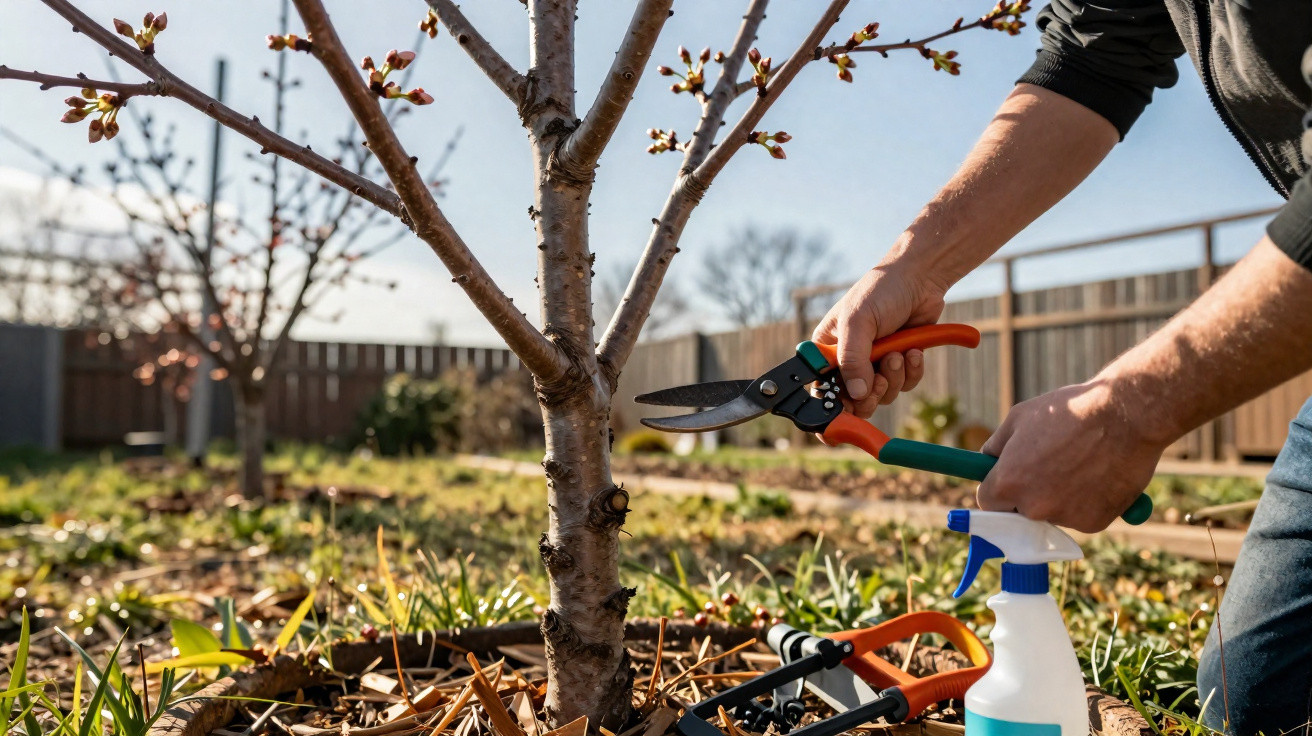
If you want to pick baskets of plump, juicy cherries in June and July, the work starts now-between the end of winter and the first signs of spring. Not with pricey fertiliser, but with a deliberate bit of pruning that earlier generations carried out as a matter of course on every cherry tree. It won’t cost you a penny-just a little time-and it helps the tree put its energy into fruit rather than pointless shoots.
The right moment: why the cherry tree is decided now
A cherry tree runs on a steady annual cycle. Just before the buds properly open, the tree is already working flat out internally to prepare leaves and blossom. That short window is when you can most strongly influence the harvest to come.
A window of just a few weeks: act just before bud break
The best time is late winter through to very early spring. Sap is beginning to rise, but foliage hasn’t yet hidden the branches. You can still see the full framework of the tree and make precise choices.
"If you thin the cherry tree now, you direct its strength into flower buds-and therefore into the summer cherry harvest."
Leave it too late and the tree has already spent a great deal of energy on leaves and unproductive new growth. Any heavy pruning done after that point adds stress and can noticeably reduce fruiting.
First step: ‘read’ the tree like a doctor
Before you reach for the secateurs, walk slowly around the tree and study it from every angle. Picture an invisible roof where light should be able to fall through into the canopy.
- Is the inside of the crown very dense and tangled?
- Can you see lots of branches growing across and through each other?
- Does the centre look like a dark knot with little air and light?
If you’re thinking “yes”, the cherry tree is overcrowded. In a packed canopy, moisture doesn’t dry out well. Fungal diseases can take hold easily, and blossoms and fruit inside the crown get too little sun-so they stay small or fail altogether.
The old gardener’s trick: remove internal troublemakers without hesitation
The essence of the old know-how is simple: a cherry tree only crops heavily when air and light can reach right into the middle of the crown. To achieve that, two types of growth must be removed consistently: branches that cross and rub, and so-called water shoots (often referred to as vigorous suckers).
Crossing branches: rubbing, wounds and hotspots for disease
Look into the crown: wherever two branches scrape against each other or even hook together, abrasion marks develop. Those open patches are perfect entry points for fungi and bacteria.
Rule of thumb: when two branches compete in the same space, only one stays. Cut out the weaker one, the poorly positioned one, or the shoot that grows more towards the centre. This opens the crown and significantly lowers disease risk.
Water shoots: strong energy thieves, poor croppers
These shoots are the quiet cause of disappointment in many cherry trees. They grow steeply upwards-often straight from the trunk or from thick scaffold branches-and they’re long, smooth and extremely vigorous.
"Water shoots look full of life, but they produce little to no cherries-they only steal energy."
Rather than shaping the canopy and carrying fruit, these shoots siphon off a large share of nutrients. The result is that fruiting branches receive less, and blossom and yield remain meagre.
Cut these shoots off as close as possible to their point of origin. Don’t leave stubs behind, as they often reshoot and create the same problem again.
Clean cuts: how the cherry tree copes well with pruning
Cherry trees can be sensitive to rough or incorrect cuts. If you hack away, you invite disease and rot at the wound. If you cut with precision, you support the tree’s ability to seal and heal.
Tools like a surgeon’s: sharp and disinfected
Before you start, get your tools in order. Blunt blades tear the wood and leave larger wounds that close slowly.
- Sharp hand pruners or bypass secateurs for thinner shoots
- A pruning saw or folding saw for thicker branches
- Alcohol (70–90%) to clean blades between different trees
A quick wipe over the cutting edges is enough to avoid carrying pathogens from one tree to the next. Without it, many fungi and bacteria are spread invisibly with every cut.
The ideal cut: just above an outward-facing bud
Make the cut a few millimetres above a bud that points outwards. Hold the blade at a slight angle so rainwater can run off the cut surface.
"Every cut sets the direction of growth: an outward-facing bud encourages an open, light-filled crown."
Always remove larger branches in two stages: first shorten further out to take the weight, then make the final cut cleanly at the branch collar (the small swelling at the base). This prevents the branch tearing away and ripping the bark deeply.
What changes inside the cherry tree after pruning
After thinning, the tree can look a bit “bare” at first, which often alarms home gardeners. This is exactly where the old lesson proves itself: less wood, more cherries.
Less leaf growth, more energy for blossom
With fewer shoots to support, the cherry tree has fewer “consumers”. The nutrients available are spread across less growth and are channelled more strongly into the buds that actually set fruit.
- The remaining blossoms develop more robustly.
- Fruit reaches its variety-typical size more easily.
- Colouring improves because more light reaches the inner crown.
At the same time, airflow improves. Morning dew and rain dry faster, which greatly reduces fungal issues such as Monilia or leaf spot.
Light and air: the invisible fertiliser duo
Where shade used to dominate, sunlight can now reach the centre of the tree. Leaves work more efficiently when well lit and produce more sugars for the fruit. Wind can move through the canopy and carry moisture away more quickly.
"A well-ventilated cherry tree needs far fewer sprays-often none at all."
Traditional orchards relied heavily on this effect. With skilful pruning, they kept trees healthy long before modern chemicals existed.
What else you can do for strong cherry trees
Pruning is the decisive intervention, but a few other straightforward steps help keep the tree resilient over the long term.
Soil care and mulch around the trunk
Cherry trees prefer soil that is loose and well aerated. Lightly loosening the surface around the trunk and adding a thin mulch layer of chipped branches or leaves helps retain moisture and feeds soil life.
Important: don’t pile mulch directly against the trunk, or the bark at the base can rot. Leaving a gap of a few centimetres is enough.
Be cautious with extra fertiliser
Too much nitrogen-such as heavy applications of lawn fertiliser close to the trunk-mainly drives leafy growth and water shoots. The outcome is plenty of green and few cherries.
- When in doubt, feed sparingly.
- Work in compost lightly; don’t heap it on.
- On very poor soils, use an organic fruit-tree fertiliser in a targeted way.
Common mistakes-and how to avoid them easily
Many misconceptions about cherry trees come from the fear of cutting “too much”. In practice, the greater harm is usually the opposite: not pruning at all, or only doing it timidly.
Cutting back too hard into old wood
If thick branches are shortened drastically, the tree often responds by producing masses of new water shoots. It reacts to the shock with vigorous regrowth. A better approach is gentle thinning regularly, rather than chopping it back hard every few years.
Only ‘topping’ the outside of the crown
Many people prune as if they were trimming a hedge, removing only the outer tips. That simply pushes the problem inward: the crown stays congested, the outer shell becomes even denser, and hardly any light gets in.
"The most important work happens inside the crown, not just on the silhouette."
Focus on crossing branches, inward-growing shoots and water shoots. The outer shape will then largely take care of itself.
Why this traditional pruning matters more than ever today
At a time when many people want to avoid chemical treatments, this simple skill is coming back into focus. With a handful of deliberate cuts, you create a stable balance between growth, health and yield.
If you watch your cherry tree year after year, you quickly learn how it responds to pruning. Over time it becomes a quiet kind of dialogue: the tree shows, through its growth, what helps it; you reply with secateurs and saw. And the reward is exactly the scene everyone hopes for: a summer garden, children with red-stained mouths, and a bowl of home-picked cherries on the table.

Comments
No comments yet. Be the first to comment!
Leave a Comment