
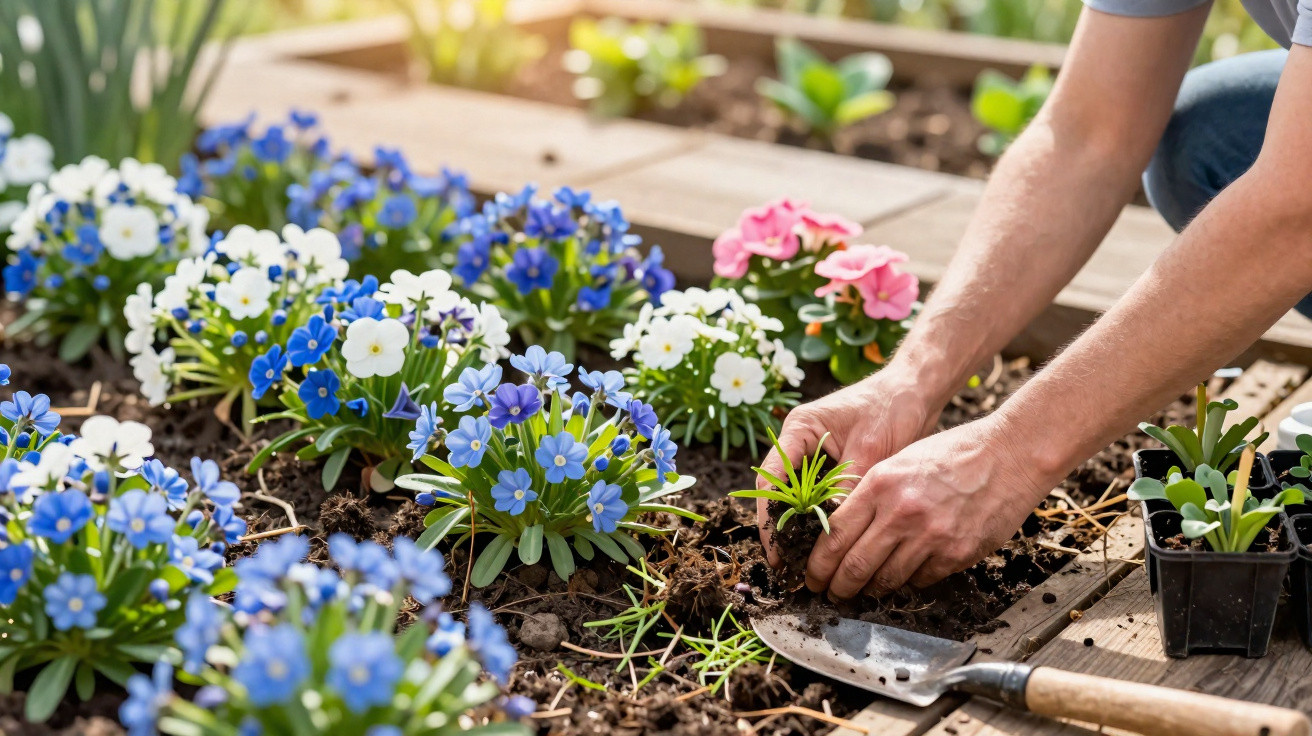
As soon as spring shows itself, many hobby gardeners recognise the pattern: buckets fill up with pulled greenery, and after two showers the whole lot is back again. Rather than spending every weekend on their knees, more and more garden owners are choosing a different approach-planting hardy, low-growing perennials that cover the soil seamlessly and simply crowd out unwanted weeds. March is an ideal moment to get started.
Why weeds keep coming back
Anyone who thinks one thorough weeding session will solve the problem is mistaken. In the soil sits a huge reserve of weed seed-an invisible "seed bank". Give it a little light and moisture, and the next wave germinates.
A common mistake is to loosen the soil deeply and pull everything out indiscriminately, which brings even more seed up to the surface. The result is predictable: within a few weeks the bed looks much the same as before.
"Any bare patch in a bed is an invitation to weeds-the simplest protection is to keep the soil covered permanently."
Annual and perennial weeds: two different jobs
Not every "weed" behaves in the same way. If you know what you are dealing with, you can plan more effectively:
- Annual species such as chickweed or purslane germinate, grow, flower and set seed within a single season. They are short-lived, but they produce vast quantities of seed.
- Perennial troublemakers such as dandelion or cleavers form deep roots and will return again and again from the smallest remaining fragments.
Annuals are best dealt with by slicing them off just above the surface using a sharp hoe. The key is not to hack deeply, so you do not drag fresh seed up into the light. For deep-rooted perennials, only careful digging out will do-ideally when the soil is moist, so as much root as possible comes away.
Living mulch: ground cover as a natural weed barrier
Instead of fighting constantly, you can turn the tables: fill bare ground early with perennials and you deny weeds both light and space. Gardeners call this "living mulch"-a closed plant layer that protects the soil and looks attractive at the same time.
"Living mulch works like a plant carpet: cool, shaded, moist-and an uncomfortable place for weed seeds."
The benefits of these ground-cover plants go well beyond saving effort:
- They shield the soil from the sun and reduce drying out.
- Raindrops do not hit bare earth directly, so erosion is reduced.
- The soil’s microclimate becomes more stable, and soil life and earthworms thrive.
- Many species provide insects with early nectar and pollen in spring.
These perennials cover the soil in March
Planting in March gives the plants the whole growing season to spread. The crucial point is choosing varieties that suit the site.
Brunnera: spring blue for part-shaded corners
A standout among ground-cover plants is Brunnera macrophylla, often known as Caucasian forget-me-not. This perennial forms heart-shaped leaves and produces countless small, sky-blue flowers in spring that resemble forget-me-nots.
Garden experts value Brunnera for several reasons:
- It quickly forms dense clumps that let very little light reach the soil.
- It flowers for many weeks-from mid-March through into May.
- It copes well with partial shade and shade, making it ideal beneath shrubs and trees.
- Once established, it needs only occasional watering and minimal maintenance.
Mixing different cultivars with pale-patterned or silvery foliage can also create striking light effects in a shade border.
Other tough ground-cover plants for March
Brunnera is not the only choice. Here is a selection of proven ground-cover plants that suit planting in March:
| Plant | Position | Notable feature |
|---|---|---|
| Purple bugle (Ajuga reptans) | Partial shade to sun | Purple foliage, blue flower spikes, very tolerant of light foot traffic |
| Lesser periwinkle (Vinca minor) | Shade to partial shade | Evergreen, blue or white flowers |
| Creeping phlox (Phlox subulata) | Sunny | Early flowering carpet in pink, white, violet |
| Stonecrops / Sedum species | Sunny, dry | Extremely low-maintenance, ideal for poor soils and wall tops |
| Sweet woodruff (Galium odoratum) | Shady, humus-rich | Scented leaves, white starry flowers, spreads quickly |
Important: not every plant fits every spot. Strongly spreading species are better for areas that really can be allowed to knit together completely-for example under trees or in awkward corners where you rarely work.
How to plant in March, step by step
For living mulch to do its job, a little preparation pays off. A straightforward guide:
- Prepare the soil: On a dry (but not parched) day, remove existing weeds as completely as possible. With perennial weeds, watch for leftover root pieces.
- Loosen only at the surface: Lightly rake or cultivate the top layer without digging deep. This keeps most of the "seed bank" down below.
- Work in compost: A thin layer of mature compost improves structure and nutrient supply, especially on sandy soils.
- Plant close together: Ground-cover plants go in more densely than typical perennials. Depending on the variety, 6–9 plants per square metre helps the foliage close over quickly.
- Do not skip watering in: Water thoroughly after planting, and keep moisture even during the first few weeks.
"The first season is decisive: if you water regularly in the planting year and remove the few weeds that remain, you will have almost peace in the years that follow."
How much care does a living carpet of flowers need?
Ground cover does not mean zero work, but the workload shifts. Instead of constant pulling, you mostly just keep an eye on things.
In the first months after planting, you may still see individual weeds appearing between young perennials. They are easy to remove while the planting has not yet fully closed. After one to two years, maintenance usually comes down to:
- occasionally trimming back spent stems,
- restraining or thinning species that spread too strongly,
- watering during prolonged dry spells, particularly on light soils.
Leaving a thin layer of fallen leaves in autumn supports the natural cycle: the leaves break down between the plants and feed the soil. Only thick, airless mats should be removed or chopped up.
Typical mistakes when using ground-cover plants
To make the plan of "garden instead of weed field" work, it helps to avoid the most common pitfalls:
- Planting too far apart: If spacing is wide, weeds exploit the gaps. Set plants a little closer.
- Choosing the wrong position: Shade plants scorch in full sun; sun lovers struggle in deep shade. Take label guidance seriously.
- Over-complicated mixed planting from day one: If you combine lots of species immediately, it is easier to lose track. Start with two or three robust foundation perennials.
- Ignoring established root weeds: Bindweed or ground elder should be removed as thoroughly as possible before planting, otherwise they will push up through the carpet.
How living mulch changes the garden long term
Many people who commit to ground-cover plants quickly notice the overall maintenance approach changing. Rather than continually "working" new bare patches, you build dense, stable planting pictures. Borders look calmer, and wet spells are less daunting because everything is not instantly overrun afterwards.
At the same time, there is an ecological gain. Flower-rich carpets attract wild bees and hoverflies, while dense leaf cover protects small organisms. In dry summers, perennials and shrubs benefit from shaded soil and improved moisture retention.
If you are unsure, start with a small area: a perennial bed, a strip along a fence, or the bare ground beneath a tree. If the idea works there, you can expand it year by year-until the former "weed battlefield" becomes an easy-care, flowering garden floor.


Comments
No comments yet. Be the first to comment!
Leave a Comment