
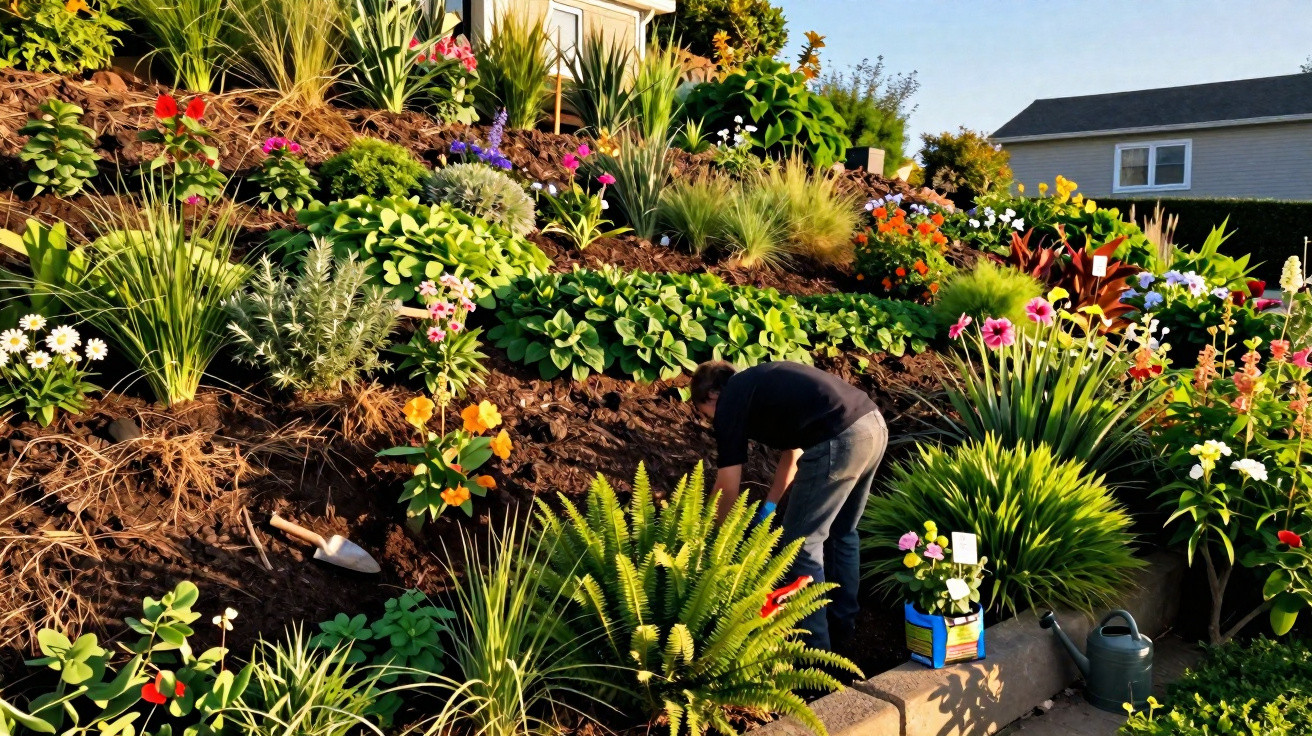
A single good planting concept can completely change how a slope looks - and how it behaves.
Rather than spending a fortune on concrete and retaining walls, more and more professionals are relying on smart planting. Done properly, it reinforces the soil, slows down rainwater run-off and turns a bare bank into a flowering cascade - for under €20 per square metre.
Why a planted slope is often better than a concrete wall
When homeowners first see a slippery, unstable bank, they often jump straight to quotes for expensive walls. Yet there’s a more affordable - and far more lively - approach. The principle is simple: it’s not concrete that holds the slope in place; it’s the plants’ root network.
"With carefully chosen groundcover plants, shrubs and perennials, a slope can be stabilised, greened and visually enhanced - for less than €20 per square metre."
Fine roots thread through the ground and act like a three-dimensional mesh. Rain no longer hits bare soil head-on; leaves and stems break the impact. Water can then soak in gradually instead of carving channels into the bank or rushing towards the house foundations.
At the same time, you create a small biotope: insects, birds and soil life gain food and shelter. In summer, the soil stays damp for longer and doesn’t dry out as quickly. Many gardeners notice after a year or two that the slope actually takes less effort than a traditional lawn.
Phytostabilisation: how plants anchor a slope
Professionals refer to a “phytostabilised slope”. It sounds technical, but the idea is surprisingly straightforward. Groundcovers and tough perennials form dense root cushions that branch out and quite literally bind the soil together.
Typical choices include creeping Hypericum varieties (St John’s wort), Cotoneaster, periwinkle, moss phlox, cushion-forming perennials and low shrubs. They spread quickly, close gaps and help prevent soil being washed away during heavy rain.
"The trick isn’t a miracle mix, but the combination: ground-hugging cover plus taller accents, arranged in tiers from top to bottom."
Step-by-step guide for your own slope
If you want to turn your bank into a flowering cascade yourself, it pays to work methodically. A common professional rule of thumb is around 4 to 5 plants per square metre, ideally staggered rather than lined up in rigid rows.
- Prepare the soil: remove grasses and deep-rooted weeds thoroughly, loosen the ground, and roughly pick out stones.
- Set out a planting plan: plant in a staggered pattern (zig-zag); small groups of 6–7 of the same species create strong visual impact.
- Mulch immediately: a 5–7 cm layer of chipped prunings or bark chips helps stabilise the soil and retain moisture.
- Secure steeper gradients: from a slope angle of about 15 degrees, a jute or coir mesh fixed with pegs is helpful.
- Choose the right planting window: mid-September to late November, or March to April, are ideal.
When using a jute mat, gardeners cut cross-shaped slits, fold back the corners, place the young plants, then pull the pieces snugly back around them. The mat rots down over time; by then, the roots have taken over the holding job.
Three tiers for the perfect flower cascade
A slope becomes both stable and attractive when you plan planting in zones: top, middle and bottom. Each tier has its own challenge - from wind and drought to waterlogging.
Tier 1: the upper, dry edge
Right at the top conditions are usually toughest: little moisture, plenty of wind, and lots of sun. This is where hardy, drought-tolerant plants tend to thrive. Good options include:
- ornamental grasses (such as fountain grass and blue fescue)
- compact ornamental shrubs such as serviceberry, low-growing broom varieties, and spindle
- aromatic sub-shrubs such as germander or lavender (in very sunny positions)
These choices give the top of the slope a defined line and structure. In summer, they also cast a little shade onto the soil, which reduces evaporation.
Tier 2: the middle - the erosion battle zone
During rainfall, the middle section is often where water bites hardest. This is the place for strong groundcovers and cushion plants that knit together quickly:
- Heuchera varieties (coral bells)
- Stachys byzantina (lamb’s ear)
- Sedum species (stonecrop)
- Erigeron (fleabane; flowers generously with a long season)
- Gypsophila (baby’s breath, for light, airy clouds)
- creeping Hypericum varieties (St John’s wort) for powerful root networks
If you like, add a few low shrubs here too, such as compact privet or Cotoneaster. They lift the planting visually without shading the slope like a hedge would.
Tier 3: the bottom is where it gets lush
At the foot of the bank, water and nutrients collect. That’s ideal for plants that prefer slightly fresher conditions:
- Alyssum and rock cress for yellow carpets of flowers
- Campanula (bellflowers) in different shades of blue
- violets and low-growing cranesbill varieties
- again Sedum and Erigeron, which often grow especially vigorously here
A few larger stones or strategically placed boulders can create small steps. They hold back soil, store warmth, and give the planting a natural frame - almost like an alpine rock garden on a slope.
Practical example: a slope secured for under €20 per square metre
How well this works is illustrated by a typical single-family-home scenario: a bank at roughly 30 degrees beside a patio slipped a little further with every bout of heavy rain. Quotes for a brick retaining wall quickly ran into five figures.
Instead, the solution was a broad planting of periwinkle, groundcover St John’s wort and creeping bugle, combined with a sturdy jute mat and a generous mulch made from chipped branches. Planting was done in autumn, after the bank had been thoroughly cleared of deep-rooted weeds.
"After two growing seasons, the slope was rock-solid, fully covered and flowering from spring to autumn - at costs well under €20 per square metre."
Rainwater now soaked into the ground rather than heading for the basement wall as a brown surge. What had felt like the garden’s “problem area” became one of the best views from the living-room window.
Limits of the method and sensible combinations
Despite the advantages, there are situations where plants alone won’t be enough. Extremely steep banks with very loose fill, sharply inclined new-build embankments, or slopes right next to public footpaths can require extra measures.
In those cases, planting can be combined effectively with lighter supporting elements:
- low dry-stone walls as small terraces
- gabions (stone-filled cages) with planted joints
- timber or recycled construction elements used to create stepped levels
Vegetative stabilisation then does the fine work: it prevents small sections of soil from breaking away, softens the look of technical structures, and creates a cohesive green finish. On very sandy ground, or soil heavily scoured by rainfall, a strong biodegradable slope mesh is close to essential - at least for the first one to two years.
If you’re unsure whether a slope is already causing structural problems, bring in a specialist contractor or a structural engineer. Cracks in masonry, slipping paving, or sunken paths are warning signs that should be taken seriously.
Key extra notes for planning and maintenance
To keep the budget at up to €20 per square metre, it helps to watch unit prices: young plants in 9 cm pots or small containers are far cheaper than large specimens. On slopes they often establish better anyway, because smaller root balls adapt more easily.
| Item | Guide cost | Note |
|---|---|---|
| Plants (4–5/m²) | approx. €10–14 | mixed selection of perennials and groundcovers |
| Mulch / chippings | approx. €2–3 | often cheaper from municipal chipping sites |
| Jute or coir mat | approx. €3–4 | only needed on steeper slopes |
| Fixings (pegs, timber stakes) | approx. €1–2 | for the initial period while plants establish |
Ongoing care is manageable: in the first few weeks after planting, water regularly during dry spells. Early on, weeds still need removing by hand until the planting has knitted together. Later, a spring cut-back and occasional thinning are usually enough if certain species start to dominate.
Many garden owners initially assume a planted slope must be more work than a “quick” concrete wall. In practice, the opposite often proves true: once the cover is dense, the spade and strimmer stay in the shed far more often. At the same time, the property gains value - not just financially, but especially in visual appeal and ecological benefit.


Comments
No comments yet. Be the first to comment!
Leave a Comment