
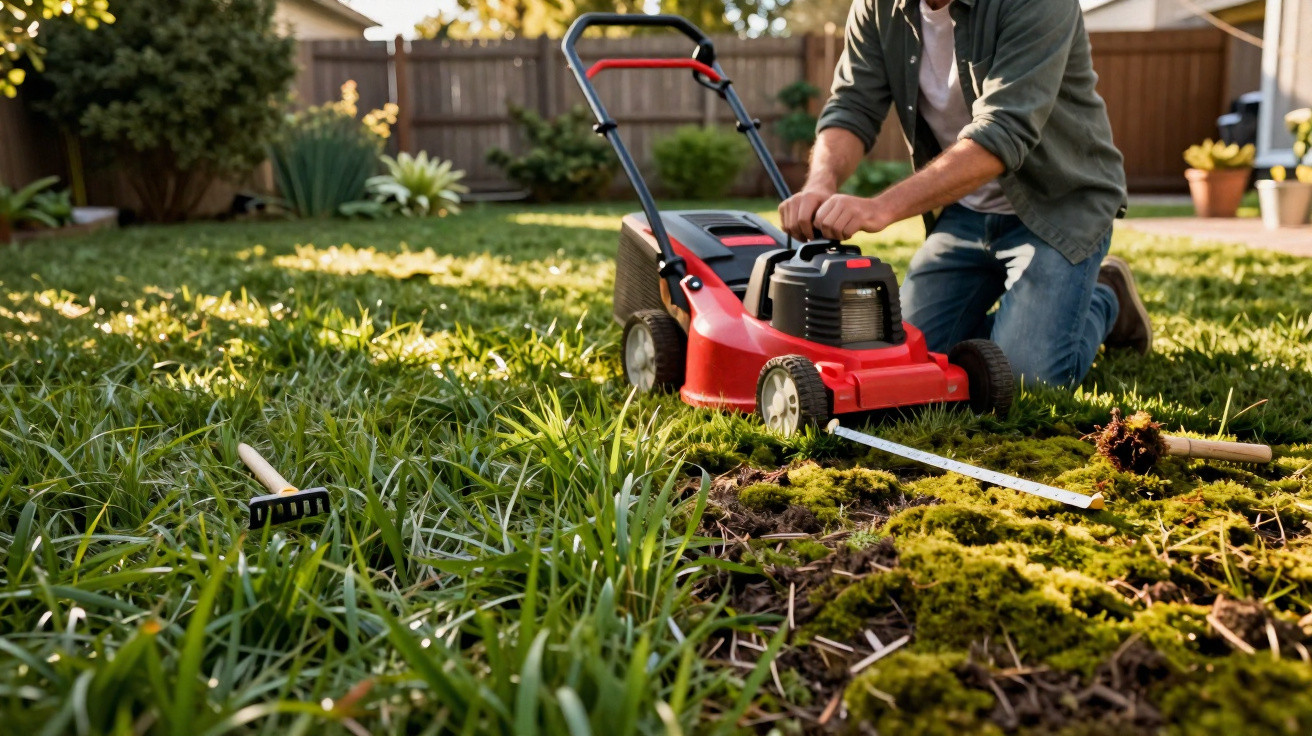
In most gardens, the real trigger is much closer than you think: the lawnmower’s height adjustment. A difference of just a few centimetres can decide whether grass develops strong roots or whether a wet, spongy carpet of moss takes over. A garden expert explains which setting protects your lawn - and which one quietly wrecks it.
Why cutting height matters more than fertiliser
Across front gardens, the same habits crop up again and again. Some people mow as short as possible “so you don’t have to do it again for ages”. Others leave the lawn until it’s almost wild, then hack it right back. Both approaches weaken turf far more than most realise.
Grass blades are not just for show. They act as the plant’s “solar panels”. The more leaf area you leave standing, the more energy the grass can store through photosynthesis. That energy is then invested in a dense, deeper root system - the most reliable defence against drought, heat and competition from moss.
“The cutting height determines whether the lawn builds up reserves - or whether it’s constantly running on empty.”
If you keep cutting too low, the grass has to regrow repeatedly from its reserves. Roots stay shallow, the ground warms up faster and dries out, and gaps open between the shoots. Those spaces are exactly where moss cushions and weeds move in.
On the other hand, if you let the grass stay very long everywhere, a thick thatch layer forms at the base. Moisture gets trapped, air circulation drops, and the surface soon feels soft and spongy. Moss thrives in this kind of damp microclimate.
The ideal height: how to set your mower correctly
The best cutting height depends on how you use the lawn and how much light it receives. There isn’t one universal setting - but there are clear guide values you can use.
Lawn in full sun
For a standard family lawn in a sunny position - where children play or the barbecue sits - the rule of thumb is:
- A cutting height of 4 to 5 cm is ideal for most months.
- Below about 3 cm, even hard-wearing mixes quickly become stressed.
Within this range, the lawn keeps enough leaf mass to produce energy, yet stays short enough to remain dense and resilient underfoot. The sward closes up, making it harder for weed seeds to reach the soil and establish.
Shaded lawns and damp corners
In semi-shade to shade - for example under trees or on north-facing sides - grass needs extra help from its leaves. Here a different guideline applies:
- A cutting height of 6 to 8 cm is noticeably better.
- Longer blades capture more light and strengthen the plants.
This allows turf to cope with fewer hours of sun and to push back against moss. Moss is usually the first to benefit when grass is weakened by lack of light.
Fine turf and ornamental lawns
If you maintain very fine ornamental turf - something like a small bowling-green look - you can go shorter, but only with suitable varieties and intensive care:
- A cutting height of 2 to 2.5 cm can work with fine-leaved ornamental grasses.
- At this height, the lawn needs more irrigation, more nutrients and frequent, gentle mowing.
For most home gardens, this depth rarely makes sense. Typical garden lawns are for use, and they generally perform far better around 4 to 5 cm.
The one-third rule: how to prevent stress and moss
It’s not only the set height that matters - it’s also how much you remove in one go. Professionals rely on a simple principle that makes a big difference:
Never remove more than one third of the current blade length in a single cut.
In practice, that means: if the lawn is at 6 cm, you should cut it back to no lower than 4 cm. If it has grown to 9 cm, don’t drop straight to 4 cm - mow in two passes instead.
Ignoring this rule and scalping after a long gap shocks the grass. It burns through reserves, yellows more quickly and becomes more vulnerable to disease and moss.
How often should you actually mow?
How frequently you mow depends heavily on the season and growth rate:
- Spring (March to May): During strong growth, mowing up to twice a week may be necessary to stop the grass shooting up.
- Summer: Once a week is usually enough. In hot spells, it helps to raise the cutting height slightly to shade the soil.
- Autumn (September to October): Weekly to fortnightly mowing is generally sufficient.
At the start of the season, it’s best to set the mower to its highest position. You can then lower it gradually once growth is steady and there’s no longer a risk of frost.
The perfect heights by season
| Season | Sunny lawn | Shaded areas |
|---|---|---|
| Spring | approx. 4–5 cm | approx. 6–8 cm |
| Summer | 5–6 cm (a little higher in heat) | 6–8 cm |
| Autumn | 5–7 cm | 6–8 cm |
With these values, you give the lawn a chance to build reserves for dry periods and winter. At the same time, you remove moss’s advantage in the competition for light, water and space.
More than just mowing: how to weaken moss on purpose
The correct cutting height is the most powerful lever, but it’s not the only one. A few supporting steps make the impact much stronger:
- Only mow in dry conditions: Wet blades tear out more easily, smear the cut and encourage thatch.
- Aerate or scarify the soil: Compaction and thatch create ideal conditions for moss. Aerators or scarifiers break up this layer.
- Check soil pH: Strongly acidic soil favours moss. Garden lime can help - but only if a test really shows a low pH.
- Provide the right nutrients: A healthy, deep-green lawn is better at crowding out moss on its own.
If you combine these steps with the right mower setting, you’ll often see a noticeably denser, greener surface after just one season.
Common mistakes that practically invite moss
In many gardens, the same errors run through the year:
- Cutting on the lowest setting to mow less often.
- Long gaps where grass gets far too tall, followed by a drastic cut.
- Keeping the same mowing height in sun and shade, and throughout the seasons.
- Never scarifying or aerating even though the lawn feels spongy.
With a few clicks on the height lever and a bit more consistency, these issues are easy to fix - without specialist chemicals or expensive re-seeding.
Practical example: what happens at the wrong height?
A typical case: a terraced-house garden with lots of sun, a heavily used lawn, and a mower that has been left on level 2 for years. The blades sit at around 2.5 cm permanently. In mid-summer, yellow patches appear, the soil turns dusty-dry, and moss starts to settle between the shoots.
If you raise the mower to 4 to 5 cm, the following tends to happen:
- The soil is shaded by the blades and loses moisture more slowly.
- Roots grow deeper because extra leaf area provides more energy.
- Gaps close up, and moss loses both space and light.
Together with a one-off thorough scarification and targeted overseeding, the lawn can visibly recover over the course of a season.
What a “moss lawn” reveals about your site
If you still have large moss patches despite the right cutting height, it tells you a lot about the conditions in your garden. Most often, moss points to at least one of the following:
- heavy shade from trees or buildings
- persistently wet, poorly drained soil
- compacted ground from frequent foot traffic or building work
- very nutrient-poor or very acidic soil
Not every area can be turned into a perfect sports lawn. In extremely dark or boggy spots, it may be more sensible to change approach - for instance, choosing shade perennials, ground cover plants or deliberately designed moss greenery. For typical garden lawns, though, a fresh look at the mower’s height adjuster is often enough to create the decisive turning point.



Comments
No comments yet. Be the first to comment!
Leave a Comment