
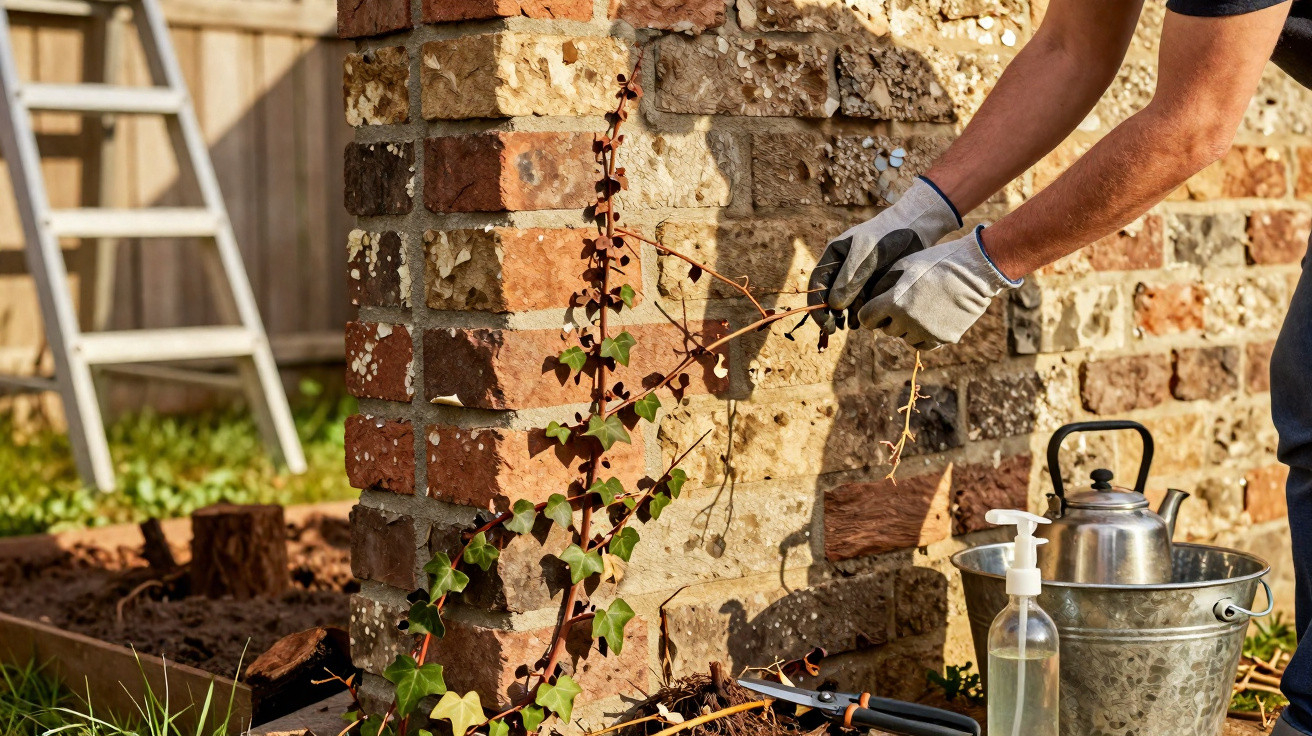
When faced with a plant that has been established for years, many gardeners react in the same way: they pull at the long stems to clear the wall as quickly as possible. This is often when the trouble begins. The holdfasts resist, patches of render come away and the plant may even grow back the following spring. A more measured approach, starting at the base, produces far better results.
Why long stems cling so firmly to walls
This climbing plant does not simply twine around its support. It also produces small holdfasts, sometimes known as aerial roots, which adhere to timber, stone, brick or render. These allow it to climb to considerable heights without needing a trellis.
On a sound, solid wall, these attachments do not necessarily cause immediate damage. The position changes where the masonry already has cracks, crumbling mortar joints or an ageing surface coating. Stems can then work their way into flaws in the wall. On a roof, they retain moisture, block downpipes and may lift poorly secured components.
Pulling hard on the green growth does not tackle the issue at its source. The base remains alive underground. It continues to feed the cut stems or prepares fresh shoots. An old rootstock can become extremely thick, almost woody, and can survive for several decades.
“The right approach is to cut off the stems’ supply before trying to remove them from the wall.”
The pruning cut that changes the rest of the job
First, locate where each substantial stem begins at ground level. Leaves can conceal several separate plants, particularly beside an old wall or behind a hedge. Carefully move the foliage aside and look for the main stems, which are often brown, thick and rigid.
Using sharp secateurs, cut every stem as close to the soil as you can. Loppers are suitable for medium-sized diameters. If a stem resembles a small branch, use a pruning saw. The aim is straightforward: separate the climbing growth from the rootstock that feeds it.
Rather than making one cut, it can help to remove a short section a few centimetres long. This prevents a stem from remaining connected and healing over. With particularly vigorous plants, check that no secondary stem has been missed behind fencing, a downpipe or a border.
- Put on thick gloves to prevent scratches and skin reactions.
- Use disinfected secateurs, particularly after working on diseased plants.
- Wear eye protection when cutting taut stems or working overhead.
- Do not work alone with a ladder near a gutter or roof.
Wait instead of pulling everything away on the same day
Once cut, the leaves will not vanish straight away. They usually turn yellow within one to two weeks, then become brown and dry. Complete drying may take longer, depending on the season, the wall’s aspect and the thickness of the stems.
Waiting greatly reduces the risk of damage. As a dead stem gradually loses flexibility, its attachments are easier to loosen. You can then take it down in small sections without applying force. On a delicate façade, work slowly by hand and use a soft brush.
A wire brush can be useful on hard stone or robust brick, but it may scratch painted finishes and pull away loose areas of render. Always try your chosen method on an inconspicuous area before tackling the whole surface.
Removing the rootstock to reduce new shoots
Cutting the hanging stems stops further spread, but it is not always enough to resolve the problem completely. Once the dry foliage has been removed, deal with the base. Loosen the soil around the rootstock to a depth of around 20 to 30 centimetres with a narrow spade or digging fork.
Large roots often radiate outwards like a star. Trace them as far as possible and cut them cleanly. Where the plant is growing against a wall, do not drive a heavy tool into the foundations. Work in small sections so that already damaged masonry is not weakened further.
“An old rootstock will not always give way in one session: it is better to work several times over three to six months than to damage the wall or your back.”
After lifting it out, collect stem fragments and thick roots. Leave them to dry on a sheet in the sun before disposing of them. Avoid placing them directly in a home compost heap. Some pieces can regrow in damp conditions, especially if they remain in contact with soil.
Monitor for three months to prevent another invasion
New growth is often barely noticeable at first. A small glossy leaf emerging near the wall can signal that an overlooked root is starting again. Inspect the area every 10 to 15 days for roughly three months. Pull out young shoots as soon as they appear, while they come away easily.
This monitoring takes only a few minutes, yet it prevents the plant from colonising the façade again the following year. If the soil is bare after the work, a thick mulch can also hinder the emergence of new shoots. Bark, dead leaves or chipped prunings are a simple option around existing plants.
Should you use boiling water or vinegar?
Very hot water can scorch visible young shoots, but it will not necessarily deal with a deep rootstock. Pour it carefully, well away from plants you want to keep, and without creating a burn risk for people or animals.
Vinegar, often promoted as a garden solution, makes the soil more acidic and can harm neighbouring plants. Repeated use also disrupts beneficial soil organisms. For a plant growing against a façade, cutting the stems, progressively removing the roots and carrying out regular checks remain more manageable options.
If the stems have already reached a roof, are touching cables or cover a large part of the façade, calling in a professional can prevent a fall or expensive damage. In other cases, secateurs, some patience and regular inspections are often enough to regain lasting control of the garden.



Comments
No comments yet. Be the first to comment!
Leave a Comment