
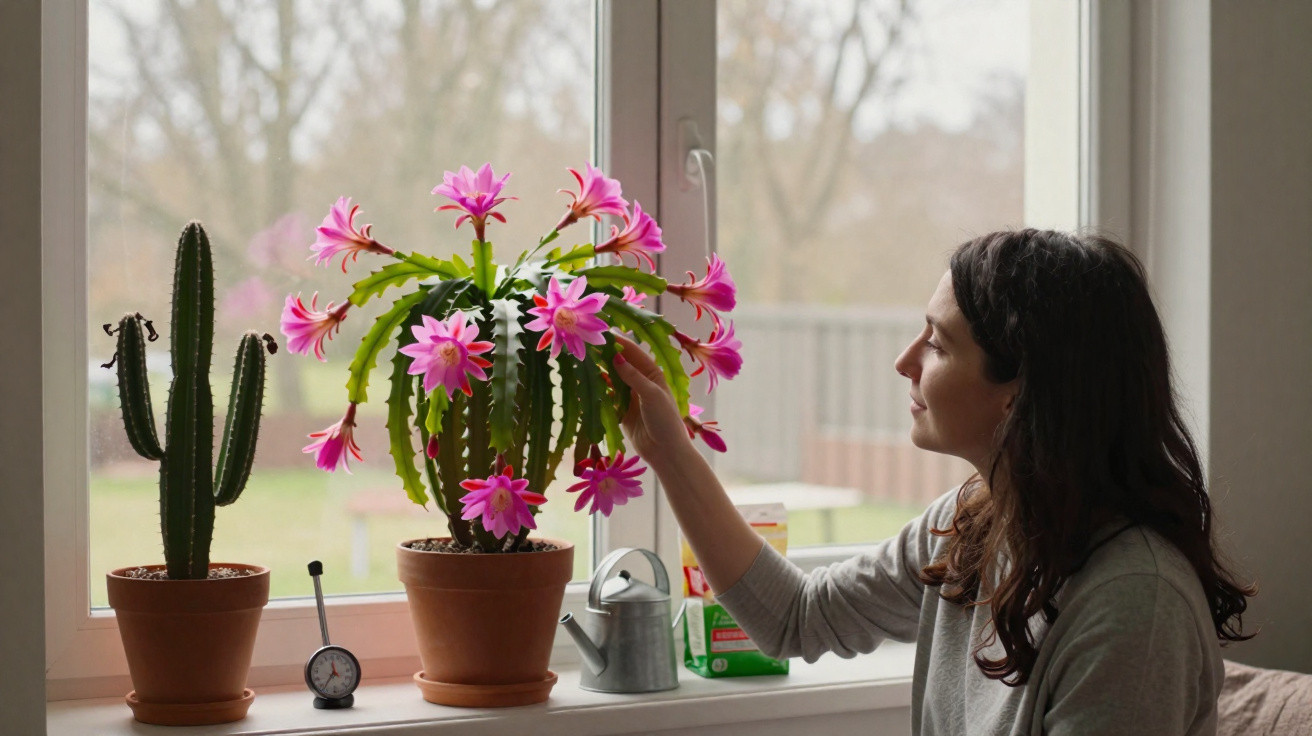
The reason is often set months earlier - in winter.
Plenty of houseplant enthusiasts know the pattern: in the garden centre the Easter cactus is covered in bright, starry flowers; at home it blooms brilliantly for one season - and then, the following spring, nothing happens. The plant still looks fit, the segments stay green and firm, yet the familiar coloured stars never appear. This is not a mystery at all: it is usually a specific winter-care mistake that throws the whole flowering schedule off.
What makes the Easter cactus so different from desert cacti
The classic Easter cactus (botanically Rhipsalidopsis, sometimes also sold as Hatiora) is not a desert plant. It originates in the humid forests of South America. There it grows as an epiphyte - meaning it lives on trees rather than in soil - tucked into branch forks among leaf litter and moss.
That background explains what it needs indoors:
- Bright light, but not harsh direct sun
- A loose, well-draining root ball rather than heavy, compact compost
- Consistently slightly humid air - not bone-dry air from radiators
- Mild temperatures without extremes of heat
In nature, the Easter cactus concentrates its flowering between March and May. That is when its star-shaped blooms open. To put on that display, it needs a rest period beforehand - and this is exactly where the most damaging mistakes tend to happen.
Easter cactus or Christmas cactus - the important difference
Many plants arrive in living rooms with the wrong label, which makes care even more confusing. Easter cactus and Christmas cactus look similar, but they run on different annual rhythms.
How to identify your Easter cactus with confidence
- Flowering time: Easter cactus - spring; Christmas cactus - winter
- Segments: Easter cactus - smoother, more rounded joints; Christmas cactus - more toothed, “notched” segments
- Flower shape: Easter cactus - star-like and upright; Christmas cactus - more drooping and tube-shaped
If you follow the timetable of the wrong cactus, it is easy to miss the crucial rest phase - and then you are left wondering why the pot stays green but never really gets going again.
The hidden timetable: how the yearly cycle works
For your Easter cactus to start forming buds in good time for Easter, it needs a clear alternation between growth and pause. Without that pause, it effectively “forgets” to flower.
Autumn to late winter: plan a cool rest period
The decisive window runs from late autumn to the end of winter. Across these 8 to 12 weeks it is determined whether your cactus will explode with blooms in spring - or simply continue producing greenery.
For lots of flowers, the Easter cactus needs cool temperatures, short days and significantly less water in winter - otherwise it forms hardly any buds.
Ideal rest-period conditions:
- Temperature: around 10 to 15 °C - cooler than a typical living room
- Light: roughly eight hours of indirect daylight, followed by consistent darkness
- Night: at least twelve hours of uninterrupted darkness with no artificial light
- Watering: very sparingly, about a small drink every three to four weeks
- Fertiliser: stop completely during this period
Good options include a cool stairwell window, an unheated bedroom, or a bright, frost-free conservatory - well away from any radiator.
Spring: wake it gently, not at full throttle
From February onwards, the Easter cactus starts to stir again. This is when it can move from its cooler spot into a brighter, warmer room. A temperature of about 18 to 20 °C is ideal.
The key is not to switch straight from “almost dry and cool” to “soaking wet and hot”. Increase both light and water gradually. Let the surface dry slightly before watering again. During this stage the flower buds begin to show - and any rush or upheaval can lead to bud drop.
The most common mistake: winter treated like midsummer
Most failed attempts to get an Easter cactus to bloom can be traced back to the same setup: the plant spends the entire winter in a warm living room, often above a radiator, watered regularly and exposed to light in the evenings.
What this leads to:
- The plant may grow, but it produces very few flower initiations.
- Without a proper day–night rhythm, it does not register a seasonal change.
- Tissue stays soft and the segments stretch instead of becoming sturdy.
Constant artificial light - from the television, ceiling lights or LED strips - can also destroy the long, dark night period it needs. The cactus requires weeks of reliably extended darkness to reset its internal calendar.
Watering - but correctly: how to avoid rot and stress
Watering is where many hobby gardeners go wrong, because they treat the Easter cactus either like a parlour palm or like a desert cactus. Neither approach is right.
| Phase | How often to water | Note |
|---|---|---|
| Spring / summer (growth) | every 7–14 days | Let the surface dry slightly; avoid waterlogging |
| Autumn | less often, increase the intervals | Prepare the plant for its rest period |
| Winter rest | every 3–4 weeks, very little | Only to prevent the segments shrivelling; do not soak the pot |
A root ball that stays wet and dense quickly results in soft, glassy segments - a clear sign of root rot. A better option is an airy mix, for example about two-thirds quality potting compost and one-third drainage material such as perlite, pumice, coarse sand, or fine pine bark.
Stress factors before flowering: what makes buds drop immediately
Even if everything has gone to plan, an Easter cactus can still become fussy at the last moment. Typical causes of buds dropping suddenly include:
- Changing position: turning or moving the pot once buds are visible
- Temperature shock: draughts at a window or a sudden heat blast near a radiator
- Extremely dry air: heated air with no added humidity
- Overwatering: water sitting in the saucer, or wet compost directly around the roots
A simple trick is to stand the pot on a saucer filled with damp expanded clay pebbles. The base of the pot stays dry, while the air immediately around the plant is slightly more humid. This reduces stress for the buds without leaving the roots sitting in water.
More flowers with small extras: position, repotting, nutrients
If you keep an Easter cactus for several years, a few finer points can noticeably improve flowering.
The right everyday spot
After flowering and outside the rest period, the Easter cactus is particularly happy with:
- a bright windowsill without strong midday sun, such as an east- or west-facing window
- no position directly above a radiator
- in summer, it can also go outdoors - in light shade and protected from rain
Outside, it benefits from higher humidity as long as it is not hit by a sudden cold snap. The plant should not be kept below 8 °C for extended periods.
Using repotting and fertiliser properly
Repotting into fresh substrate is worthwhile every two to three years. The new pot should only be slightly larger. Too much extra volume stays wet for too long and encourages rot.
Only feed during the growth period from spring to late summer - roughly every four to six weeks using a lightly diluted cactus fertiliser or general-purpose feed. During rest periods and while buds are forming, keep the fertiliser put away.
Why the winter mistake ruins so much - and how to fix it immediately
The central issue with an Easter cactus that stays “always green, never flowering” is simple: it never gets a genuine pause. Cool temperatures and long winter nights are not a nice bonus; they are the trigger for flower formation. If you consistently move the cactus from a warm living room to a cooler space with reduced light, you reset its internal calendar.
If you make the change early enough - ideally from November - your chances are excellent that it will perform again the following spring. And even if this year is already too far along: next autumn will come around. That is the time to correct the winter-care mistake and give your Easter cactus the cool, quiet period it needs for its burst of colour.






Comments
No comments yet. Be the first to comment!
Leave a Comment