
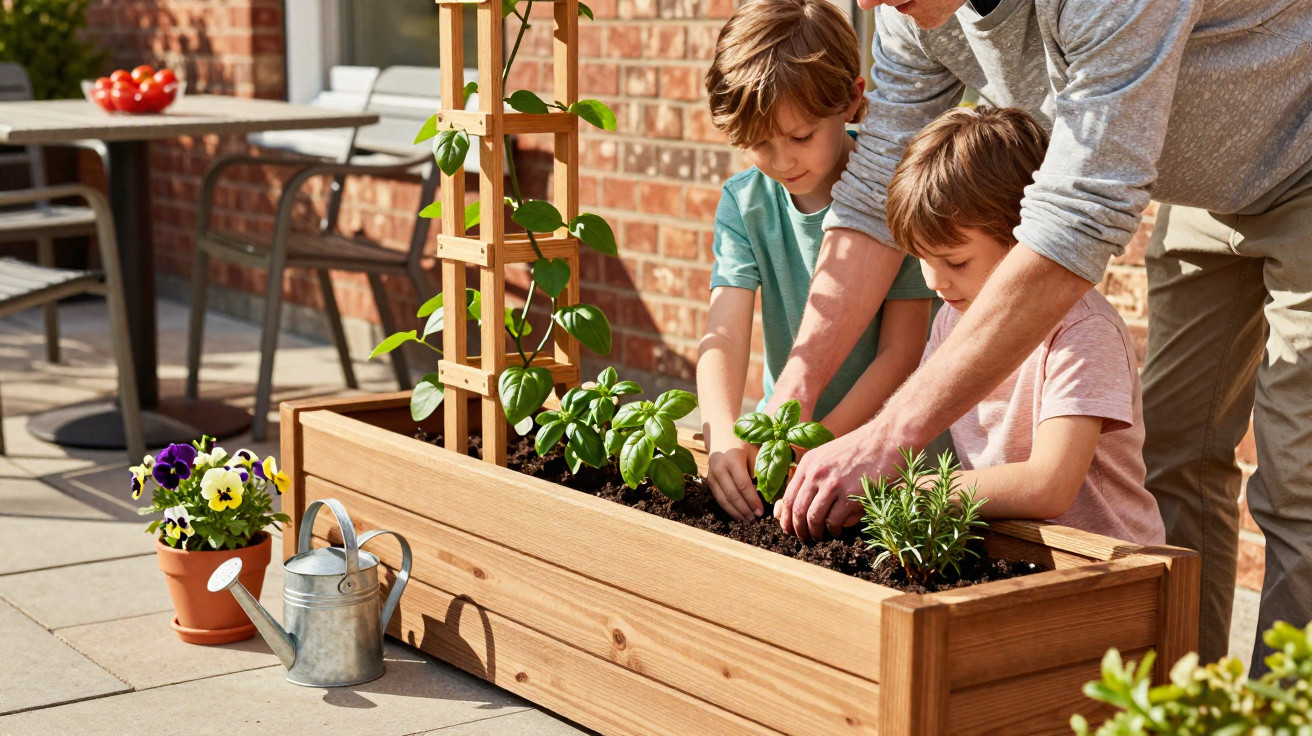
Lidl is putting a new garden buy on shelves just in time for the start of the season - and it’s aimed squarely at two everyday frustrations for hobby gardeners: a lack of greenery and a lack of privacy. A relatively compact wooden module is designed to make balconies, patios and small terraced-house gardens feel noticeably cosier, without eating up much floor space.
What’s behind the new planter
Lidl is launching the “Parkside Planter with Trellis” in the UK: a sturdy wooden planter with a fixed, built-in climbing trellis for £29.99. It’s due to go on sale in mid-March, right when many people start stepping outside again with a mug of coffee or a watering can.
The specifications are refreshingly precise. The planter holds around 20 litres of compost, supports up to 30 kg, and measures roughly 60 cm wide, 28 cm deep and 100 cm high. The result is a slim but eye-catching vertical column of planting that can still fit into narrow terraced gardens or on very small balconies.
“The planter with trellis combines privacy screening, vertical gardening and decorative planting in one single, relatively affordable unit.”
The timber comes factory-treated with a water-based stain and, according to the manufacturer, is weather-resistant and UV-resistant. A fitted plastic liner is included, and the screws and instructions are in the box. In other words: carry the flat-pack home, and with a few quick steps you’ve got a compact vertical garden feature ready to plant up.
Why small gardens benefit from this design
Plenty of people in towns and cities know the reality: outside space often feels more like a narrow corridor than a park. When every square metre matters, the layout has to work hard. That’s exactly where the combination of planter and trellis earns its keep - it grows upwards rather than spreading out.
- Needs very little floor space because it’s only 28 cm deep
- Works as both a planting area and a privacy screen
- Suitable for balconies, patios and along garden boundaries
- Works well for herbs, flowering plants and climbers
- A strong option for rented homes with limited space
Compared with traditional raised beds, this unit takes up far less ground area while delivering a similar benefit: plants sit higher up, are easier to reach, and over time can form a green “wall”. If your seating area is close to a road, a parking space or a neighbour’s patio, it can also create a helpful bit of visual separation.
Family-friendly: gardening at child height
This setup is also appealing for families. Children can reach the planter far more easily than ground-level beds. They don’t need to bend down as much, and they’re less likely to dig directly in lawns or borders that parents may have carefully established.
One practical example: a child takes responsibility for “their” section of the planter, sowing cress, marigolds or radishes, while parents plant herbs in the same box. The area is small enough to manage, results show up quickly, and the sense of responsibility is still genuine.
“A clearly defined little planting patch gives children a protected space to learn - without turning the whole garden into an experimental zone.”
The trellis does more than simply add structure. It guides climbing plants upwards, making it easy for children to follow growth week by week. That, in turn, is a handy springboard for everyday chats about the seasons, the water cycle or insects.
How to get the best out of the Lidl planter
To make the system really work, the planting choice matters. The box suits a mix: ground-covering or trailing plants at the base, with climbers trained up the trellis.
Planting ideas for keen cooks
If you enjoy cooking, the lower section is ideal for fragrant herbs. Common favourites include:
- Rosemary – tough, likes sun, fits well in Mediterranean-style corners
- Thyme – copes with dry conditions, great alongside gravel or stones
- Mint – vigorous growth, but easier to keep in check in a planter than in open ground
- Parsley – happier in partial shade and can be harvested regularly
On the trellis itself, you can grow climbers such as beans, peas or nasturtiums. That way you end up with a small productive garden feature right by the patio doors.
Flowering ideas for more colour and privacy
If the main aim is a green divider, flowering climbers are a strong choice. These are particularly suitable:
| Plant | Light requirement | Special feature |
|---|---|---|
| Sweet pea | Full sun to partial shade | Strong scent, colourful flowers, ideal for cut arrangements |
| Clematis | Bright position, “cool roots” | Many varieties, some with very long flowering periods |
| Jasmine (hardy varieties) | Sunny | Intense fragrance, good summer screening |
| Nasturtium | Sunny | Edible flowers, fast and lush growth |
If you’re willing to play the long game, pair perennial climbers with annual flowers. The annuals fill gaps in year one, while the permanent planting gradually gains height and coverage.
Care: low effort, but not maintenance-free
The wood is pre-treated, but long-term upkeep is still worth thinking about. A planter lives outdoors year-round - rain, sun, wind and frost all take their toll. Without occasional attention, any timber structure will suffer.
- Recoat with a weatherproof stain every one to two years
- Check the plastic liner regularly for cracks
- Prevent waterlogging by keeping drainage holes clear
- In winter, protect root balls from deep freezing (for example with horticultural fleece)
Keeping on top of these points can significantly extend the lifespan. Another advantage of the compact footprint: it’s easy to reposition. If the spot turns out to be too windy or too shady, you can simply move it a few metres.
Price-to-performance: is it worth buying?
Against typical garden-centre pricing, £29.99 looks reasonable. Comparable wooden planters with a trellis often cost noticeably more, especially when they already include an internal liner. If you try to buy timber, screws, protective stain and a trellis separately, you can quickly exceed this amount - before adding the time and tools needed to build it yourself.
“For anyone who doesn’t want to build a full privacy fence, the planter is a quick, manageable solution that can simply be removed again if it isn’t for you.”
The small, movable design also reduces the risk of clashing with rules from a managing agent or landlord, which can be stricter for fixed installations. A portable element is more likely to be treated as garden décor rather than a structural change.
Real-world examples: how the planter changes everyday situations
The product becomes more interesting when you picture common living setups. Take a young family in a terraced house whose patio directly borders the neighbour’s garden. A full screening fence could be expensive, visually heavy, and would likely require agreement next door. By contrast, placing two or three of these planters side by side - planted with sweet peas and nasturtiums - can create an airy green strip between the plots.
Or consider a studio flat with a narrow balcony on a busy road. The goal isn’t perfect tranquillity so much as softening the view of cars and wheelie bins. A planter positioned by the railing, filled with dense climbers, helps filter what you see. It won’t do much for noise, but it can reduce visual “stress” - and that alone can noticeably improve how pleasant the space feels.
Risks, limits and sensible combinations
Of course, one planter won’t solve every outdoor-space challenge. If your balcony is exposed to strong winds, you’ll need to secure the unit properly so it can’t tip. On very tight balconies, the height can also block too much light if it’s placed right by the door. It’s worth taking a moment to judge the intended position critically before reaching for the drill.
It gets especially effective when combined with other elements: a small folding table beside it, fairy lights threaded through the trellis, or a second planter at a different height - and you’ve created a little “room” outdoors. With thoughtful placement, you can even encourage a mini microclimate: more shelter from wind, a patch of shade for heat-sensitive plants, and a protected seating spot for people.
Once you grasp the principle, it’s easy to scale. Several smaller vertical planting modules can add more structure and comfort than one large, empty square of paving or lawn. In that sense, the Lidl planter with trellis is less a flashy one-off and more a straightforward building block that helps many people get started with practical, space-saving gardening.



Comments
No comments yet. Be the first to comment!
Leave a Comment