
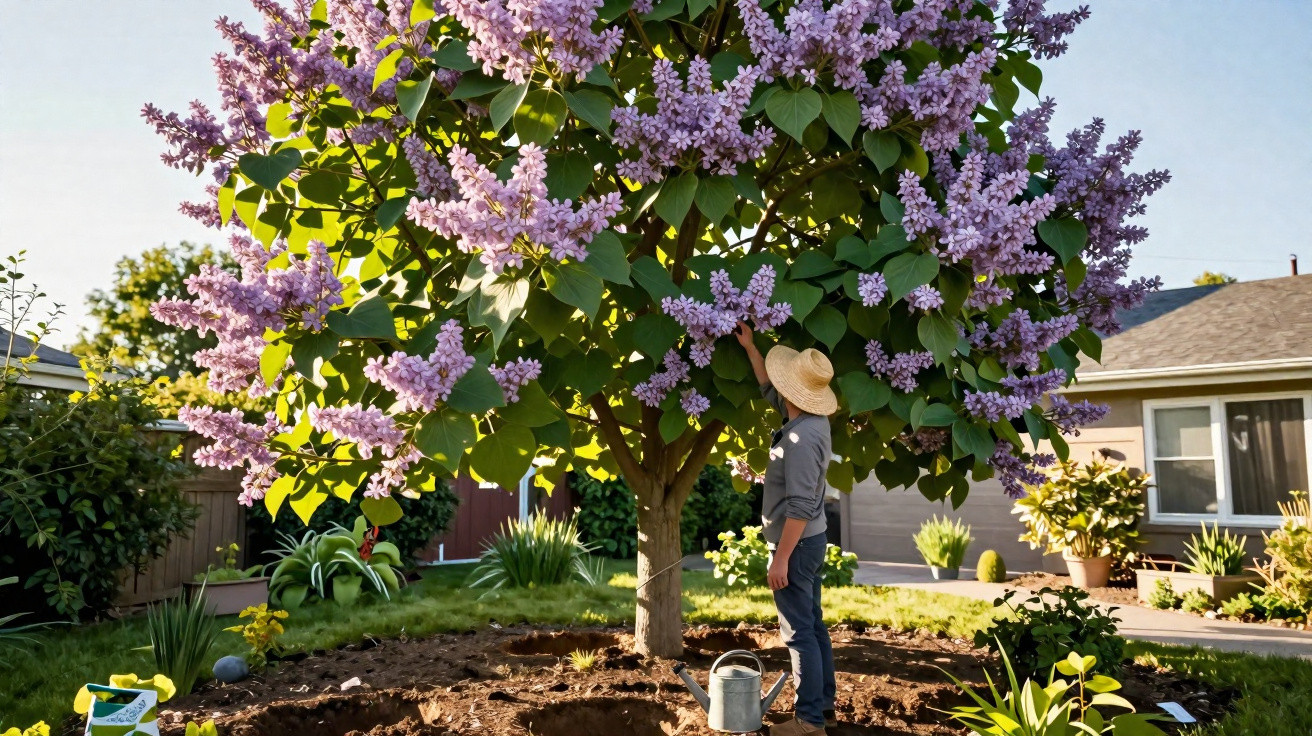
Many keen gardeners want privacy quickly, abundant flowers and, ideally, none of the hassle that comes with rampant roots. That is exactly where a tree comes in that is still something of an insider tip: the Paulownia, also known as the Kaiserbaum or Blauglockenbaum. It shoots up almost as fast as bamboo, yet is far easier to keep under control - and in spring it puts on a flowering display that is hard to forget.
A tree that becomes a giant in just a few years
The Paulownia’s biggest advantage is the speed at which it grows. If you are impatient and don’t want to wait decades for a mature tree, this one is a very good fit.
"In good conditions, a young Paulownia puts on around 1.5 to 2.5 metres per year - after three years, it is often already 5 to 7 metres tall in the garden."
A slim little trunk turns into a proper tree in surprisingly little time, reaching a final height of around 10 to 12 metres. It usually develops a distinct, upright main stem and a broad, spreading crown. The enormous, heart-shaped leaves are particularly striking, quickly forming a dense canopy.
In high summer, that canopy creates a pleasantly cool patch of shade - ideal for a seating area or patio. And unlike many bamboo species, Paulownia does not produce aggressive rhizomes. It stays where you plant it, which tends to mean far fewer worries for the neighbours.
Why its blossom turns gardens into lilac clouds
The real show starts in spring. Before the first leaves appear, the tree pushes out thick flower panicles from its buds, distributed all over the crown.
Each bloom looks like a small, bell-shaped tube, with colours ranging from soft mauve through to violet-blue shades. Seen from a few metres away, it can look as though the crown has been wrapped in a pastel veil.
There is also a light fragrance that, in mild weather, can be noticed throughout the garden. The flowers are considered exceptionally bee-friendly: they provide plenty of nectar and attract not only honeybees, but also bumblebees and butterflies.
"With a flowering Paulownia in the garden, you create shade, colour and a true paradise for pollinators in one go."
The right location: sun, space and a loose soil
For the tree to make the most of its rapid growth, it needs one thing above all: light. A fully sunny position is best. A little shelter from cold easterly winds is helpful, particularly in exposed areas.
When it comes to soil, Paulownia is fairly tolerant, but it reacts badly to waterlogging. The ground should be deep, humus-rich and free-draining. In compacted, permanently wet soils, the roots struggle and growth slows markedly.
Planting success, step by step
- Dig a planting hole of roughly 60 × 60 × 60 centimetres.
- Mix the excavated soil with 10 to 20 litres of well-rotted compost.
- Set the tree in place so the root collar sits level with the soil surface.
- Backfill with the soil–compost mix and firm it in lightly.
- Water straight after planting with around 20 litres, so the soil settles snugly around the roots.
- Finish by forming a mulch ring 5 to 8 centimetres thick around the trunk.
Mulch - for example, bark chips or shredded prunings - helps the soil retain moisture and protects young roots from temperature swings.
Care in the first few years: water, prune, protect
The key window is the first two to three years after planting, when the tree is establishing its root system. If you give it proper attention then, you are usually rewarded later with a hardy, low-fuss specimen.
How much water does a Paulownia need?
During dry spells in summer, it should be watered thoroughly at least once a week. Depending on the heat, 10 to 20 litres per watering is sensible. The main point is to water less often but deeply: that encourages roots to grow downwards and makes the tree less sensitive to drought.
Pruning correctly for a stable crown
A gentle shape tidy-up is best done after flowering. Remove dead wood or branches that rub or cross, and aim for a well-balanced crown. The goal is an open, well-lit structure with a few strong main branches.
As a rule, hard cutting back is not required. If you want to keep the crown deliberately smaller, you can reduce it regularly - but do so with an eye to a harmonious framework, so the tree does not become top-heavy.
Frost and flower buds: a tricky combination
Depending on the species, Paulownia can tolerate sub-zero temperatures, but its flower buds are noticeably more sensitive. Late frosts in spring can damage the developing flowers partly or entirely. That does not mean the tree will die - it simply means the flowering display will be weaker that year.
In very cold areas, horticultural fleece can protect young trees. After a frost spell, prune back any frozen shoot tips once no severe frost is forecast. In most cases, the tree then reshoots strongly from lower down.
How far does the Kaiserbaum spread?
Unlike bamboo, Paulownia does not send out long, running root shoots. It can, however, spread by seed. The lightweight seeds are carried by wind for several metres and, in exceptional cases, much further.
In Central European gardens, seedlings do occasionally appear in borders or lawns. If you do not want that, pull them up or dig them out early. In ecologically sensitive areas, it is worth doing a quick check with the local council or conservation groups beforehand to see whether the tree is considered problematic.
The most important varieties and where they work well
The most commonly grown types are forms of the Blauglockenbaum (Paulownia tomentosa) and the Chinese Kaiserbaum (Paulownia fortunei). They mainly differ in flower colour, leaf size and overall vigour.
| Variant | Characteristics | Suitable use |
|---|---|---|
| P. tomentosa | strong growth, large leaves, violet flowers | specimen tree in a lawn, fast shade provider |
| P. fortunei | slightly finer crown, sometimes more delicate flower colours | smaller, more delicate gardens; in some situations also in rows |
If you want the tree as a focal point in the middle of the garden, plan for 6 to 8 metres of clearance from the patio, house wall and neighbouring boundary. For an avenue or a loose line along a driveway, spacing of around 6 metres between trunks is a good rule of thumb.
Not just pretty: further benefits of Paulownia
Beyond its looks, the tree has a few practical upsides. Its wood is very light yet relatively strong. In some countries it is used for furniture, lightweight panels or musical instruments. In a private garden this is usually secondary, but it can become relevant over the long term if large limbs - or an older tree - ever need to be removed.
Its reputation as a “climate tree” is also noteworthy. Because it grows so quickly, it binds comparatively large amounts of CO₂ in a short time. That alone will not solve climate issues, but in thoughtfully planted housing areas or urban neighbourhoods it can certainly be a positive factor.
Practical tips for day-to-day life in the garden
If you are thinking about planting a Paulownia, it is sensible to consider what the overall garden picture should look like in future. With its size and huge leaves, it can quickly dominate the surrounding space.
- Underplant with robust perennials such as geraniums or hostas to keep the shaded area looking tidy.
- Spring bulbs like crocuses and daffodils benefit from the tree’s early flowering period and add extra pops of colour.
- An annual feed of about 10 litres of compost per tree in spring supports healthy growth without over-fertilising.
If children play in the garden, keep an eye on the area beneath the crown: remove dead branches routinely so there is no risk while they are running around under the tree.
Who the Kaiserbaum is particularly worth it for
Paulownia is especially suitable for people who want a sizeable tree quickly, find pure conifers a bit bleak, and have no desire to deal with sprawling bamboo roots. It is not a “no-maintenance” plant, but it does forgive many beginner mistakes, provided you avoid waterlogging and make sure it has enough water in the first few years.
If you can give it a bit of room, you end up with a tree that fills several roles at once: a natural sunshade, a springtime statement piece, a magnet for bees, and - in the long term - even a potential source of timber. For many gardens in the German-speaking world, it is a surprisingly interesting alternative to the usual suspects such as cherry laurel, thuja or maple.
Comments
No comments yet. Be the first to comment!
Leave a Comment