
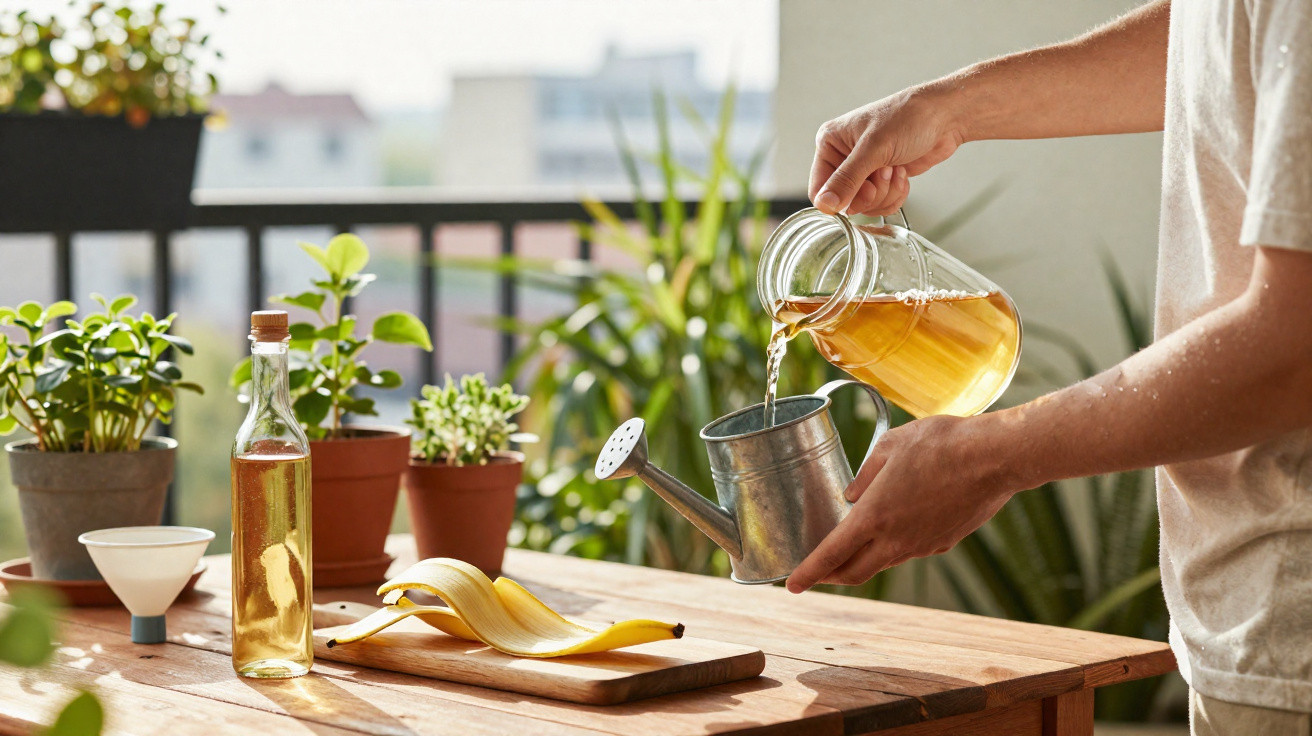
Rather than throwing banana peel in the bin, many gardeners now use it in a straightforward vinegar mixture to make a homemade fertiliser. The combination has become popular because banana peel contains potassium, phosphorus and magnesium, all nutrients that are important for plant development. Vinegar, meanwhile, helps speed up the breakdown of organic matter while the solution is being prepared. To prevent harm to plants, however, the mixture must always be diluted and used sparingly.
How can banana peel and vinegar benefit plants?
Banana peel contains minerals involved in root growth, flower production and the healthy development of plants. As the mixture rests, some of these nutrients are released into the liquid, creating a solution that can be used to supplement fertilisation.
Vinegar is not a fertiliser. Instead, it promotes the decomposition of the peels and lowers the pH of the preparation. Experts therefore warn that it should never be poured undiluted directly onto the soil or plants, as excessive acidity can damage roots and disrupt the balance of the growing medium.
How should this banana peel and vinegar mixture be prepared safely?
Preparation is simple and uses ingredients that are usually already available in the kitchen. The key points are allowing the mixture to rest and diluting it before application.
Once ready, the solution should only be used as a fertiliser supplement, never as a replacement for proper soil care.
- Peels from 2 or 3 bananas
- 500 ml of white vinegar
- A glass jar with a lid
- A sieve
- Water for dilution before use
- A watering can or spray bottle for applying it to the soil
How can the fertiliser be applied without harming plants?
After resting for around one week, strain the liquid and dilute a small amount in water before using it. Apply the solution directly to the soil, keeping it away from leaves, flowers and stems.
It is also advisable to use this fertiliser only occasionally and monitor how each species responds. Plants have different nutritional requirements, and too much of any fertiliser, including a natural one, can create imbalances in the soil.
- Dilute the mixture before applying it
- Water the soil only
- Avoid applying it to leaves
- Use small quantities
- Space out applications
- Monitor the plants’ response
Is this homemade fertiliser worth trying?
For anyone looking for sustainable alternatives, reusing banana peels can be a useful way to reduce household waste while supplementing plant nutrition. Experts stress, however, that this type of preparation cannot replace balanced fertilisation and does not provide every nutrient needed by all species.
When used correctly, the solution can form part of a more sustainable gardening routine, alongside suitable watering, good light and soil rich in organic matter.





Comments
No comments yet. Be the first to comment!
Leave a Comment