
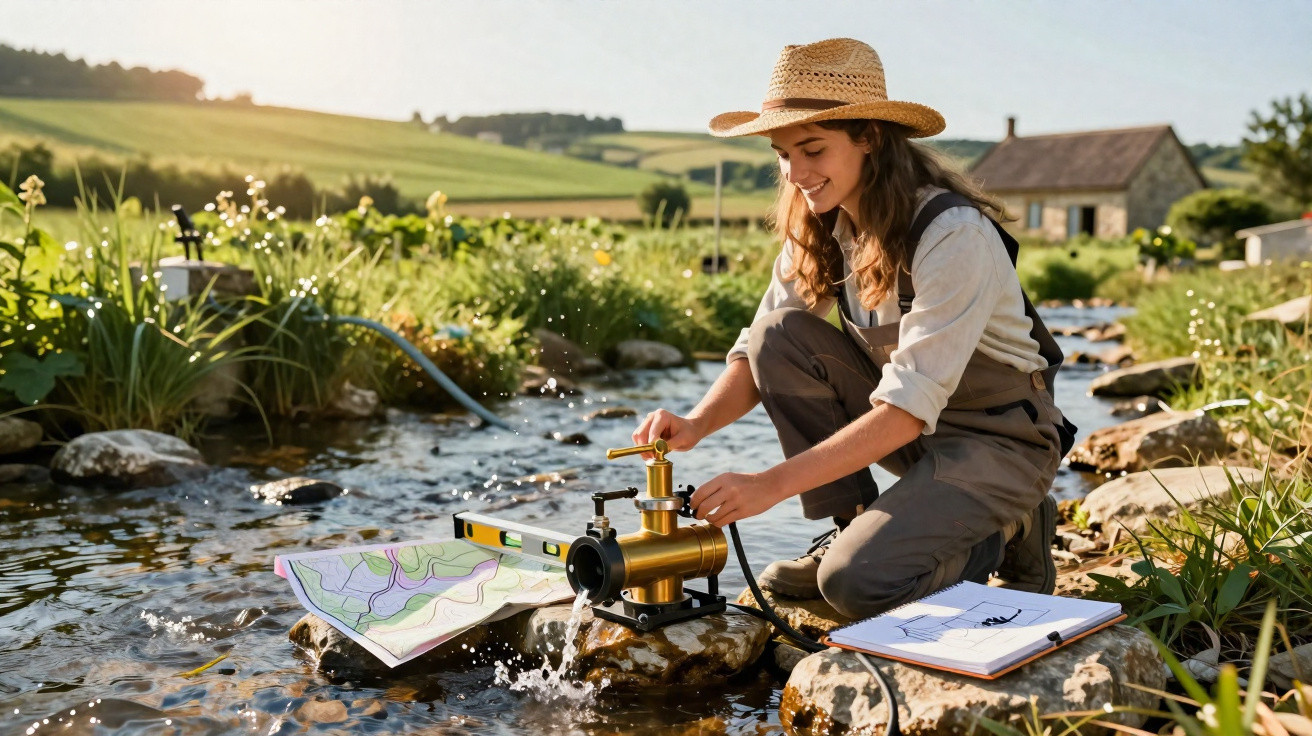
A trickle of water runs through a pipe, somewhere at the bottom of a garden or beside a spring. At regular intervals, a sharp clack breaks the silence, almost like the beat of a mechanical heart. There is no motor, mains connection or drop of petrol: only water using its force to move more water. In 2026, the hydraulic ram, a French invention dating from the late 18th century, is emerging once again from barns, old manuals and DIY workshops. It is attracting fresh interest both on remote farms and among advocates of technical simplicity. We all know the moment when a straightforward solution suddenly seems more appealing than a device packed with electronics. This one is worth listening to.
The hydraulic ram, the old French machine that refuses to disappear
The hydraulic ram was popularised by Joseph-Michel Montgolfier in 1796, the same inquisitive mind associated with the famous Montgolfier balloon brothers. Its operation seems almost implausibly simple: some of the water flowing naturally down a pipe creates a pressure surge, which then drives a small volume of water to a higher point. The machine sacrifices part of the flow, but gains height. In a world accustomed to electric pumps, its repeated sound is oddly reassuring. It shows that well-designed mechanics can operate independently for years.
Where a spring sits several metres above a vegetable plot, a hydraulic ram can lift water to a tank, sometimes across several tens of metres of vertical rise depending on the setup. Efficiency varies widely, yet the general principle remains revealing: out of every 100 litres entering the system, one portion may be delivered uphill while the rest returns to the stream or a pond. It is neither magic nor free in physical terms. Its energy comes from the available water drop. However, no fuel is burned to operate the pump.
This renewed attention is not simply a retro fad. Low-tech supporters see it as a practical answer to an ordinary issue: how can water be used for irrigation, livestock or filling a storage tank when the electricity network is distant, unreliable or expensive? The hydraulic ram relies neither on a battery that needs replacing nor on software that requires updating. Above all, it needs a continuous water supply and a carefully considered installation. Its strength is also its limitation: without steady flow and a drop in height, it cannot work. In the right conditions, it can prove remarkably durable.
Before fitting a hydraulic ram, assess the land rather than the promises
The first step is to measure two very practical factors: the spring's flow rate and the height between the water intake and the hydraulic ram's location. A graduated bucket and stopwatch can provide a useful indication of the true flow rate; a level, a topographical survey app or even a clear hose can help estimate the change in elevation. Before it can send water uphill, the hydraulic ram requires an initial drop, often modest but genuine. Spending an hour watching a stream in summer is wiser than rushing to buy an appealing piece of equipment online.
A common mistake is to assume that a hydraulic ram will suit every garden. Many videos show water cheerfully spraying out, without explaining what happens when the source weakens in August, the strainer becomes blocked or frost arrives. Let us be honest: nobody really does this every day. Even so, a minimum level of monitoring must be accepted, particularly during the first few weeks. A reliable installation needs clean incoming water, a rigid supply pipe and protection from leaves, sand and small stones that may wear out the valves.
For a realistic project, it is better to begin on a small scale: supply an irrigation tank, a remote livestock trough or a few rows of crops, rather than claim to meet every need of a house. A craftsperson or farmer experienced in local water abstraction may also prevent plenty of uncertain calculations.
“The best hydraulic ram is not the most powerful one: it is the one that beats consistently with the water the site provides.”
The checks to make before starting are straightforward:
- available flow, including during the dry season;
- sufficient drop at the inlet;
- controlled drainage for water that is not pumped uphill;
- easy access for cleaning and adjusting the valves.
A low-tech idea that raises a very current question
The hydraulic ram will not replace every pump, nor will it single-handedly save areas affected by drought. Nevertheless, it raises a useful question in 2026: have we sometimes forgotten the tools that make intelligent use of the forces already present around us? In a garden crossed by a trickle of water, this French invention can turn a constraint into a resource, using few parts and a great deal of patience. Low-tech is not a step backwards: it is often a return to the land itself, its limitations and its possibilities. The finest installations are not necessarily the most visible. They beat quietly behind a hedge while the tank fills.
| Key point | Detail | Added value for the reader |
|---|---|---|
| French origin | The hydraulic ram was popularised by Joseph-Michel Montgolfier in 1796. | Rediscover an old invention with highly relevant modern uses. |
| No fuel required | It uses the energy from a water drop to lift part of the water. | Reduce reliance on electricity and engines at certain sites. |
| Real-world conditions | Regular flow, elevation change, filtration and valve maintenance remain necessary. | Assess a project without believing overly simple promises. |






Comments
No comments yet. Be the first to comment!
Leave a Comment