
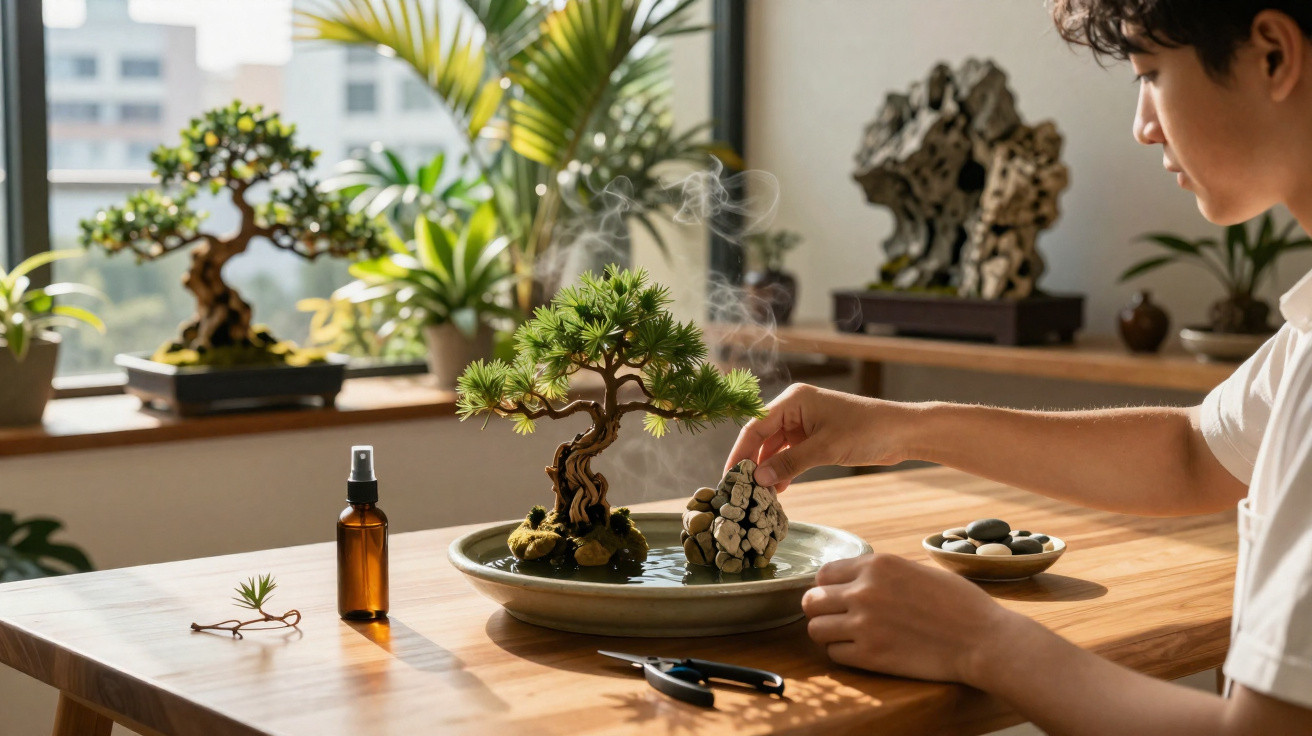
People seeing Penjing for the first time often instinctively think of bonsai. On closer inspection, however, it becomes clear that these Chinese miniature landscapes are rooted in their own deeply established artistic tradition. They are not merely small trees, but entire worlds in miniature, featuring rocks, water, paths, buildings and sometimes even tiny people and animals.
What Penjing really is – and why it does not copy bonsai
Penjing is regarded as one of Asia’s oldest forms of landscape art. The term roughly translates as “landscape in a container”: “pen” means bowl or pot, while “jing” refers to a landscape or scene. Its focus is always a living fragment of nature, condensed into just a few centimetres.
Penjing is less a single tree in a pot than a living landscape painting intended to make emotions and the laws of nature visible.
Unlike bonsai, which can often appear highly strict, stylised and controlled, Penjing draws more strongly on the untamed. Wind-bent trunks, rugged rocks and seemingly accidental shapes all have their place, yet every element is deliberately composed. The aim is to capture a particular atmosphere, such as the solitude of a mountain ridge or the stillness of a riverbank at sunrise.
Many artists use miniature figures: a solitary traveller, a small house or a horse on a path. This creates a kind of narrative scene. Penjing is intended not only to look beautiful, but also to suggest a story, almost like a frozen image from a dream.
From Daoists to design enthusiasts: the long history of Penjing
Historical sources trace the origins of Penjing back at least to the 1st century AD. At that time, Daoist scholars and mystics sought to concentrate the power of vast landscapes within reduced scenes. Those without access to mountains or sacred places could bring the atmosphere of such locations closer to themselves – in a figurative sense, like “shrunken” natural sanctuaries.
Legends tell of masters who could seemingly draw entire landscapes into a bowl by magic. Buddhist monks later adopted the concept and brought it to Japan. Over many centuries, it developed there into an independent tradition that ultimately produced the bonsai known today.
In China, by contrast, Penjing retained a stronger emphasis on landscape and storytelling. It is still considered a demanding art form: those who take it seriously often study for ten years or longer with a master or in botanical gardens before their own work is viewed as mature.
The three main forms: trees, rocks and mixed landscapes
China is vast, and this diversity is reflected in Penjing styles. Regional approaches include the Lingnan, Taiwan, Shanghai and Yangzhou styles. Despite this variety, specialists generally identify three fundamental forms into which most works can be placed.
Potted tree landscapes: Shumu
Shumu Penjing focuses on trees and shrubs arranged in a bowl. The artist shapes trunks and branches through:
- selective pruning of branches and roots
- wiring to guide growth directions
- controlled restriction of size and density
Visually, this type strongly resembles bonsai, although it often feels somewhat wilder: forests of several trees, weathered trunks and intentionally irregular canopies. Rather than presenting an idealised single tree, it seeks to evoke a woodland edge, a gorge or an old mountain path.
Rock and water in dialogue: Shanshui
Shanshui roughly means “mountain and water”. In this form, one or more carefully chosen rocks take centre stage, usually in a shallow bowl that contains water or is intended to suggest it.
The stones are selected purposefully: their shape, grain and colour should recall mountains, cliffs or rock pinnacles. Artists often add small plants that resemble vegetation on slopes or riverbanks. A successful Shanshui Penjing makes viewers forget they are looking at a bowl on a table – ideally, they see an entire valley from above.
Everything in one scene: Shuihan
Shuihan Penjing combines tree, rock and water elements into a complex composition. Typical features include:
- miniature trees or shrubs
- rocks representing mountains or cliffs
- expanses of water, ponds or suggested rivers
- figures such as houses, boats, animals and people
These works often tell small stories: a fisherman’s cottage by a lake, a monastery in the mountains or a lone traveller crossing a pass. The purpose is less realistic model-making than an abstract, concentrated atmosphere. A single tree may stand for an entire forest, and one stone for a vast mountain range.
Living art that is always changing
Penjing can seem static because it stands as an object on a table, yet the art is alive. Plants grow, die back and alter their shape. Water evaporates, while stones develop a patina. Artists describe it as a “flowing” art form that continues to evolve.
A good Penjing shows not only one moment, but also the passage of time: growth, age and transience.
Contemporary artists approach the tradition creatively. Some use unusual plant species, while others explore surrealism more intensely, with rocks that appear to float or highly abstract forms. Even so, one core principle remains unchanged: the large should be felt through the small – “seeing the large in the small” is a frequently quoted guiding idea.
How to try Penjing at home
For most people, traditional training over many years in a Chinese garden is unrealistic. Even so, the spirit of Penjing can be brought into everyday life quite easily, with patience, curiosity and a willingness to experiment.
First steps for beginners
Anyone wishing to begin does not need a huge budget. The essentials can be broadly summarised as follows:
- Get a shallow bowl with drainage holes – ceramic or plastic will do, provided it is sturdy and allows water to drain.
- Choose a location – bright, ideally with indirect light and moderate temperatures.
- Adapt the growing medium – use free-draining soil mixed with sand, pumice or lava granules.
- Select plants and stones – compact woody plants, mosses, grasses and distinctive stones.
- Plan a scene – rather than creating “something pretty”, start with a clear idea: a riverbank, a chain of hills or a rocky island.
Many garden centres now stock plants suitable for miniatures, along with stones and decorative elements. Anyone looking for inspiration will find numerous examples in bonsai books, forums and image platforms. The technical side is similar, even if the design approach in Penjing remains more open.
Common difficulties for beginners
The main obstacles tend to arise less from design than from day-to-day care:
- Water: Miniature bowls dry out quickly. Regular watering, without overwatering, is essential.
- Light: Too little light causes weak growth, whereas too much direct sunlight can lead to scorching.
- Pruning: Many people hesitate to use the scissors, but gentle cutting maintains the form and encourages fine growth.
- Impatience: A convincing Penjing often takes years to develop, not a single weekend.
Anyone who keeps these points in mind can create an initial, believable miniature landscape using simple materials. With every growing season, not only does the plant develop, but so does the creator’s own sense of proportion and harmony.
Why Penjing fits everyday life so well right now
Many people are looking for a counterbalance to screen-based daily life. Penjing offers exactly that: a calm, practical activity combined with direct contact with nature. It allows you to observe the seasons in miniature, watching a tiny shoot become a branch and moss gradually cover a stone surface.
Psychologists have pointed to the relaxing effects of caring for plants for years. Penjing intensifies that effect because it brings together several dimensions: creativity, practical precision and long-term responsibility for a living object. Working on it also develops concentration and mindfulness almost incidentally.
Its cultural dimension is equally compelling: Penjing links horticulture, painting, architecture and philosophy. Those who explore it more deeply soon encounter Daoist and Buddhist themes, including the interplay between emptiness and fullness, stillness and movement, closeness and distance – all concentrated in a container on a windowsill.
For many people, the journey does not end with one arrangement. Some extend their hobby to other forms of miniature garden, such as moss landscapes, small rock gardens or aquascaping aquariums. The principles are similar: balance, rhythm, clear visual direction and respect for living material. Penjing acts as a kind of original idea from which much else can be derived – a quiet, patient art that develops day by day without demanding attention loudly.
Comments
No comments yet. Be the first to comment!
Leave a Comment