
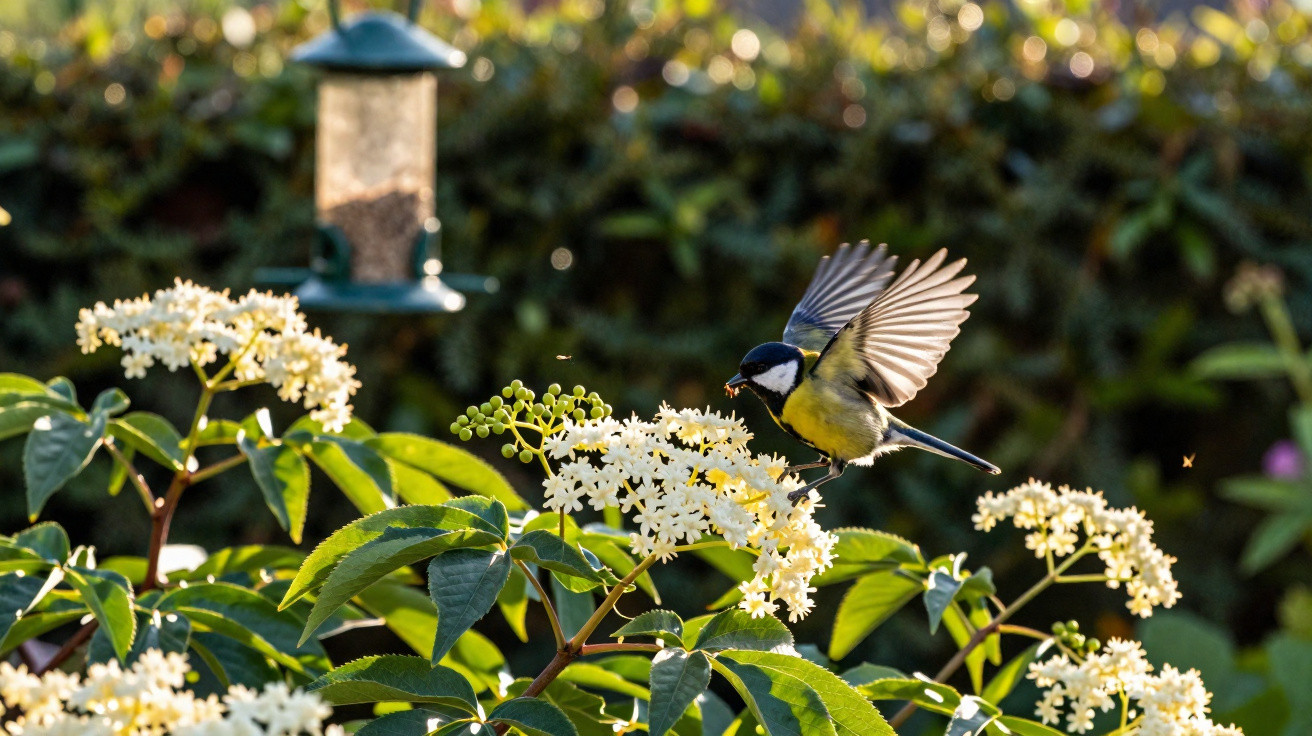
A seemingly ordinary shrub can transform this overnight - provided it is planted in the right way.
Anyone eagerly awaiting great tits in spring will know the frustration: expensive bird food, a neatly maintained lawn and stylish ornamental shrubs, yet the garden remains surprisingly quiet. The problem is rarely the feeder itself. Far more often, it is the garden’s structure and one key question: are there sufficient insects and dense shrubs to provide shelter?
Why great tits stay away despite full bird feeders
The great tit is regarded as one of Europe’s most widespread garden birds. Some areas support more than 300 breeding pairs per square kilometre. In theory, then, almost any garden could receive a visit. If great tits do not appear, something in their immediate surroundings is unsuitable.
“For great tits, a lively, insect-rich area of shrubs and hedges matters more than a bowl of food.”
In spring, great tits need insects above all else. A feeding station stocked with sunflower seeds is more of a snack for the parents than the main meal for their young. Gardens containing only manicured turf, gravel gardens and exotic shrubs offer very few caterpillars, aphids or other small creatures. This is where an often-overlooked native shrub becomes important.
The overlooked star: black elder
Black elder (Sambucus nigra) has fallen out of favour in many gardens. It grows rapidly, can look too “wild” for some people and is therefore often removed. From a bird’s perspective, that is a mistake.
“Black elder functions like an all-inclusive hotel in the garden: insects in spring, berries in late summer and shelter throughout the year.”
A few key facts about black elder:
- Native species: ideally adapted to the climate and insect fauna
- Planting period: November to March, provided the ground is frost-free
- Height: around 3 to 5 metres in only 3 to 4 years
- Position: full sun to partial shade; ordinary garden soil is sufficient
- Benefits: food, cover and a nesting environment for numerous bird species
Its loose, multi-stemmed growth creates dense branches where small birds can quickly hide. For great tits, this means genuine safety: they can fly from the feeding area into thick cover within seconds.
How black elder becomes an insect buffet for great tits
In spring, black elder is often colonised by the black elder aphid. Gardeners frequently regard it as a “pest”. For great tits, however, it is a jackpot.
During the breeding season, a pair of great tits must supply its chicks with hundreds of insects every day. Estimates suggest that a single brood may require up to 500 insects daily. The birds prefer to hunt where prey is concentrated - precisely on and around a black elder shrub.
The result is that the shrub is searched thoroughly, the aphid colony diminishes, the young birds grow and the gardener avoids the need for chemical treatments. What initially appears to be a problem becomes a functioning natural cycle.
By late summer, black elder provides another food source: its black berries. Rich in fats, they help many bird species build energy reserves for autumn and winter.
Great tits in the garden: needs and common mistakes
Great tits are easy to identify: a black head, white cheeks and yellow underparts marked by a dark lengthways stripe resembling a tie. They readily use nest boxes and soon visit bird feeders. Even so, breeding often fails in heavily built-up areas.
Their annual cycle makes the reasons clear:
| Phase | Period | Particular requirement |
|---|---|---|
| Territory formation & pairing | Late winter to spring | Safe hedges and dense shrubs |
| Egg laying & incubation | Spring | Quiet nest sites with little disturbance |
| Raising young | Spring to early summer | Plenty of insects and short journeys to food |
| Late summer & autumn | From August | Energy-rich berries and protection from predators |
Typical issues in urban and suburban gardens include:
- Perfectly clipped lawns with almost no wild plants
- Thuja and cherry laurel hedges, which support few native insects
- Using pesticides against aphids or caterpillars
- Hard-pruning shrubs in late winter, when many insects are still overwintering in the wood
Studies show that young birds often starve in such “tidy” gardens, even when feeders are hanging within sight. The route from the nest box to an insect source is simply too long, or the available supply is too limited.
Planting black elder: step by step to a great tit magnet hedge
A black elder shrub can be planted with little effort. Planting it between November and March can give great tits an appealing territory within the next few years.
What to do
- Choose the position: select a sunny to partially shaded spot that does not become excessively dry, ideally near the garden boundary.
- Dig the planting hole: make it roughly three times as wide as the root ball.
- Loosen the soil: break up compacted layers using a spade.
- Improve the soil: mix in 2–3 spadefuls of mature compost.
- Set the plant: place the black elder at the same depth as it stood in its pot.
- Backfill and firm: refill with soil and press it down lightly.
- Water thoroughly: add around 10 litres of water, even if it is raining - this closes any air pockets.
In subsequent years, the shrub needs very little attention. Light thinning is enough if it becomes too sprawling. From the birds’ point of view, it can happily look a little “overgrown”.
What one gap in a thuja hedge can achieve
Many suburban gardens are bordered by dense rows of thuja or cherry laurel. These evergreen plants may provide privacy, but they offer food or habitat to very few native insects.
Even a modest alteration can make a considerable difference. Replacing just two metres of thuja with black elder significantly improves the food supply around a nest box. Aphids, caterpillars and spiders - everything great tits need - will establish themselves there.
“An elder in the fence does not replace expensive specialist food; it replaces missing natural structures.”
Those who also hang a nest box near the shrub, avoid toxic chemicals and do not over-maintain the lawn will often notice substantially more activity in the garden after a short time.
Further simple steps for a great tit-friendly garden
Black elder is an important element, but it is not the only one. A few additional measures enhance the effect:
- Provide nest boxes: use a 32 mm entrance hole, avoid positioning the opening directly towards the south and choose a sheltered location.
- Avoid pesticides: allow birds to control aphids naturally.
- Limit lawn fertiliser: less fertiliser encourages wild plants and, in turn, more insects.
- Leave dead wood in place: do not cut thin dead branches until mid-March, allowing overwintering insects to emerge.
- Add other native shrubs: blackthorn, hawthorn, hazel and dog rose create further diversity.
Why native shrubs offer birds far more than exotic plants
Many popular garden plants originate on other continents. They may look attractive, are often evergreen, yet can function like a green façade with no real purpose. Native insects are specialised to particular plants. When those plants are absent, the insects disappear too - and with them the food needed by young birds.
Black elder is among the species explicitly recommended by specialists. It connects the garden with the wider landscape and birdlife. Anyone initially bothered by its untidy growth will usually change their mind when the first group of great tits begins clambering among its branches.
There is another point: black elder has an effect not only outside, but within the household too. Children learn that aphids are not a disaster, but part of a cycle. Rather than immediately reaching for sprays, people can wait and watch great tits, ladybirds and lacewings do the work.
This turns a “forgotten” shrub into an example of how little is needed to change a silent garden into a lively meeting place for birds - one spadeful of effort, one black elder and a little patience. Then, suddenly, an entire flock of yellow-and-black visitors is hanging in the branches in spring.



Comments
No comments yet. Be the first to comment!
Leave a Comment