
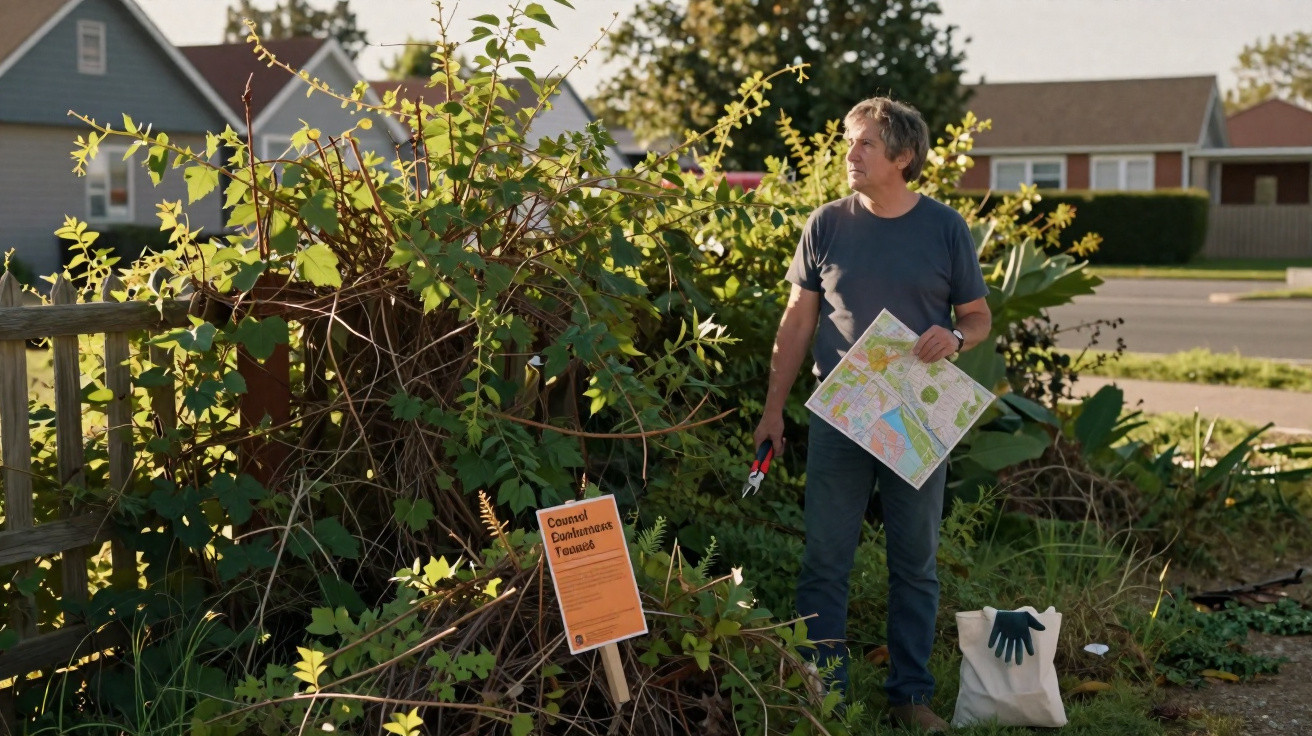
Every summer, Marc brings out his brushcutter behind his detached house. On the other side of the wire fence, the neglected plot has taken over again: dense brambles, shoulder-high nettles, young trees trapped in the fencing, and an old mattress nobody claims. He cuts back what encroaches onto his side, clears the branches, then does it all again three weeks later. We all know that point when we wonder why the effort never seems enough. That is because scrubland is not truly pushed back by blades alone: its future is often decided much further away, in a council office. And that changes everything.
Cutting back brambles tackles only the visible part of the problem
From his patio, Marc feels as though he is fighting an absurd battle against a wall of vegetation. As soon as the rain returns and temperatures rise, the stems grow back, creep beneath the fence and catch on the rose bushes he has tended for fifteen years.
In many villages, the same scene plays out from May to September. A bramble can spread by several metres in one season, while stems that touch the ground can root again: simply running a brushcutter over them, without removal or follow-up work, often allows the plant to return even more vigorously.
The neighbour who clears the edge of their plot is helping the neighbourhood, but cannot sustainably manage land that does not belong to them. Scrubland is not merely a matter of vegetation: it often exposes a stalled property situation, a complicated inheritance, an absent owner or a project that never came to fruition.
At the council, the tools exist but are not activated automatically
The first useful step is to report the matter to the local council calmly, providing clear details: the plot's address, dated photographs, the nature of the nuisance, and any fire risk or danger of falling trees. A letter or email creates a record, preventing the case from being lost between two telephone calls.
Many residents hesitate to do this because they fear being seen as the difficult neighbour. That is understandable, particularly in a small community where everyone meets at the bakery, yet reporting a neglected plot does not necessarily mean attacking anyone: it means asking for the situation to be examined.
The council can identify the owner, remind them of their maintenance responsibilities and, depending on the local circumstances, begin firmer action where safety, public health or fire risk is involved. A mayor's powers are not magical, but they can start a procedure that a neighbouring resident cannot pursue alone.
“Scrubland rarely stops being a problem when you cut back what overhangs; it begins to retreat when someone decides to deal with the entire plot.”
- Include photographs taken from your own land or from a public space;
- Set out specific facts: branches over the road, a fire starting, pests or unsafe access;
- Ask whether the case has been passed to the planning department or municipal police;
- Keep copies of correspondence and record the date of the report.
A lasting solution for scrubland often requires a collective decision
A local council can use several levers: reminders to owners, maintenance rules, clearance operations, consideration of abandoned land, and development projects where these comply with planning documents. Depending on the circumstances, a plot may become a shared garden, a maintained natural area, a land reserve or simply land that is finally monitored.
Let us be honest: nobody really does this every day. Following a case, chasing up a department, finding the right contact and understanding administrative timescales all require patience, especially as brambles never wait.
The most effective approach is often to avoid an isolated stand-off across two fences. When several local residents report the same difficulty, proportionately and without turning it into a neighbour dispute, the council has a clearer picture and can include the matter in a lasting response rather than a one-off intervention before summer.
| Key point | Detail | Added value for the reader |
|---|---|---|
| Brushcutting has its limits | Cutting back overhanging brambles deals with neither the roots nor the wider neglect of the plot. | Prevents people from exhausting themselves through repeated action that only addresses the immediate issue. |
| A report must be precise | Dated photographs, the exact address and a factual description help council services assess the situation. | Improves the likelihood of receiving a clear response and meaningful follow-up. |
| The council can create a lasting solution | Required maintenance, mediation, safety measures or a council project depend on local powers and circumstances. | Places the issue at neighbourhood level instead of leaving one neighbour to carry the burden. |





Comments
No comments yet. Be the first to comment!
Leave a Comment