
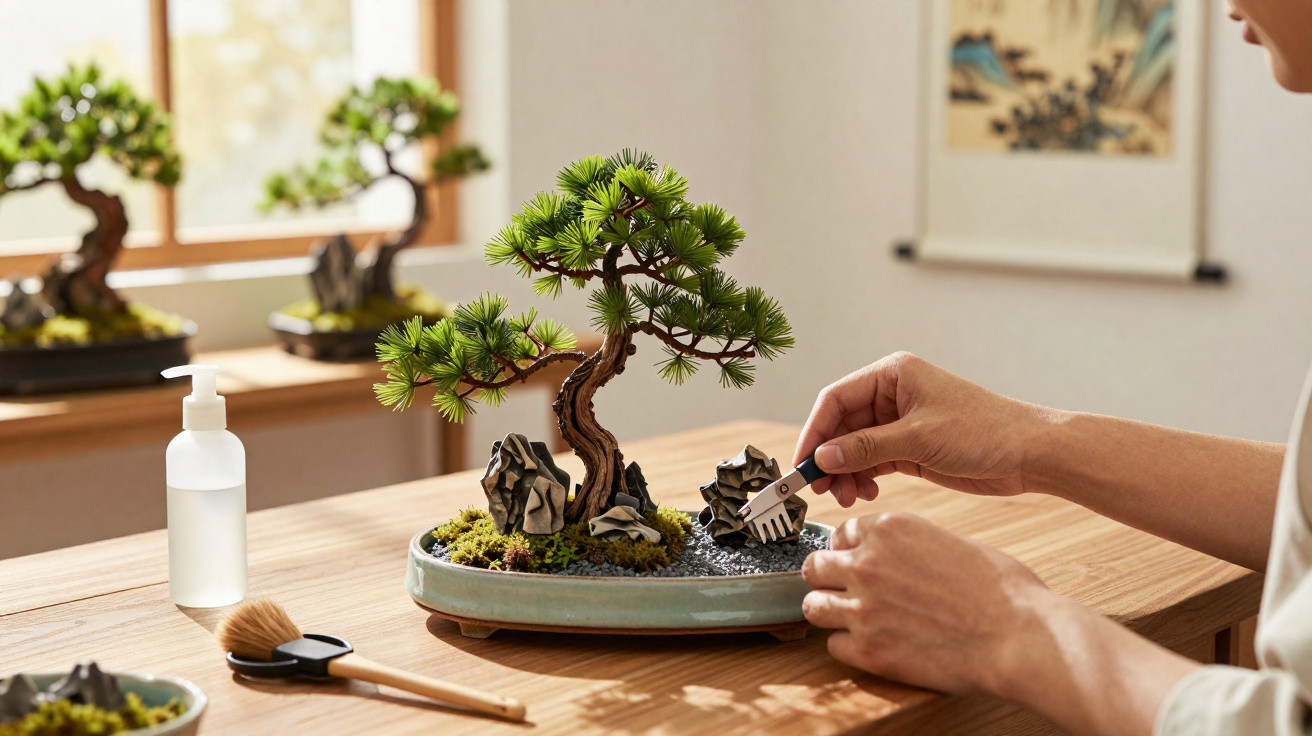
What may look like bonsai at first glance is often something quite different: Penjing, a Chinese art form with a history spanning millennia. Rather than shaping a single tree alone, it creates complete miniature landscapes-combining rocks, water, mosses and tiny figures. Behind it sits a distinctive philosophy that reaches well beyond routine plant care.
What Penjing really is – and how it differs from Bonsai
Penjing translates literally as “landscape in a pot”. Artists build scenes that evoke mountain ranges, river valleys or solitary woodland. The aim is to reveal the patterns of nature in a drastically reduced scale, while keeping the emotional impact intact.
"Penjing does not primarily put the tree at the centre, but the feeling of a landscape - including weather, atmosphere and history."
Common elements include:
- living plants such as trees, shrubs, mosses and grasses
- naturally shaped stones and rock formations
- water surfaces or dry-looking riverbeds
- miniature figures, for example people, animals or small houses
Bonsai generally focuses on a single tree: its line, its bark, its silhouette. Penjing, by contrast, is deliberately more untamed-sometimes almost dreamlike. A composition can feel surreal, playful or poetic: a fisherman in a tiny boat, a lone temple in mist, a rider high in the mountains.
2,000 years of history in a shallow tray
Penjing’s origins go back a very long way. As early as the 1st century AD, Daoist scholars and mystics were working to recreate vast landscapes in miniature. The belief was that the power of a significant place-such as a sacred mountain-could be concentrated, or at least experienced, through a small-scale version.
Later, Buddhist monks adopted the technique and carried the idea to Japan. There, it gradually developed into a distinct tradition, from which bonsai later emerged. While Japan increasingly favoured strict, controlled forms, Penjing in China remained more naturalistic, less restrained and more narrative in character.
Even today, Penjing is regarded as a demanding art. In China, learners sometimes complete ten years of intensive training in botanical gardens-such as those in Shanghai-before being recognised as masters.
The three major styles of Penjing
China is vast, and that variety is clearly reflected in Penjing. There are regional schools such as the Lingnan style in the south, the Taiwan style, the Shanghai style, or the tradition from Yangzhou. Within these regions, specialists typically distinguish three main categories.
Potted tree landscapes: Shumu-Penjing
In the Shumu style, trees take centre stage, arranged within a shallow pot. It can strongly resemble bonsai, but is often composed as a group or a small woodland scene. Through careful pruning, wiring and shaping, the result becomes an image that recalls real forest edges, coastal pines or mountain spruces.
Typical characteristics:
- emphasis on tree structures, trunks and canopies
- usually little water; instead soil, stones and moss
- the composition should read like a naturally formed slope
Rocks and water: Shanshui-Penjing
Shanshui means “mountain and water”-and that is exactly what defines these works. A low vessel holds water, paired with carefully chosen stones that represent crags, cliffs or rock faces. Small plants heighten the impression of shores, hillsides or islands.
Here, the placement of stones matters greatly. A single striking rock might symbolise a sacred mountain, while a cluster of stones can suggest an entire mountain chain. The water represents rivers, lakes or the sea-often with reflective surfaces or deliberately crafted “surf”.
Everything in one scene: Shuihan-Penjing
With Shuihan, both worlds come together: trees, rocks and water are combined in a single composition. Tiny figures are also frequently included-such as a small house, animals, boats or people. These arrangements tell stories especially clearly.
"Shuihan-Penjing feels like a film scene frozen in time, except it stays alive, grows and changes."
One example: a tiny house sits on the edge of a rock; in front of it, a person stands on a path; below, a river runs past with a boat. In just a few square centimetres, a complete narrative emerges-of solitude, travel or home.
A living art form that keeps evolving
Penjing is not a fixed tradition. Contemporary artists experiment with new forms, plant species and themes. Some focus on abstract lines and structures; others work with particularly wild, gnarled tree shapes. Some aim for the most faithful possible miniature of real places, while others build dreamlike landscapes.
A well-known guiding idea is “seeing the great within the small”. In a handful of soil and a piece of stone, the eye should suddenly perceive a vast mountain range. That shift in perspective-from the pot to an imagined panorama-sits at the heart of its appeal.
Creating Penjing at home
Anyone who wants to try Penjing does not need to travel to China or complete formal training. With patience, curiosity and a few basic principles, it is possible to create first miniature landscapes in a living room, garden or on a balcony.
Basic kit for getting started
| Element | What to look for |
|---|---|
| Tray or pot | shallow, with good drainage, frost-resistant if kept outdoors |
| Substrate | airy and free-draining, a blend of mineral and organic components |
| Plants | naturally compact species, tolerant of pruning, suitable for the local climate |
| Stones | natural-looking shapes, harmonious colour, not too heavy for the tray |
| Light | a bright position, without extreme heat or strong draughts |
One crucial factor is the climate in your home or garden. Many classic Penjing plants come from regions with distinct seasons. If you are creating a composition indoors, it makes sense to choose species that tolerate typical room temperatures-such as certain ficus varieties or resilient succulents. For a balcony, native woody plants such as hornbeam, pine or juniper can work well.
From a mental image to a landscape in a tray
Most compositions begin with an idea. That might be a memory of a holiday destination, a favourite mountain, or a river from childhood. It helps to sketch the scene roughly:
- What theme should the landscape suggest: mountains, coast, woodland, river valley?
- Where is the “focal point” - a rock, a tree, a house?
- Which viewing angle feels compelling: from above, from the shoreline, looking out from a valley?
With that vision in mind, you can choose plants and stones. If you want to recreate a steep mountain slope, for instance, you will need a distinctive rock, with gnarled, small-leaved trees positioned above or beside it. A calm lake reads more convincingly when you add moss, small grasses and a few “shore stones”.
How much care Penjing actually requires
Penjing is not a plastic ornament: it is alive, and it demands attention accordingly. Almost every intervention shows up later in how the miniature landscape develops.
Typical tasks include:
- regular but controlled watering, adjusted to the season and the depth of the tray
- trimming branches to maintain proportions
- removing dead material so nothing rots
- occasional repotting when roots completely fill the available space
Mistakes often come from too much water or too little light. Shallow trays dry out faster, yet can also hold moisture quickly if the drainage is poor. If you are unsure, it is better to start with hardy plants and learn, through them, how they respond to pruning and watering.
Why Penjing is more than a hobby for plant enthusiasts
Many people experience Penjing as a counterbalance to digital life. Caring for a miniature landscape inevitably slows you down. Branches do not grow hour by hour, but over weeks and months. Choices have long-term effects-a poorly placed cut can reshape the scene for years.
That slowness can be meditative. You literally stand over the tray, studying details, feeling the weight of a stone, arranging tiny cushions of moss. Over time, a relationship forms with the small landscape: you recognise every branch and every root.
The storytelling aspect is equally compelling. With figures and carefully positioned elements, themes such as loneliness, wanderlust, safety or departure can be expressed. A single hiker on a suggested mountain path can stir more emotion than a perfectly styled solitary tree.
Beginners may also benefit from looking at related pursuits. Anyone with experience in bonsai, aquascaping, terrariums or model landscapes already has many useful skills-from an eye for proportion to patience. Penjing connects these worlds and extends them with a strong philosophical dimension: not merely depicting nature, but reflecting its inner principle in miniature.
Comments
No comments yet. Be the first to comment!
Leave a Comment