
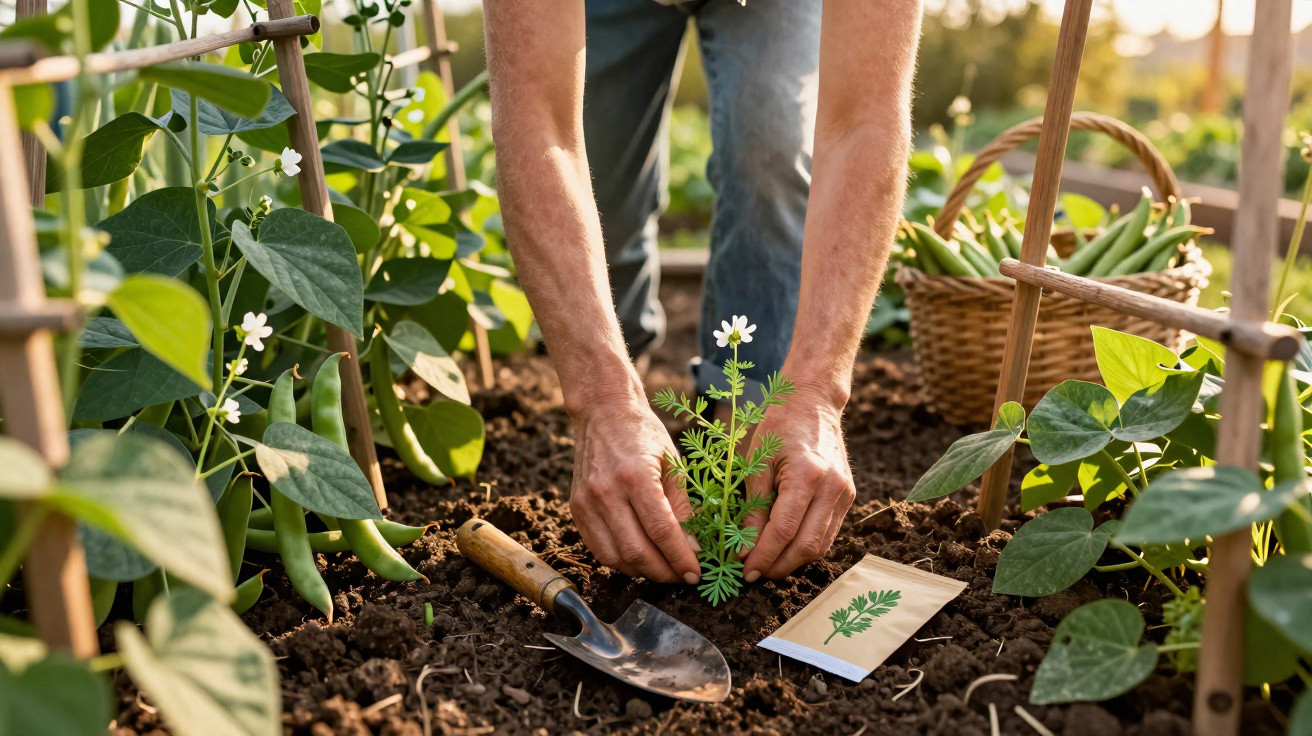
Between two rows of beans, gardeners of the past often tucked in a small plant with dense, almost unobtrusive foliage. It was not basil, nor a flourish intended to flavour salads: it was summer savoury, a somewhat forgotten herb with a genuine purpose in the vegetable garden.
We all know that moment when young bean plants finally emerge, neatly lined up and still fragile, and we hesitate to disturb even the smallest patch of soil around them. In my grandfather’s garden, however, there were always clumps of summer savoury between the rows, planted without ceremony in one quick movement. He would simply say: “Beans like having company.” At the time, I assumed he meant flavour or tradition. Over the years, I realised that this pairing followed a very practical logic involving scents, insects, light shade and observation. It is an old habit that deserves more than a nostalgic smile.
Summer savoury, the companion beans have never truly forgotten
In many family vegetable gardens, beans grow on their own, in bare soil that can dry out over a single hot day. Older gardeners would instead sow or transplant summer savoury among the rows, without trying to fill every gap as we might now with ornamental flowers. This low-growing herb, with its small dark-green leaves and understated flowers, created a living presence at the base of the crop. Its fragrance, more peppery than thyme, rises as soon as the foliage is brushed. In a vegetable garden, a scent is never entirely insignificant.
The tradition is especially well established with French beans, dwarf beans and runner beans. In some rural areas, summer savoury was even known as “the bean herb”, a particularly revealing nickname. Gardeners positioned one plant every 30 to 40 centimetres between the rows, or sowed a few seeds in small pockets. A single clump can spread during summer while remaining less invasive than mint. It keeps pace with harvesting from July to September, when baskets quickly fill up and beans eventually start being given to neighbours.
Its role is not limited to miraculously repelling every pest, as some gardening tips that sound too good to be true may suggest. Summer savoury releases aromatic compounds that somewhat disrupt the scent cues of certain insects, while its flowers attract small pollinators and beneficial insects. It also gives the ground light cover, reduces soil splashes onto leaves after rain, and introduces useful diversity into a plot that is often too uniform. A thriving vegetable garden is rarely one in which every plant grows in isolation.
Why gardeners planted summer savoury between bean rows
Positioning makes all the difference. Summer savoury can be planted at the end of a row, but it will mainly act as a fragrant border there; among the beans, its foliage releases its scent where insects move about and where leaves remain damp for longer in the early morning. Sow it once the soil has warmed up, generally between April and June depending on your region. For dwarf beans, plan a small group of summer savoury every two rows rather than placing a plant at random. The aim is not to crowd the crops, but to break up the effect of a “large table laid” for pests.
A common mistake is planting too densely, especially after buying a well-filled pot of summer savoury. It is easy to assume that an aromatic plant will not need much room, only to find in high summer that the beans lack airflow and moisture becomes trapped between the leaves. Allow roughly 25 centimetres between a clump and the first bean plants, and more if you are growing a particularly vigorous variety. Let us be honest: nobody measures every gap every day. It is enough to check that you can pass your hand between the plants without flattening everything.
Annual summer savoury, often called garden savoury, is particularly suitable for this method because it follows the beans’ growing cycle and disappears with the first cooler weather. Perennial savoury, being hardier, is better given a permanent position at the edge of a bed, as it develops into a small woody shrub over the years.
“Summer savoury is an excellent companion for beans, provided it is given enough room and is not expected to work miracles.”
- Annual summer savoury: ideal between bean rows during summer.
- Perennial savoury: useful near the vegetable garden, but often too long-lasting to sow in the middle of a crop rotation.
- Recommended spacing: 25 to 40 centimetres, depending on the vigour of the beans.
- Harvesting: cut a few stems before full flowering to encourage the plant to branch.
A simple practice that also changes how you see your vegetable garden
Perhaps the most interesting aspect of this old pairing is not the promise of a perfect harvest. There will always be an aphid that finds its way in, rain that lasts too long, or a row of beans that germinates poorly for no clear reason. Summer savoury replaces neither well-nourished soil, watering at the base of plants, nor crop rotation. Instead, it adds a subtle layer of life to a space we can sometimes make too tidy. Older gardeners used fewer products, but they paid closer attention to what was happening between their plants.
This small combination also reminds us that a vegetable garden is not a sequence of separate compartments. A bean shades the soil, an aromatic herb attracts insects, a flower feeds a pollinator, and together they create a plot that is less vulnerable to imbalance. Some gardeners still prefer nasturtiums, marigolds or basil around their vegetables: everyone develops their own habits over the seasons. Yet summer savoury has the appeal of modest solutions, the kind passed on without elaborate explanation by slipping a few seeds into a child’s hand.
If you try it this year, do not look for instant proof in the first week. Watch your rows as the days pass, notice the fragrance left on your fingers after brushing through them, and observe the insects visiting the small white or mauve flowers. You may have fewer damaged beans, or perhaps simply a patch that is more pleasant to tend. That is already worthwhile. Between two rows, this aromatic plant tells a different story about growing food: less solitary, more patient, and almost instinctive.
| Key point | Detail | Added value for the reader |
|---|---|---|
| The plant to choose | Annual summer savoury works particularly well with beans over a single season. | A straightforward, inexpensive pairing that is easy to try. |
| The right position | Place a few clumps between the rows without crowding the bean plants. | The fragrance circulates through the centre of the crop and the soil remains more alive. |
| What to realistically expect | Summer savoury helps diversify the vegetable garden without guaranteeing the complete absence of pests. | A realistic approach based on observation rather than miracle promises. |


Comments
No comments yet. Be the first to comment!
Leave a Comment