
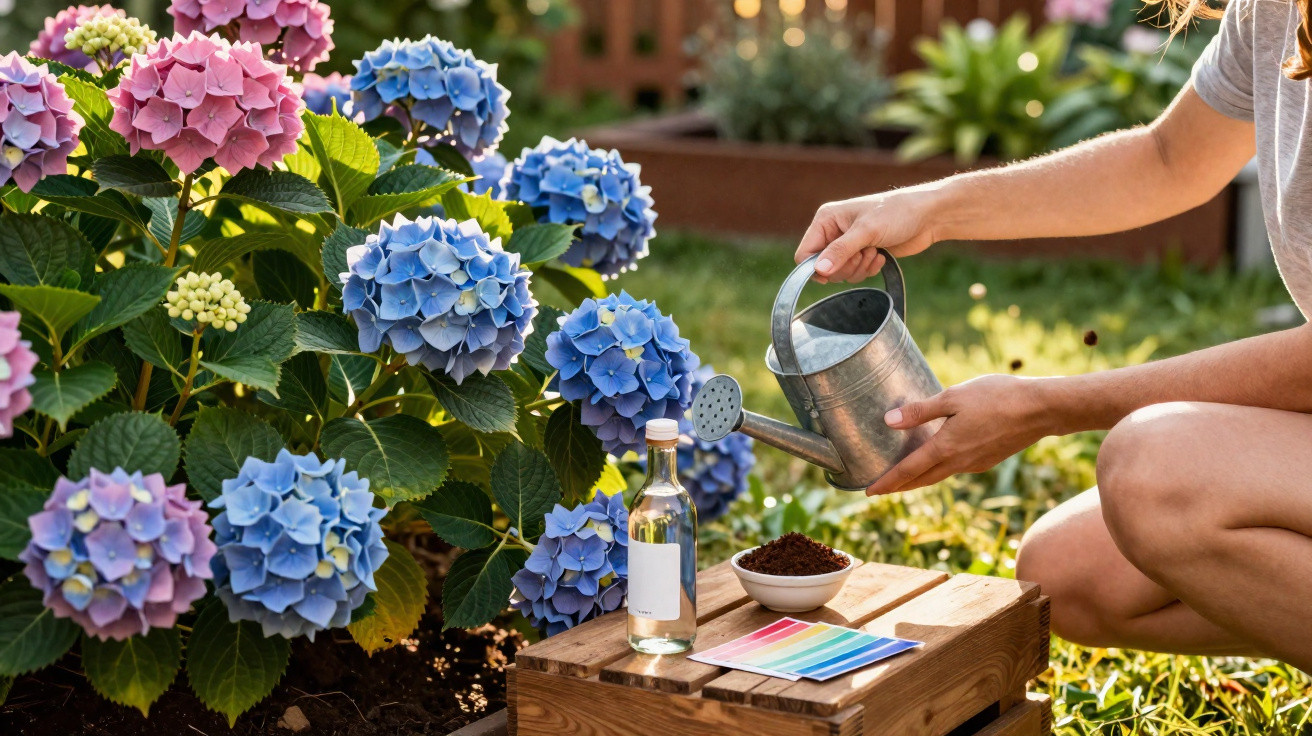
If you bought your hydrangea at the garden centre in vivid blue but discover only candy-pink flowers on the shrub the following year, you have not done anything “wrong” – a chemical process is simply taking place in the soil. With one straightforward kitchen ingredient and the right timing, you can significantly influence this change and help your hydrangeas produce rich blue blooms again.
Why hydrangeas suddenly flower pink instead of blue
Hydrangeas are like miniature chemistry laboratories. For varieties such as Hydrangea macrophylla, flower colour is determined only partly by the cultivar; soil pH and the nutrient aluminium have a far greater influence.
“Blue hydrangeas need acidic soil and available aluminium – when the soil becomes more alkaline, the blue shades disappear and pink takes over.”
Put simply:
- pH 5.0–5.5: acidic soil, the ideal range for intense blue
- pH 6.0–6.5: a transition zone that produces purple and mixed shades
- pH from 6.5–7.0: neutral to lime-rich soil, where pink and red predominate
In acidic soil, aluminium becomes available to the plant. The hydrangea incorporates it into its pigments, resulting in blue flowers. In lime-rich or compacted ground, however, the soil binds the aluminium so the plant can no longer access it, causing the blooms to shift towards pink.
There is another issue, too: excessively lime-rich soil disrupts nutrient uptake. For instance, hydrangeas may struggle to absorb iron, causing leaves to become paler with yellow areas between the veins. This condition is known as chlorosis. Acidic, humus-rich additions such as leaf compost or conifer mulch can make a substantial difference here.
It is important to note that not every hydrangea can be “recoloured”. The following groups in particular respond well to pH changes:
- Mophead hydrangeas (Hydrangea macrophylla)
- Japanese mountain hydrangeas (Hydrangea serrata)
Panicle hydrangeas (H. paniculata), smooth hydrangeas (H. arborescens) and pure white varieties generally retain their base colour regardless of what happens in the soil.
The overlooked kitchen ingredient: vinegar water
Gardeners have been trying specialist shop-bought fertilisers for years to keep hydrangeas blue. Yet a simple, inexpensive alternative can be found in the kitchen: cider vinegar or clear household vinegar.
“Lightly diluted vinegar gently lowers the pH around the roots – exactly what blue hydrangeas need.”
How to mix the vinegar solution correctly
The following mixture has proved effective:
- 200 ml of cider vinegar or clear vinegar
- 10 litres of water, roughly one standard watering can
Stir the mixture briefly, then apply it directly to the soil around the plant rather than over the leaves. Repeat this every two to three weeks during the growing season.
At this strength, you are not subjecting the plant to chemical shock treatment; instead, you are gradually moving the pH around its roots into the acidic range. If the flowers become intensely blue as the season progresses, reduce the frequency or pause the vinegar applications. This keeps the colour manageable.
How vinegar works in the soil
Vinegar is a weak organic acid. Soil organisms break it down fairly quickly, so its effect is not permanent but acts more like a gentle “nudge” towards acidity. That is precisely what makes this method appealing: it corrects the direction without permanently overturning the soil’s entire chemistry.
Even so, less is more. Overly concentrated vinegar solutions can scorch fine roots, harm soil life and ultimately have the opposite effect to that intended. Always dilute it thoroughly and do not use it more often than every one to two weeks.
Step by step: the route to a brilliantly blue hydrangea
Anyone hoping to see their hydrangea turn blue again by summer should start early. Late winter and spring are crucial, as this is when pigments develop in the forming flower buds.
- Test the soil: Take a sample from the root area using a simple pH test kit from a garden retailer, then establish the pH value.
- Prepare the ground: If the reading is above 6.5, incorporate acidic material the next time you loosen the soil, such as rhododendron compost, leaf compost, bark mulch or conifer litter.
- Begin the vinegar treatment: From late winter or spring onwards, water every two to three weeks with the diluted vinegar solution.
- Consider your water: Use rainwater where possible, particularly in areas with hard tap water.
- Monitor the outcome: From early summer, new flowers will reveal whether you are moving in the right direction towards blue.
Lime-rich tap water can undermine many of these efforts. In areas with very hard water, it repeatedly raises the pH around the plant. If you can collect and use rainwater instead, you remove a significant burden from your hydrangea – and will often need less vinegar or other acidifying products.
Other natural helpers: coffee grounds, mulch and more
Vinegar is not the only everyday material that can gently acidify soil. Dried coffee grounds are particularly popular.
- Coffee grounds: They contain nitrogen, some potassium and phosphorus, and have a mildly acidifying effect on soil. Scattered thinly or mixed with mulch, they are a useful addition – but avoid thick, wet layers, as these can go mouldy.
- Leaf compost: Compost made particularly from oak or horse chestnut leaves helps create humus-rich, relatively acidic soil over time.
- Conifer litter and bark mulch: These offer long-term acidification while also protecting the soil against drying out.
Combining several of these measures creates an environment in which hydrangeas can retain blue shades much more reliably, even if you occasionally water with tap water.
Which hydrangeas are best suited to blue flowers
Not every variety can be shifted in colour equally easily. Garden centres sell mophead hydrangeas specifically labelled “blue”, often with name additions such as “Blue”, “Azur” or “Sky”. These naturally have the potential to become intensely blue in acidic soil.
| Hydrangea type | Response to soil pH |
|---|---|
| Mophead hydrangea (macrophylla) | Can change colour between pink, purple and blue |
| Mountain hydrangea (serrata) | Similarly variable, often with slightly softer tones |
| Panicle hydrangea (paniculata) | Remains largely white to rosy pink, with very little blue |
| Smooth hydrangea (arborescens) | Usually white and scarcely responds to acidification |
For reliably blue-flowering hydrangeas, it is best to choose a cultivar bred for this purpose from the macrophylla or serrata group. At the planting site, provide sufficient moisture, partial shade and humus-rich soil.
Risks and limits of the vinegar method
Although this quick kitchen trick sounds tempting, it does have limits. Amateur gardeners should be aware of a few points:
- Root tolerance: Vinegar applied too frequently or in too high a concentration can damage fine roots. Sudden wilting, brown leaf edges or severely restricted growth are warning signs.
- Soil buffering: Heavy, strongly lime-rich soils neutralise vinegar relatively quickly. In such conditions, this method alone is usually insufficient for lasting blue flowers.
- Container plants: Vinegar acts far more directly in pots. Use a more cautious dose here and choose good-quality, slightly acidic container compost formulated specifically for ericaceous plants.
If you are unsure, begin with a solution at half the strength and watch the plant closely. If it produces fresh, healthy growth and the leaves remain a deep green, you are usually on the right track.
A practical starting example for your own garden
Imagine a hydrangea in the front garden that was blue for years but now reliably flowers pink. The soil is fairly clay-heavy and the tap water is hard. In February or March, the following plan is worthwhile:
- Carefully loosen the soil in a ring around the plant with a spade, taking care not to damage thick roots.
- Work in rhododendron compost, leaf compost and a little bark mulch.
- Carry out a pH test to establish the current value.
- From then on, water every two to three weeks with diluted vinegar water, ideally mixed with collected rainwater.
- Inspect the newly formed flower heads closely in summer; they provide the most reliable indication of the direction in which the colour is changing.
This combination of soil care, adapted watering and cautiously applied vinegar solution considerably increases the likelihood that the hydrangea will shift increasingly towards blue in the coming seasons rather than remaining pink.
Anyone who enjoys such effects can also try creating a small “colour collection”: place one shrub of the same variety in a more acidic bed and another in a more lime-rich area. It becomes strikingly clear how a few pH points in the soil affect flower colour – and how much influence a gardener can have over this colour display.

Comments
No comments yet. Be the first to comment!
Leave a Comment