
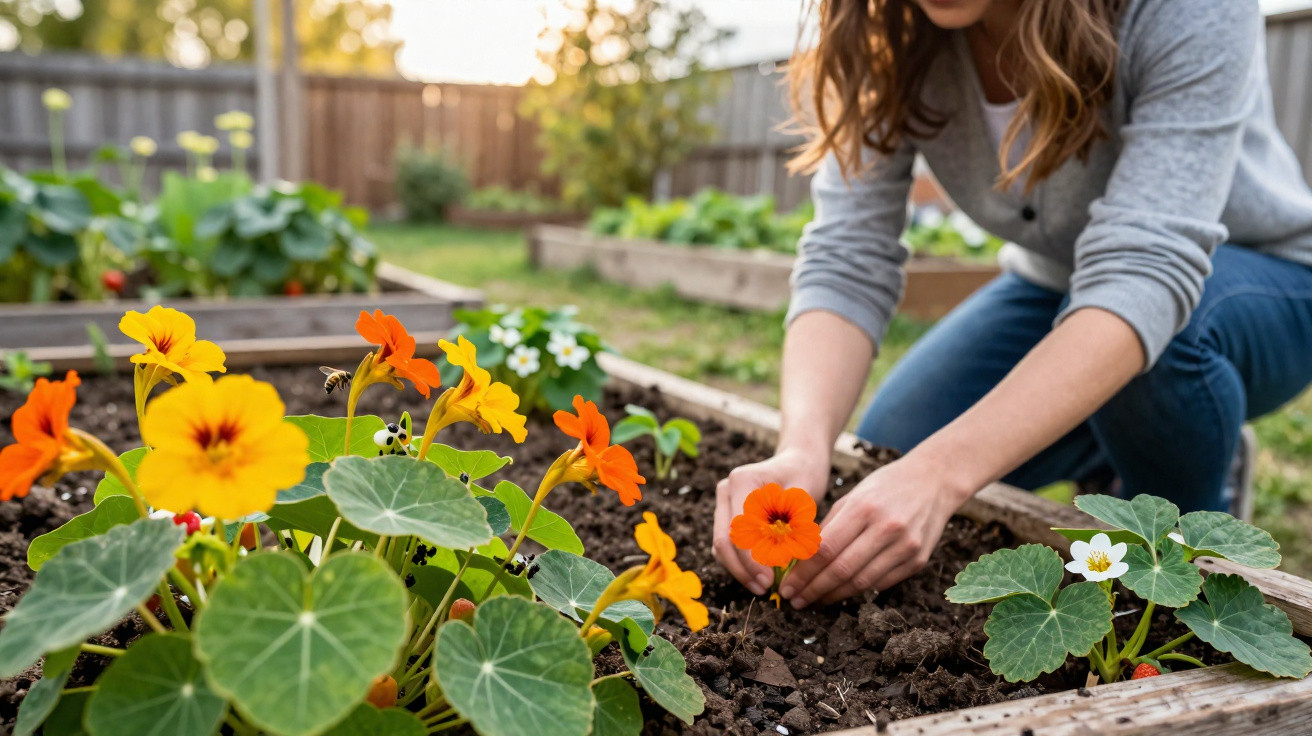
Experienced gardeners once swore by it, and many amateur gardeners have forgotten it – yet anyone who sows it from March onwards will see their vegetable patch in a completely new light.
Among tomatoes, beans and courgettes, one flower can make a real difference: fewer pests, bigger harvests and more life in the garden. Once a standard feature of kitchen gardens, it is now returning under the banner of “natural gardening”. It all starts in March with a small but brilliantly coloured flower: nasturtium.
Why a grandparent-era favourite is suddenly fashionable again
Nasturtiums used to grow in almost every productive garden, and they are once again near the top of shopping lists. Their yellow-orange flowers may look purely ornamental, but they are actually a smart addition to a vegetable garden.
For many years, chemical sprays displaced plants like these from their role in the garden. As more people seek less poison and better yields from their own plots, this traditional knowledge is making a comeback: plants can support one another when they are combined properly.
“Nasturtium is not simply pretty decoration; it is a living protective barrier and a yield booster in the vegetable patch.”
Garden centres now display the seeds prominently, often in sections labelled “beneficial insect plants” or “organic gardening”. Anyone looking for a simple, affordable alternative to pesticides will almost inevitably come across this flower.
March is the starting point: sow now for summer benefits in the vegetable patch
An early start delivers strong results
The first milder days of March mark the busy period in the garden: preparing beds, sowing the first vegetables and filling propagation pots. This is precisely when nasturtiums should go into the soil, rather than waiting until aphids are already on their way.
Early sowing gives the plants a head start. They develop robust roots and dense foliage, ready for the moment vulnerable vegetable plants are moved outdoors. They can then accompany lettuces, beans, peas, brassicas, courgettes and cucumbers from the very beginning.
- March/April: sow outdoors or in pots under glass
- From a soil temperature of 10–12 °C: germination takes place within 10–14 days
- From May: the bed is fully planted and nasturtiums are already well established
How to sow successfully
Nasturtiums are forgiving plants, although they should not be allowed to dry out at the outset. Sow the seeds around 2 cm deep in loosened soil, ideally in small groups.
A straightforward layout for the vegetable garden:
- 3–4 seeds at each position (“packets”)
- Spacing between positions: 30–40 cm
- Plant in rows along the bed edge and stagger them between vegetable rows
Water lightly after sowing, then keep the soil evenly moist, but never waterlogged, until the seedlings emerge.
A living shield: how nasturtiums draw aphids away from vegetables
The plant that willingly takes on pests
This is the real trick: nasturtiums act as a magnet for certain aphids, particularly black bean aphids. The insects are far more attracted to the succulent nasturtium shoots than to beans, peas or young brassica plants.
“The flower makes the sacrifice: aphids gather on it in large numbers, leaving many nearby vegetables alone.”
Look closely and the pattern soon becomes clear. Black colonies gather first on the nasturtiums, while beans or broad beans planted nearby show noticeably less infestation.
No chemicals, just help from nature
When aphids are concentrated on a small number of highly visible plants, beneficial insects get their chance. Ladybirds, lacewing larvae and hoverflies quickly find food there and breed nearby.
This provides several benefits at once:
- Less need for spraying
- Lower costs and less work
- More beneficial insects across the whole garden
- A more stable balance between pests and their natural enemies
If preferred, heavily infested nasturtium shoots can even be cut off and disposed of without greatly disturbing the vegetable garden. The aphids are then, quite literally, “served on a platter”.
A colourful invitation: how nasturtium flowers increase harvests of tomatoes, strawberries and squash
A bright signal for bees and bumblebees
Nasturtiums do more than protect plants: they also work as a “billboard” for pollinators. Their large, vivid yellow, orange and red flowers are like a runway in a sea of green from a bee’s perspective.
“Every bee that lands because of the nasturtiums will also visit tomato, strawberry and squash flowers on the same trip.”
The effect can be especially strong in densely built-up urban areas or gardens with few flowering plants. Where only an occasional bumblebee appeared before, there can suddenly be busy air traffic.
More pollinated flowers, higher yields
For many vegetable crops and fruit trees, sufficient pollination is essential: without it, flowers may fail to set or fruits can develop poorly. Nasturtiums have an indirect but clearly noticeable influence on this.
They work particularly well alongside:
- Tomatoes and peppers
- Strawberries
- Squash, courgettes and other cucurbits
- Fruit trees at the edge of the bed
Many gardeners report fuller tomato trusses, better-developed courgettes and more strawberries once nasturtiums are flowering between or in front of the rows.
How to position nasturtiums most effectively in the bed
Between rows and around the edges
Placement matters greatly if the plant is to fulfil its role as a protective ring and pollinator magnet. Combining edge planting with scattered groups throughout the bed works well.
- As a colourful border along bed edges
- In clusters between especially vulnerable crops, such as beans and brassicas
- At the ends of vegetable rows, where infestations often begin
Trailing varieties can be trained up short canes or fences, while compact types form a carpet between rows. This creates an open network that settles around the vegetables like a natural protective belt.
Watering without encouraging fungal problems
Care requirements are limited. Nasturtiums prefer sunny to partially shaded spots and relatively low-nutrient, loose soil. Too much fertiliser encourages foliage growth at the expense of flowers.
A simple watering rule helps:
- Water directly around the roots, rather than over the leaves
- Water less often but thoroughly
- Keep the soil slightly moist, not constantly wet
This watering approach helps prevent fungal diseases in nasturtiums and in the neighbouring vegetable plants at the same time.
More than protection: edible, attractive and affordable
Flowers and leaves can go straight into the kitchen
One frequently overlooked benefit is that nasturtiums are entirely edible. The leaves have a peppery heat, similar to cress or rocket, while the flowers add colour to salads and open sandwiches.
- Flowers as a colourful touch in a summer salad
- Finely chopped leaves to season soft cheese or herb butter
- Immature seeds pickled as an affordable substitute for capers
One packet of seeds therefore performs several jobs at once: protection, improved yields, decoration and a seasoning herb.
Risks, limitations and useful combinations
The method does have its limits. If nasturtiums stand entirely alone in the garden, aphids may remain established on them permanently. The key is the interaction between flower, pest and beneficial insect.
Growing wildflowers, herbs such as thyme and oregano, or other nectar-rich plants as well strengthens the beneficial-insect network. Over time, the balance then shifts in favour of ladybirds and their allies.
It can also be sensible to remove severely infested nasturtium plants eventually and replace them by sowing young ones. This keeps the protective shield active without allowing an aphid outbreak to become established.
The fact is that one small packet of seeds is often enough to make a vegetable bed noticeably more resilient – visually more lively, more appealing to insects and far less stressful for the gardener.
Comments
No comments yet. Be the first to comment!
Leave a Comment