
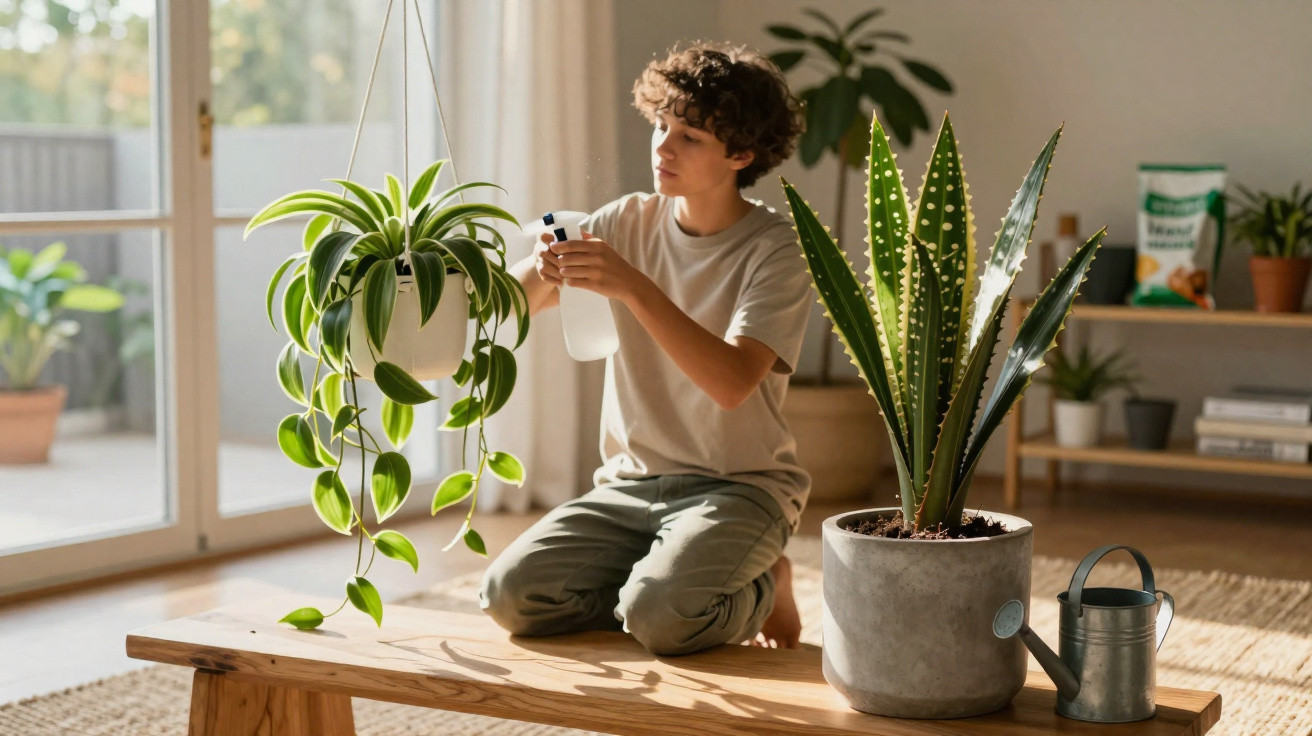
Yet the spider plant and snake plant could scarcely be more different botanically.
Both are considered easy-care classics, both enhance offices and living rooms, and both improve indoor air quality. Even so, spider plant (Chlorophytum) and snake plant (Dracaena/Sansevieria) differ in far more than appearance alone. Understanding their individual characteristics prevents frustration and helps you choose the plant that genuinely suits your everyday routine.
Related, but not interchangeable: origins and classification
Although spider plants and snake plants belong to the same botanical family, Asparagaceae, they are entirely separate genera that have diverged considerably over the course of evolution.
The spider plant originates from tropical and southern parts of Africa. It grows there in generally warm, humid areas, forming dense clumps of arching leaves. Its name comes from the many plantlets dangling from long shoots, which resemble little spiders.
By contrast, the snake plant is native to West Africa, including Nigeria and the Congo. It has adapted to far drier, more demanding conditions. Its thick, sword-shaped leaves grow upright and retain water, giving it a clear survival advantage in sparse landscapes. Familiar common names include “mother-in-law’s tongue” and “viper’s bowstring hemp”, referring to the leaves’ sharp, almost blade-like shape.
Spider plants and snake plants are therefore distant relatives that have developed entirely different survival strategies – and this is reflected in their care, appearance and growth.
What they really look like: comparing growth habit and appearance
Place these two houseplants side by side and their contrasts become apparent immediately – they effectively play different “roles” in a room.
Spider plant: a green waterfall in a pot
A spider plant forms something like a green fountain. Long, narrow leaves emerge from the centre before arching downwards. They appear soft and flexible, somewhat like a tuft of grass but much larger. Many varieties are variegated, meaning they feature two colours: usually green with lengthways stripes in creamy white or yellowish tones.
Its long shoots carrying numerous plantlets are particularly characteristic. These cascade over the edge of the pot and look especially striking in hanging baskets or on top of cupboards.
Snake plant: an architectural statement for the living room
The snake plant has a much more structured, contemporary appearance. Its leaves are stiff and upright, often 2 to 40 centimetres wide and, depending on the variety, up to one metre tall or more. They emerge directly from an underground rhizome, a thickened root structure.
The leaf surface is thick and leathery, almost succulent in character. Grey-green or dark-green cross-bands are typical; some cultivated varieties display silvery shades (“Moonshine”) or a golden-yellow leaf edge (“Golden Hahnii”). In a room, a snake plant can look almost like a living design object.
| Feature | Spider plant | Snake plant |
|---|---|---|
| Leaf shape | Long, narrow, trailing | Stiff, upright, sword-shaped |
| Growth habit | Rosette with cascading growth | Upright clumps from rhizomes |
| Leaf texture | Soft, flexible | Thick, succulent-like |
| Propagation | Plantlets on long shoots | Rhizome division or leaf cuttings |
| Flowers | Often small, white, star-shaped flowers | Rare, greenish-white flower clusters |
Their propagation methods also clearly set them apart: the spider plant does it almost by itself, while the snake plant needs a little more hands-on effort.
Care: the same home, completely different watering needs
Both species are sold as “easy-care” plants. Treat them in exactly the same way, however, and yellow leaves or rotting roots can soon follow. Watering is the greatest difference.
Watering and soil moisture
- Spider plant: prefers soil that stays consistently slightly moist. It does not tolerate prolonged dry spells; if the root ball dries out entirely, brown tips and limp leaves will result.
- Snake plant: is exceptionally drought-tolerant. It needs to dry out fully between waterings and copes well with watering intervals of two to six weeks, depending on its location and the season.
Overwatering quickly harms a snake plant because its thick leaves store water. Waterlogging causes root rot more rapidly in snake plants than in spider plants.
Light, temperature and humidity
When it comes to light, the snake plant is noticeably more adaptable. It tolerates darker corners; while it grows more slowly there, it remains resilient. Spider plants perform far better in bright, indirect light, quickly decline in rooms that are too dark and produce fewer plantlets.
For indoor conditions:
- Spider plant: is happiest at temperatures of around 18 to 24 degrees and benefits from higher humidity, such as in a bathroom or through occasional misting.
- Snake plant: copes well with temperatures of roughly 13 to 30 degrees and has no trouble with the normally dry air in heated homes.
Anyone who often forgets to water or spends plenty of time travelling will be far safer with a snake plant. Those who enjoy lush growth and regular watering should choose a spider plant.
Feeding and repotting
The two species are also worlds apart in their growth rate. Spider plants grow quickly, fill their pots rapidly and often need fresh compost and more room after only one year. A small amount of liquid feed once a month during the growing season is perfectly sufficient.
Snake plants grow at a more leisurely pace. Feeding once per quarter is enough, and they only need a larger pot every few years. Crowded roots do not bother them much; some specimens even break their pots over time, demonstrating how powerful their rhizomes can become.
Which plant suits which type of person?
Ultimately, choosing between a spider plant and a snake plant depends less on botanical details than on lifestyle and interior design.
Spider plant: ideal for décor enthusiasts and plant propagators
Anyone who enjoys giving plants as gifts or filling their home with greenery will be delighted with spider plants. The plantlets are remarkably easy to root in water or straight into compost. Their green “waterfall” creates a lively look in hanging baskets, on high shelves or in stairwells.
They suit homes where watering happens regularly, such as family households or those occupied for much of the day. In bright hallways, conservatories or kitchens, they show their full potential.
Snake plant: minimalism for busy people
The snake plant is the classic recommendation for anyone short on time or just starting out with houseplants. It forgives drought, handles almost any location and looks very modern thanks to its clean form. It works especially well in tight corners, beside sofas, in hallways or in offices where other plants quickly fail.
Another consideration is that many people like to keep snake plants in the bedroom because they can release oxygen at night as well. Scientifically, the effect is limited, but it certainly has a place as part of an air-purifying “plant mix” in a room.
Air purification, pets and minor risks
Both plants repeatedly appear on lists of “air-purifying” houseplants. Laboratory studies, including research by NASA, indicate that they can absorb certain pollutants such as formaldehyde and benzene. The effects are smaller in a real living room, yet several large plants still make a measurable contribution to improving the indoor environment.
One point that is often overlooked is that both spider plants and snake plants are regarded as mildly toxic to pets and children. They are not high-risk plants, but eating them may cause nausea, vomiting or diarrhoea. In households with cat-like “leaf shredders”, it is worth placing them beyond biting range.
Practical tips for living with both plants
Anyone wanting to create a more varied home does not necessarily have to choose. Many people deliberately combine spider plants and snake plants because they complement one another visually: soft, trailing leaves above and firm, vertical shapes below.
- Position a spider plant in brighter areas where it will receive more attention, such as the kitchen or living room.
- Place a snake plant in hallways, bedrooms or offices where watering is infrequent.
- For both, use low-limescale water or leave tap water to stand first, helping to reduce brown tips caused by fluoride or hard water.
- Regularly wipe away dust that has built up over time with a damp cloth – clean leaves can photosynthesise more effectively.
Their effect on a room is also interestingly different: spider plants make a corner feel softer and more homely, taking the harshness out of cool furniture. Snake plants emphasise clean lines and are ideally suited to metal, concrete or minimalist shelving. Anyone planning an interior consciously can use these effects to advantage.
For beginners, a small experiment is worthwhile: place a snake plant in a relatively dark corner and a spider plant near a bright window. After a few months, it becomes clear which plant works better with your watering routine and lighting conditions – and whether you lean more towards being a “plant whisperer” or a “minimal-care type”.



Comments
No comments yet. Be the first to comment!
Leave a Comment